Workers Compensation Requirements for Remote Startup Teams
Hiring remote workers in new states triggers immediate workers' comp obligations you can't ignore.

A founder who approves a remote hire in a new state is making a legal decision, not just a scheduling one, whether or not the paperwork reflects that. The instinct is to treat the hire as a line item in payroll software. The law treats it as the start of a new set of obligations tied to wherever that person actually sits down to work.
Why Remote Work Creates a Compliance Problem
Most founders assume that if the company is incorporated in one state and runs payroll out of another, the rules of the state where the company is based cover the company no matter where an employee happens to live. That assumption is wrong, and it's wrong in a way that doesn't announce itself until something goes wrong. Remote-work compliance in 2026 is, in practice, multi-state compliance: the law generally follows where the person actually works, not where the employer is headquartered. A founder who hires someone in one state while running the company from another has taken on that employee's state's rules, in full, the moment that person starts work.
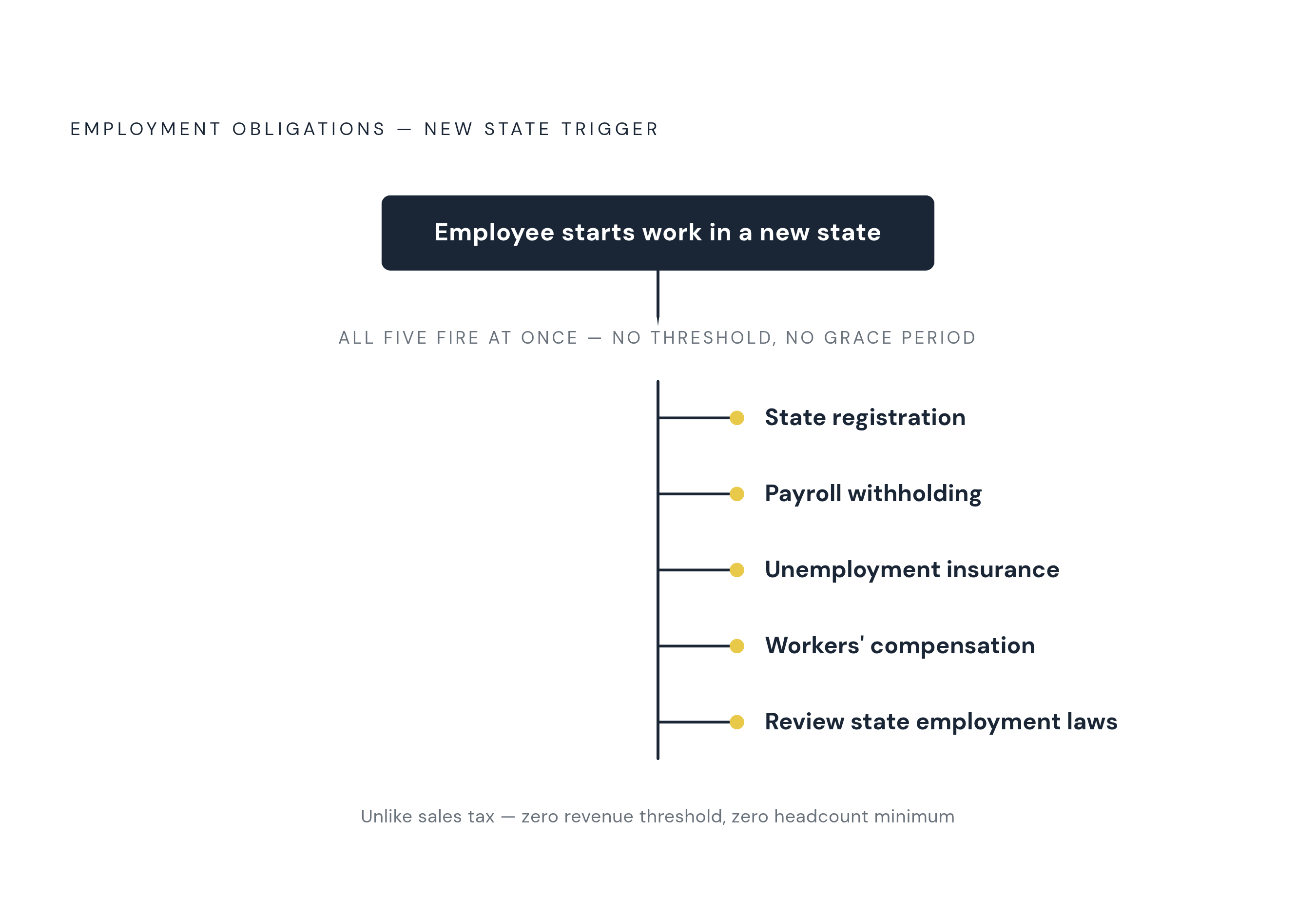
This differs from the way founders already think about sales tax. With sales tax, a state usually waits for revenue to cross a threshold before it can claim jurisdiction. Employment obligations don't offer that grace period. One remote employee in a new state can be enough to trigger registration requirements, payroll withholding, unemployment insurance, and workers' compensation coverage, all at once, with no minimum revenue or headcount required first. Every hire in a new state adds to the company's compliance footprint whether the founder notices or not, and the footprint doesn't shrink on its own.
What workers' compensation requires of employers, including remote ones
Workers' compensation is one of the few employment obligations that applies almost everywhere, and it applies to remote employees exactly as it applies to anyone working from a company office. If a business has one or more employees, it needs workers' comp coverage in nearly every state, and remote status doesn't change that. Texas is the one state where private companies don't have to carry workers' comp. Every other state imposes the obligation no matter how small the company is or whether staff work from a shared office or from home.
Whether a claim is valid comes down to a two-part test. The incident has to have occurred while the employee was doing work-related activities, and it has to have happened during work hours. Nothing in that test asks where the employee was sitting. Coverage turns on conduct, not location, and that means a home office counts as a workplace under workers' comp law in the same way a cubicle does. Federal law doesn't settle this directly: the main federal wage law is silent on workers' compensation requirements for private-sector workers. The rules live at the state level, and they vary, but the general expectation holds everywhere that requires coverage: employers must cover employees for work-related injuries even when those employees work from home.
Compensable injuries in a home workplace
Courts have upheld workers' comp claims when an injury happened in a kitchen during a video call, when repetitive strain built up at a makeshift dining-table desk, and even when a dog bit an employee during work hours. None of those scenarios resembles the factory floor or the construction site that workers' comp law was originally built around; the test is whether the injury occurred during a work activity that benefited the employer.
The range of covered injuries for remote workers is wide. It includes repetitive strain injuries like carpal tunnel syndrome from typing, accidents that happen during work-related travel, occupational hearing loss, heatstroke, gas poisoning, and chronic back problems tied to prolonged sitting, as long as a causal link to work duties and work hours can be shown. A legal principle called the personal comfort doctrine extends this further: an employee who steps away briefly to refill a glass of water, use the restroom, or stretch remains covered under workers' comp, because those moments are treated as a normal part of the workday rather than a departure from it. That doctrine means liability reaches into ordinary household moments an employer has no way to observe or control.
The exclusions matter just as much. Self-inflicted injuries aren't covered, nor are injuries from violations of company policy, injuries sustained while under the influence of alcohol, common illnesses like colds, or injuries with no connection to work. The employee has to prove the injury happened during a work activity within agreed-upon work hours. That burden doesn't eliminate the employer's exposure. A claim doesn't need to succeed, it can still cost the company time, legal fees, and an insurance audit.
Home-state policies and unprotected remote employees
A workers' comp policy written for the state where a company is headquartered doesn't automatically extend to employees working somewhere else, and assuming that it does is one of the most expensive mistakes a growing startup can make. Each state sets its own rules for coverage, reporting, and employer obligations. A business with workers spread across several states may need separate coverage, or a policy endorsement, for each jurisdiction. Coverage follows the state where the employee physically does the work, regardless of the state listed on the company's letterhead.
Consider an Arizona or Texas company that lets an employee work remotely from California. That one arrangement pulls in California wage-hour rules, reimbursement obligations, leave laws, workers' compensation requirements, payroll registration steps, and required notices, all because of where the employee's laptop happens to be open. None of that depends on how many other employees the company has in California. One is enough.
Insurance reciprocity across state lines isn't automatic either. If the insurance carrier isn't licensed to operate in the employee's state, the policy may simply not be valid there, leaving the company exposed as though it had no coverage. Founders should ask their carrier directly if a policy includes reciprocity for other states, because the fine print varies by insurer and by state.
The penalties for getting this wrong aren't uniform, and some of them are steep. In New York, if employers lack required coverage, they can be fined for every ten-day lapse, and they're also fully liable for injury-related costs. In Minnesota, fines can reach a significant amount per employee for every week the company goes without coverage. California treats operating without required coverage as a misdemeanor, with substantial fines plus separate civil penalties. Other states go further still: they issue stop-work orders or pursue criminal charges. A single injury to a remote employee working in a state where the employer lacks valid coverage can trigger an audit, back-pay obligations, regulatory fines, and legal costs that grow the longer the coverage gap has existed.
Silent employee relocations and policy violations
A company can do everything right at the moment of hire, confirm the employee's state, register where required, secure the right policy, and still fall out of compliance overnight if that employee moves without saying anything. Coverage obligations follow the employee's current location, regardless of the location recorded in the company's files from the day they were hired.
Remote work has made this kind of mobility common in a way that most startup HR processes were never built to track. If someone hired while living in one state quietly relocates to another and never tells HR, the company becomes subject to the new state's workers' compensation requirements the moment that move happens, regardless of where the company is based or where the original policy was written. An undisclosed move like this doesn't cause a single compliance failure. It causes several at once: payroll withholding calculated for the wrong state, missed leave entitlements specific to the new state, and a workers' comp coverage gap that nobody at the company knows exists.
This isn't a rare edge case. Remote work has made relocation far more common, so plenty of employees don't realize that when they move across a state line, their employer takes on new obligations. The fix is operational: requiring employees to report address changes, and auditing employee work locations on a regular schedule, belong in the same category as payroll and benefits administration, as standard HR practice. The same triggers that apply when a company hires someone in a new state, registration, withholding, unemployment insurance, workers' comp coverage, a review of that state's employment laws, apply with equal force when an existing employee simply moves.
Misclassifying Remote Workers as Contractors
Some founders try to sidestep workers' comp obligations, so they classify remote workers as independent contractors rather than employees. Contractors, consultants, and freelancers are generally exempt from workers' comp coverage, and that much is accurate. The classification has to hold up under scrutiny, and remote work doesn't supply the legal distance founders tend to assume it does.
If a worker lives far from the company, that alone doesn't make them a contractor. Regulators look at control: required hours, mandatory meetings, performance metrics, and an exclusive service relationship all point toward employee status no matter how many states separate the worker from the company's office. If a worker classified as a contractor gets injured and is later found to have been an employee all along, the company can be held responsible for wage and medical benefits, and exposed to state-backed claims and legal action, including workers' comp liability applied retroactively to a period when the company believed it owed nothing.
The ground under this question keeps shifting. In 2025, the U.S. Department of Labor issued enforcement guidance that stepped back from its 2024 rule, so enforcement moved away from aggressive misclassification cases while the rule was under review. By early 2026, the Department had proposed a new rule that would, once again, reshape how it evaluates independent contractor status. State standards complicate this further, because they frequently diverge from the federal test and tend to be stricter. A worker who passes a federal test for contractor status can still be classified as an employee under California or New York law. The financial exposure here is asymmetric: the cost of classifying a worker correctly and carrying the right coverage is predictable and budgetable. The cost of a misclassification finding, back wages, unpaid premiums, penalties, litigation, is not, and it tends to arrive all at once.
The OSHA home-office exemption's limits
OSHA doesn't send inspectors into home offices, and most founders know this. The mistake is in what gets inferred from it. Inspection is limited, but liability isn't, and the exemption was never built to give you that protection.
Under OSHA's home-worksite directive, if the company provided the equipment, materials, or work process that created a hazard at home, it still remains on the hook. If an injury ties to employer-provided equipment, you still have to record it, investigate it, and it can still feed directly into a workers' comp claim. An injury that happens while an employee is working from home counts as work-related if it occurs while the employee is performing paid work and the injury traces directly to that work, rather than to the general conditions of the person's house. Recordkeeping obligations don't go away just because no inspector is coming. A work-related home-office injury still has to be recorded, and that record can become part of a workers' comp claim later.
The absence of an inspector doesn't mean the absence of a claim. If an employee gets hurt while using a company-issued monitor, chair, or laptop at home, they can file a valid workers' comp claim, and it proceeds the same way whether or not OSHA was ever involved.
State-specific rules that create disproportionate exposure for startups hiring remotely
Some states set requirements well above the national baseline, so if you hire even a single remote employee there, you take on the full weight of those rules.
California is the state with the strictest requirements for remote employers. An out-of-state company that lets one employee work remotely from California inherits California's wage-hour rules, reimbursement obligations, leave laws, workers' compensation requirements, payroll registration steps, and required notices, the same full set of obligations a California-based company would carry. Operating without the required coverage there can mean misdemeanor charges, along with fines calculated as multiples of the unpaid premiums the company should have been paying. New York adds its own weight to this picture: employers without required coverage face fines for every ten-day period the company goes without it, a structure that punishes delay directly rather than treating the lapse as a single violation.
Neither state is an outlier in the sense of being unusual. They represent what happens when a state decides to enforce its own labor standards without regard for where the hiring company happens to be based. A founder building a distributed team needs to treat each state on a new hire's address like its own jurisdiction, because that's precisely how the law treats it.
Sources
- Workers’ Comp for Remote Employees: Coverage Guide
- Workers Comp Insurance for Remote and Distributed Teams
- Remote Work Compliance in 2026
- Compliance Requirements for a Remote Workforce - VantagePoint
- Workers' Compensation for Remote Workers in CA Explained
- Are Remote Workers' Injuries Compensable? - MVP Law
- Independent Contractors vs Employees in 2026: Why Misclassification Claims Are Spiking - Pickrel Schaeffer & Ebeling
- Workers’ Comp for Remote Employees: Compliance Risks and Employer Responsibilities