GDPR Liability Exposure for US Startups With European Users
European users expose US startups to fines up to 4% of global revenue.
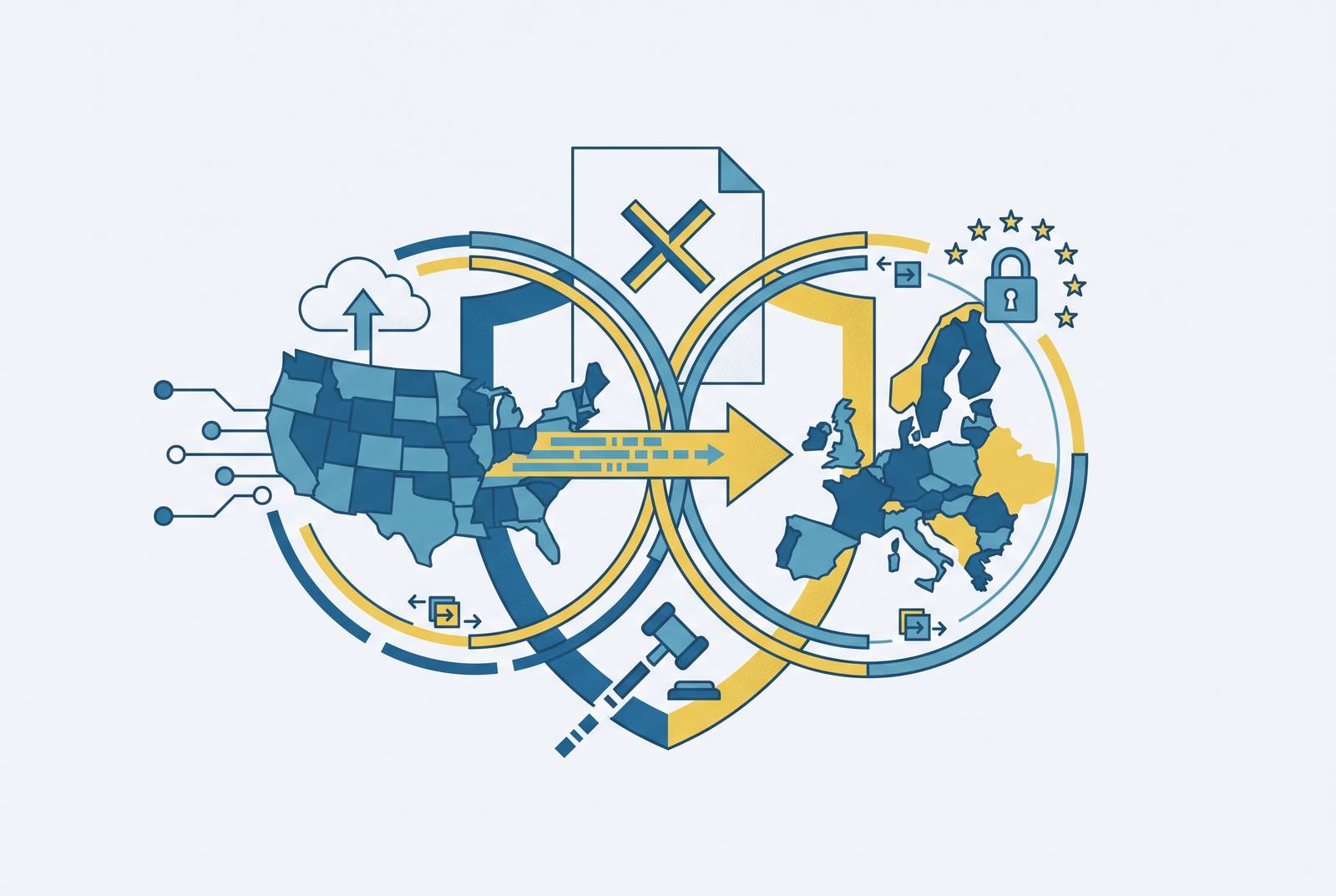
GDPR liability doesn't care where a company files its taxes. A US startup with European users is fully exposed to the regulation's penalty regime, fines running up to 4% of global revenue, regardless of size, funding stage, or whether anyone on the founding team ever intended to touch European law. The rule applies to any organization that processes the personal data of EU/EEA residents, with no size exemption and no geography exemption built into the text. A Delaware C-Corp with EU website visitors sits inside the regulation just the same, because the operative question is whose data is being processed. It's whose data the company is touching. GDPR Liability Exposure for US Startups With European Users
Three things trigger exposure in practice, and startup founders tend to trip over at least one of them without noticing. Offering goods or services to EU residents counts, even free ones, especially once the product uses EU-specific languages, currencies, or country-code domains. Systematically monitoring EU users counts too: cookie tracking, web analytics, behavioral advertising, even a stock GA4 install dropped in during onboarding week one. And shipping a physical product or running a remote service, whether that's SaaS, streaming, or an ed-tech platform, into EU addresses brings the same obligations along with it.
What counts as personal data under the regulation is wider than most founders assume. Names and email addresses are the obvious ones, but IP addresses, device IDs, browser fingerprints, and advertising IDs all qualify the moment they can be tied back to an individual. That breadth is why so many US startups find out they're in scope only after the fact, sometimes months or years into collecting European customer data, by which point the exposure has already piled up quietly in the background. The Italian data protection authority's €5 million fine against Replika, a San Francisco-based company, for processing user data without a valid legal basis, makes the point concretely: small, consumer-facing US apps sit well within regulators' field of view, not beneath it GDPR for Startups: A practical compliance guide for 2025. Three concrete triggers make this tangible for startup founders.
How the GDPR enforcement machine has scaled since 2018
The numbers describe a regulator that has been getting faster, not slower. Total GDPR fines since May 2018 now sit above €7.1 billion, a figure reported by the DLA Piper GDPR Fines and Data Breach Survey 2026 GDPR Compliance: Strategic Due Diligence for US Startups. Fines issued in 2025 alone reached €1.2 billion, roughly matching the year before it and reversing what had briefly looked like a cooling-off period in enforcement activity 2026 GDPR Compliance: Strategic Due Diligence for US Startups GDPR Fines 2026: Recent Enforcement Explained. More than 2,800 fines have been issued through mid-2025, and more than 60% of the entire cumulative fine value has landed since January 2023 alone, which tells you enforcement is compounding rather than leveling off 2026 GDPR Compliance: Strategic Due Diligence for US Startups.
Breach notifications work as a leading indicator here, and the trend is not subtle. European data protection authorities now log 443 breach notifications a day, up 22% year over year and the first time daily volume has crossed 400 since the regulation took effect. Every one of those notifications is a live thread a regulator can pull on.
The bigger shift, though, is who gets caught. Enforcement used to read like a highlight reel of household names. Between January 2023 and March 2026, regulators issued more fines against smaller businesses than they had in the previous five years put together. Spain's AEPD has issued close to 1,000 fines since 2018 on its own, more than any other European regulator, spread across companies of every size rather than concentrated at the top.
What's changed under the hood matters just as much as the headline totals. Regulators increasingly test websites themselves instead of waiting for a user complaint to land in an inbox. Automated tools now flag pre-consent tracking pixels and suspicious API calls before any human investigator gets involved. The days of flying under the radar on the theory that nobody's looking are closing, and the honest question for a startup is when enforcement reaches companies its size. It's when. Structural shift: enforcement is no longer concentrated on Big Tech.
The penalty structure: how fines are calculated
GDPR fines run on a two-tier structure, and the distinction between the tiers determines which mistakes are the expensive ones. Tier 1 covers the severe stuff, unlawful processing and unauthorized data transfers, capped at €20 million or 4% of global annual revenue, whichever number is bigger. Tier 2 covers procedural failures, things like weak security practices or skipping a required representative appointment, capped at €10 million or 2% of global annual revenue, again whichever is bigger.
That "whichever is greater" clause is where the math gets uncomfortable for a company doing well. Growth doesn't shrink the exposure. It grows the exposure right alongside the business.
Money is only one piece of what a violation costs. EU regulators publish their enforcement decisions publicly, and a fine appears in due diligence for every EU enterprise deal a startup tries to close afterward. In the worst cases, a regulator can order a company to stop processing EU data altogether, which functionally shuts down EU operations overnight. And the fallout reaches the cap table too: ComplyJet's analysis found non-compliant firms see, on average, a 26% reduction in VC investment relative to compliant peers, which makes GDPR exposure a real line item in due diligence rather than a footnote buried in the data room. Under the "whichever is greater" clause, for a startup with $50M in ARR, 4% of global revenue exceeds the €20M cap, so the penalty scales with the business rather than being a flat fee.
Where US startups get caught: the most-fined violation categories
Statista's fine data through February 2025 lays out a clear hierarchy by total euro value, showing exactly where the risk concentrates. Non-compliance with general data processing principles tops the list at €2.43 billion, the single largest category by a wide margin Statista. Insufficient legal basis for processing data is €1.97 billion Statista. Insufficient technical and organizational security measures is €836 million Statista.
"Insufficient legal basis" sounds abstract until you translate it into what a product actually does. It looks like an analytics or ad pixel firing before a user has clicked accept on the cookie banner, a gap automated scanners now catch without anyone filing a complaint. It looks like pre-ticked consent boxes, or consent bundled into a single all-or-nothing checkbox. And it looks like a team leaning on "legitimate interest" as a blanket justification without ever running or documenting the balancing test the law actually requires.
Cookie banners have become their own enforcement subcategory. Transparency failures are getting similar attention: the EDPB's 2026 coordinated enforcement action specifically targets this area, going after privacy notices that are vague, buried, or written in legal jargon without plain-language summaries.
Retention failures carry their own cautionary tale. The German data protection authority's €45 million fine against Vodafone in 2025 traced back to partner-agency oversight gaps and authentication weaknesses, where data that should have been deleted after five years sat in backup systems for more than a decade. Regulators explicitly rejected "the system was too complicated to fix" as a defense, and that pattern occurs constantly in startups whose data infrastructure has outgrown their governance.
Children's data is its own minefield. Article 8 sets 16 as the default age for digital consent, though member states may lower that to 13, and the UK GDPR uses 13 How GDPR strangled European tech before it could compete. Consumer-facing US apps in social, gaming, and ed-tech that have not implemented effective age verification and have processed minors' data for behavioral advertising faced multiple fines in 2025 from the Irish DPC, French CNIL, and UK ICO How GDPR strangled European tech before it could compete. And vendor management is quietly becoming its own enforcement front: regulators have signaled that 2026 will bring more scrutiny of Article 28 due diligence failures, since controllers stay responsible for their processors, and a SaaS stack running third-party analytics, CRMs, and AI tools without signed Data Processing Agreements is a gap regulators can document in minutes. On cookie consent and dark patterns, the French CNIL has issued multiple fines for cookie banners that make rejecting cookies structurally harder than accepting them, a design choice, not just a policy failure.
Enforcement cases that show the pattern extends to US companies well below Big Tech scale
A handful of cases, spanning wildly different company sizes, tell the same story from different angles. Meta's €1.2 billion fine from the Irish DPC in 2023, still the largest GDPR penalty on record, came from unlawfully transferring EU user data to US servers, and it set the template for how expensive transfer violations can get GDPR Fines 2026: Recent Enforcement Explained. TikTok followed with a €530 million fine from the Irish DPC in April/May 2025 over illegal EEA data transfers, confirming cross-border transfer enforcement is a durable category GDPR Fines 2026: Recent Enforcement Explained.
Uber's story runs even longer. The Dutch data protection authority fined the company €290 million in August 2024 for transferring driver data to the US without adequate safeguards. Two years later, in August 2026, the same regulator hit Uber again, this time for €825 million, the company's fourth Dutch fine overall. A prior fine, in other words, doesn't close the file. Regulators keep watching.
Clearview AI is the case that maps most directly onto a data-heavy US startup with no European office at all. The Dutch authority fined the facial recognition company €30.5 million in 2024, and various EU regulators have fined it seven separate times since 2020, totaling more than €100 million.
Lay these cases side by side and the lesson repeats itself: US incorporation offers no defense. The movement of data triggers enforcement, not the address printed on the incorporation documents. A common technical root underlies the cases above: EU personal data moves into US-controlled systems without a valid legal mechanism to justify the trip.
Cross-border transfers are the most consistently enforced piece of GDPR, and the Meta, TikTok, and Uber fines all trace back to transfer violations at their core. Any startup moving EU data toward US servers needs to understand exactly which legal mechanism it's relying on, because right now, none of the available options sit on fully solid ground.
Around 2,700 US organizations were certified as of mid-2026. But its legal footing is shakier than the certification count suggests. The EU General Court dismissed a challenge to the framework, the Latombe case, on September 3, 2025, though that ruling can still be appealed up to the Court of Justice of the EU. Then, on June 29, 2026, a US Supreme Court ruling stripped the FTC of its independence, and the privacy group noyb has since prepared a fresh annulment challenge built on exactly that development. The adequacy decision stays in force unless the Commission repeals it or the CJEU annuls it, but a "Schrems III" scenario is a documented risk, not a hypothetical.
But SCCs alone don't automatically make a transfer lawful. The exporter also has to run a Transfer Impact Assessment, checking whether US law and government practice would actually let the importer live up to its contractual promises. The sound approach going into 2026 is to keep SCCs and a completed TIA on file in parallel, even for a recipient that's already DPF-certified, as a backstop in case the framework gets annulled. Under Article 48 of the GDPR, a CLOUD Act request is not a valid legal basis for data transfer, a position codified explicitly in EDPB Guidelines 2/2024 (Version 2.0).
Both mechanisms face a harder structural problem: the CLOUD Act. Simply complying with such a request is, on its own, a documented GDPR violation. And this isn't solved by picking a server location. Cloud offerings marketed as "European Sovereign Cloud" by US-owned providers like AWS, Google, and Microsoft remain subject to US government data requests no matter where the physical servers sit. That's an active compliance gap today for any US startup storing EU data on US-owned infrastructure, not a theoretical edge case. A startup running EU users, a US-based engineering team, and AWS infrastructure physically located in Frankfurt still has a transfer mechanism problem that no privacy policy update can paper over. Fixing it takes executed SCCs, a completed TIA, and ideally DPF certification layered on top as a backup. The framework was adopted by the European Commission on 10 July 2023, the current adequacy route for US-to-EU transfers. The current SCCs stem from Commission Implementing Decision 2021/914 of 4 June 2021, and all pre-2021 contracts had to be migrated by 27 December 2022.
Two structural obligations most US startups miss before their first EU customer signs
Two paperwork requirements get skipped constantly, and both are the kind of gap a regulator can spot in about five minutes of looking.
The first is the EU Representative under Article 27. Any non-EU company offering goods or services to EU residents, or monitoring their behavior, generally has to name a representative located inside the EU, a legal entity or individual that regulators and members of the public can actually contact. A US software company billing German customers and collecting their names and email addresses needs this representative even if it has never opened a European office. Skipping it exposes the company to fines up to €10 million or 2% of global turnover, a Tier 2 violation, but one that's trivially easy for a regulator to detect and document from the outside. Narrow exemptions exist for occasional, low-risk processing, but most US SaaS products, e-commerce shops, and consumer apps with any real EU user base don't come close to qualifying for them. Appointing the representative leaves the company's own liability intact. It's a prerequisite for operating lawfully, not a shield against being fined. The Data Protection Officer requirement is set out in Article 37.
The second gap sits on the UK side, and founders often assume one appointment covers both. Post-Brexit, a US company serving UK individuals without a UK establishment generally needs its own separate UK Representative under UK GDPR. The UK Representative constitutes a separate obligation. EU and UK representation are distinct appointments, and one does not satisfy the other.
Sources
- GDPR for Startups: A practical compliance guide for 2025
- How GDPR strangled European tech before it could compete
- 2026 GDPR Compliance: Strategic Due Diligence for US Startups
- GDPR Fines 2026: Recent Enforcement Explained
- Third Time’s the Charm? The Fate of the EU–U.S. Data Privacy Framework - Berkeley Technology Law Journal
- Client Alert: U.S. Supreme Court Decision Prompts New Questions About EU-U.S. Data Transfers - Shumaker, Loop & Kendrick, LLP
- EU%E2%80%93US Data Privacy Framework