Social Engineering and Funds Transfer Fraud Coverage
Most businesses discover their social engineering coverage has a sublimit after the money is gone.

An email arrives from the CFO, asking finance to push a wire before noon. A longtime vendor writes in to say their bank account has changed, please update it in the system. Most businesses that carry cyber or crime insurance assume this kind of loss is covered, because "cyber" and "crime" sound like broad umbrellas and fraud is a crime. The actual coverage for social engineering and funds transfer fraud is almost always narrower, lower, and more conditional than that assumption suggests, sitting behind a sublimit that most policyholders never read until after the money is gone. Phishing and social engineering now make up more than four out of five dollars in cyber insurance losses tracked by one major insurer, up from under one in five just two years earlier, yet it remains the least understood corner of a typical policy. What follows answers two questions: where does this coverage actually sit inside a policy, and what makes it fail at the moment a business needs it most.
Social engineering and funds transfer fraud, and why insurance treats them differently from theft
Social engineering fraud describes a scheme where a criminal poses as someone the target trusts, an executive, a vendor, a client, and talks an employee into sending money or handing over credentials. Nothing about the company's technical defenses fails in this scenario. The firewall holds, the login screen works, the wire transfer system processes the request exactly as designed. The failure is human. This is why this class of loss sits so awkwardly inside policies built for other things.
Funds transfer fraud is a close cousin but a distinct trigger: fraudulent instructions sent directly to a bank or financial institution, directing it to move money out of an account, typically without the account holder ever knowing the request was made. Where social engineering fraud tricks a person, funds transfer fraud can bypass the person and go straight at the institution.
A single phrase buried in most crime policies causes them to struggle with either scenario: voluntary parting. Typical language excludes coverage for loss arising from anyone acting under the insured's authority being induced by a dishonest act to voluntarily part with money or property. An employee who wires funds after reading a convincing fake email has, in the policy's eyes, voluntarily parted with that money, deception notwithstanding. Crime coverage was built around theft: property taken without consent, a lock picked, a safe cracked. Social engineering produces the opposite fact pattern: an authorized person knowingly sends the money, just to the wrong place, for the wrong reason. The policy's theft logic and the fraud's actual mechanics never lined up.
Vocabulary compounds the problem. The same attack might appear across different policies as social engineering fraud, fraudulent instruction, deception fraud, phishing, cybercrime, or funds transfer fraud, and each label can carry its own conditions and its own sublimit. A business reading one policy's table of contents has no guarantee it understands what a near-identical clause means in another. The coverage has to reach a wide range of attack variants too: business email compromise, CEO fraud, vendor payment diversion, payroll and direct-deposit redirection, and, growing faster than the rest, AI-assisted voice and video impersonation.
The Scale of Losses and the Coverage Gap as a Financial Threat
None of this would matter much if the losses were small. The losses are not small. Business email compromise, the primary delivery mechanism behind most social engineering fraud, generated tens of thousands of complaints to the FBI in its most recent reporting year, with losses in the billions of dollars and a meaningful increase over the year before. The attack type that dominates headlines and the attack type actually draining business bank accounts are not the same thing.
The exposure is also widespread rather than rare. A majority of U.S. organizations reported experiencing attempted or actual payments fraud in 2025. And once a fraudulent transfer clears, the window to claw it back is brutally short: funds move through several accounts and jurisdictions almost immediately, and after that window closes, recovery through banking channels is close to impossible, leaving insurance as the only remaining backstop.
Per Vouch's guide, phishing and social engineering now account for more than four out of five dollars in cyber insurance losses tracked by one major insurer, up from under one in five just two years earlier. Attackers impersonating Quanta Computer, a real hardware supplier, sent fabricated invoices to Facebook and Google over an extended period, and the collective losses reached roughly $121 million, the largest documented BEC case on record. In a more recent case, a finance employee at a multinational firm wired a substantial sum after joining a video call where every face and every voice, including the person who appeared to be the CFO, was generated by AI. Per Seedpod Cyber's analysis, that case is no longer an outlier. Losses at this size make the coverage gap unavoidable, because they routinely exceed the sublimits businesses assume will absorb them. BEC losses dwarfed ransomware, data breaches, and IP theft combined in the same reporting period, and the dominant financial threat to most businesses is not the attack type that dominates headlines.
Coverage across crime and cyber policies and the sublimit structure in practice
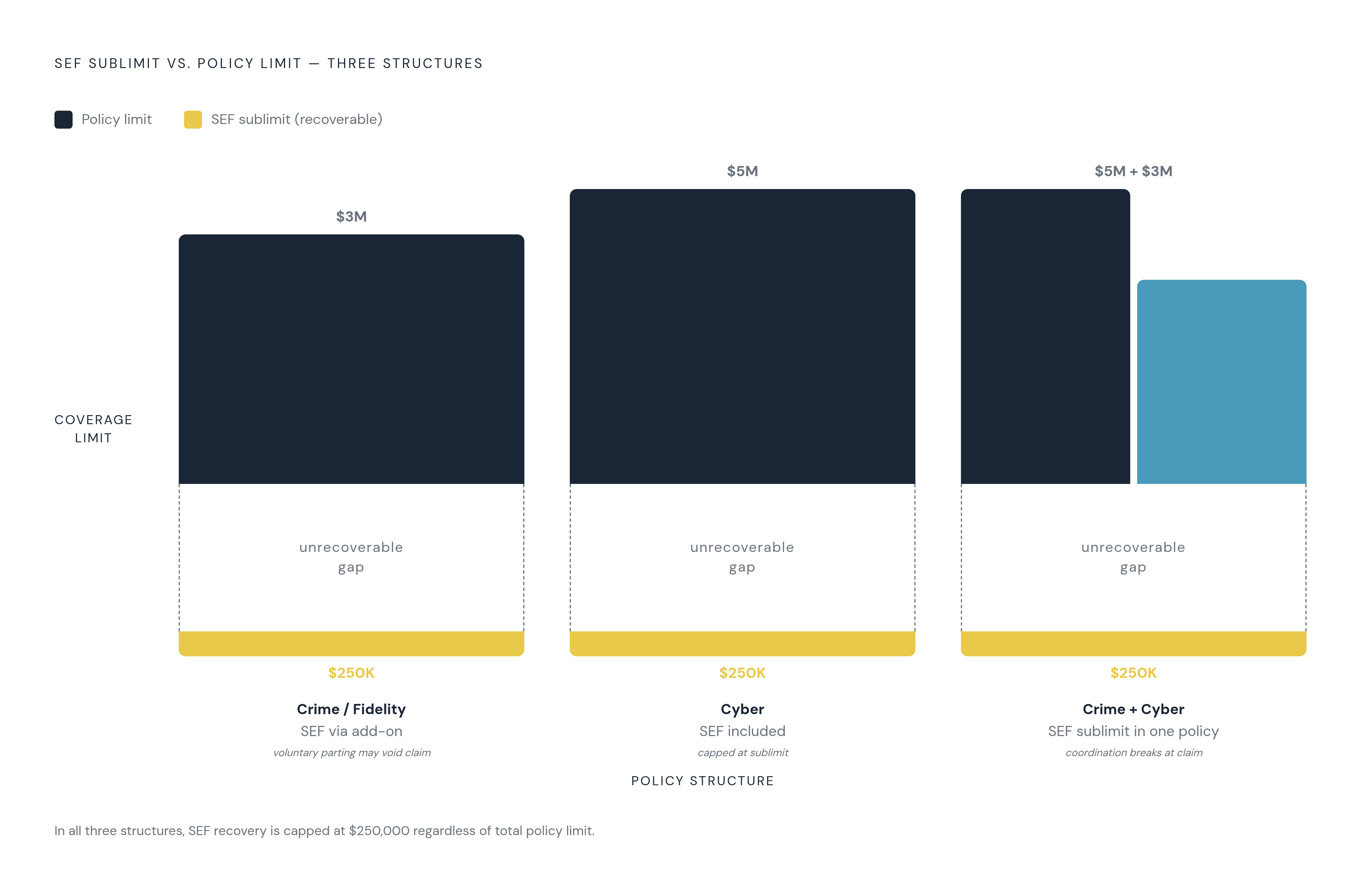
Crime and fidelity policies focus their base coverage on theft and employee dishonesty. Third-party computer fraud and funds transfer fraud usually have to be purchased as separate add-ons, and even once purchased, the voluntary parting exclusion can strip the coverage away right when a claim gets filed. Cyber policies, the second structure, mostly do include social engineering fraud coverage today, but cap it at a sublimit well below the policy's main aggregate limit, a limit that simply doesn't apply to this category of loss. The third structure, crime endorsements layered onto cyber policies or the reverse, sounds like it should close the gap by combining both, but the SEF sublimit still lives inside whichever policy happens to pick it up, and the two policies frequently fail to coordinate cleanly once a claim is actually filed.
The sublimit figures themselves cluster tightly. SEF sublimits on crime policies tend to cluster around a common midpoint, and that figure lines up closely with the cap that appears on the cyber side too. In practice, that means a mid-market company carrying a substantial cyber policy alongside a $250,000 SEF sublimit, hit by a BEC loss well above that ceiling, recovers only up to the sublimit and pays the rest out of pocket, regardless of how large the underlying policy limit looks on paper.
Two further gaps deserve mention. Impersonation fraud aimed at third parties, where attackers pose as the insured business itself to divert a client's or vendor's payment, sits outside standard coverage almost entirely; a handful of carriers offer client-funds endorsements, but this is nowhere near universal. Some policies have also started covering goods shipped as a result of fraudulent purchase requests, not just cash transfers, which matters directly to distributors, manufacturers, and contractors who ship product on trust before payment clears. The good news is that none of this is fixed in stone: sublimits can be negotiated substantially higher, and the added annual premium for doing so tends to be modest relative to the exposure it closes. Per Segal (2024) and Amwins (November 2024), three policy structures are in play regarding where coverage actually sits across crime and cyber policies and what the sublimit structure looks like in practice.
Claims denied even when coverage exists on paper
Buying the coverage is only half the problem. Even where a sublimit exists on paper, claims get denied on a short, repeatable list of grounds, and courts have already tested each of them.
Voluntary parting remains the most direct denial route. In Midlothian Enterprises, Inc. v. Owners Insurance Company, the U.S. District Court for the Eastern District of Virginia found that a voluntary parting exclusion in a crime policy properly excluded coverage for a fraudulent transfer social engineering scheme, because the employee who authorized the wire did so knowingly, even though deceived. Sublimit application produced a similarly unforgiving result in Mississippi Silicon Holdings v. Axis Insurance: a silicon metal manufacturer, hit by a spoofed supplier email, made two transfers totaling more than $1 million, and a federal court ruled the recovery was capped under the SEF sublimit rather than the policy's full limit, leaving the company to absorb most of its own loss.
Two further grounds appear regularly. Verification failure voids coverage when a policy requires a callback or dual authorization before a transfer and an employee skips that step, whether from time pressure or simple trust in a familiar name. And cryptocurrency payments, along with losses tied to attacks that began before a policy's retroactive date, are commonly excluded even under coverage that would otherwise apply.
A real estate case brings the sublimit ceiling and the verification failure together in one loss. An attacker monitored a law firm's email for six weeks, learned the rhythm of an upcoming commercial closing, and sent fraudulent wire instructions days before the deal closed; the firm's cyber policy paid out only to the SEF sublimit, leaving a real portion of the loss uncovered.
Callback and dual-authorization requirements were written into policies to reduce risk, and insurers frame them as reasonable underwriting discipline rather than traps. Amwins's analysis notes that these provisions, in practice, give insurers grounds to deny claims whenever an employee, under urgency or facing a convincing impersonation, skips a step, and the firm goes so far as to recommend businesses avoid or restrict these provisions where they can negotiate it. The insurer's position holds up fine against a crude, misspelled phishing email. It falls apart against sophisticated AI-assisted impersonation, where an employee verifies the voice, watches the face on a video call, follows every step of the procedure, and still gets deceived. That condition punishes due diligence, not negligence. Courts have not settled on one national answer to this tension. The outcome of a denial can still depend heavily on where the business happens to be sitting when it files suit.
AI-generated impersonation and the broken assumptions underlying existing coverage language
Social engineering coverage language was written for a world where impersonation was always a little imperfect: a spoofed email address with a domain one letter off, a voice on the phone that almost sounded right, a fake invoice that a sharp employee might catch on close read. Verification procedures like callbacks and dual authorization worked as real defenses in that world, because the fake was usually detectable if someone looked closely enough.
AI breaks that premise. Voice cloning now works from a few seconds of publicly available audio, real-time video filters can convincingly swap a face onto a live call, and large language models can generate emails that match a real person's writing style, vocabulary, and tone closely enough to defeat the training most employees receive to spot fakes. A 2026 phishing threat report from Cofense, cited in Vouch's guide, found AI-assisted phishing volume more than doubled year over year, letting attackers run personalized campaigns at a scale that used to require far larger operations. The $25 million video call case makes the point concretely: every face and voice on the call was synthetic, the employee followed the company's normal internal authorization procedure to the letter, and was deceived anyway. The callback-and-verification model offers no real defense against an interaction that's entirely fabricated from the start.
A newer legal argument threatens to widen the gap further. Many crime and cyber policies require that a covered loss flow "directly" from the fraudulent act, and some carriers have started arguing that when AI-generated content is the actual mechanism of deception, the AI itself functions as an "intervening agency" that breaks the direct chain of causation the policy demands. Courts in several jurisdictions are actively litigating that question right now, and the results so far aren't uniform. Expect authentication requirements tied to coverage to keep evolving in response, the same way multi-factor authentication went from optional to near-universal after the 2021 ransomware wave forced insurers' hand. Further out, agentic AI systems, the kind that can message, call, schedule, and execute workflows on their own, stretch the attack surface from tricking one person once to tricking an automated system repeatedly at machine speed, and current policy language has no real answer yet for the attribution and intent questions that raises.
The market split after January 1, 2026, and its meaning for policies renewing now
The same AI-assisted deepfake attack that is covered under one carrier's renewed policy may be explicitly excluded under another carrier's renewed policy. That split happened largely at the January 1, 2026 renewal cycle, meaning businesses that have not reviewed their policy language since then may not know which side of that divide they are on. Any business that hasn't reviewed its own policy since that renewal date has no way of knowing which side of that line it landed on, and won't find out until a claim is already on the table.
Sources
- Understanding Social Engineering Fraud Insurance
- Social Engineering Fraud Insurance: Coverage, Limits & Gaps
- How Cyber and Crime Insurance Policies Respond to Social Engineering
- Cyber Insurance Social Engineering: Coverage Guide
- Funds Transfer Fraud and Social Engineering Coverage
- AI-Assisted Social Engineering and Cyber Insurance: Real Claims, Real Coverage Gaps