State Data Breach Notification Laws Affecting Startups
Startups must navigate a fragmented maze of state laws with conflicting deadlines and definitions.
Every state in the union, plus the nation's capital. and several territories, now runs its own data breach notification law, and no federal statute overrides any of it. For a startup with customers in more than a handful of states, that means a single breach can trigger a dozen different clocks, a dozen different definitions of what counts as sensitive data, and a dozen different regulators to answer to, all from one incident.
Why the 50-state patchwork exists
California went first, passing the country's original breach notification law in 2002. It took sixteen more years for the rest of the map to fill in. Alabama and South Dakota were the last two holdouts, both adopting laws in 2018. The patchwork isn't an accident of federal gridlock so much as the product of fifty separate legislatures moving at fifty separate speeds, and there's no serious push in the national legislature to collapse it into one standard.
What's striking is how consistent the direction of travel is, even without anyone coordinating it. Deadlines keep getting shorter. Definitions of "personal information" keep getting broader. Regulators keep asking for more visibility into incidents, not less. States aren't converging on identical text, but they are converging on the same posture: less time to notify, more categories of data that count, more paperwork owed to attorneys general.
None of this is theoretical for a company running a normal SaaS business. In the first half of 2026 alone, state agencies and a federal health department published 5,429 breach notification filings, describing 1,969 distinct breach events that touched at least 343 million people. That's the environment a startup lands in the moment it has customers in more than one state, which, for nearly any software company, is day one.
The notification-deadline split that breaks most internal SLAs
Only 20 states, about 39%, put a hard number on the deadline for notifying affected individuals. The other 31 lean on language like "without unreasonable delay," which sounds looser but doesn't necessarily mean more forgiving in practice.
Among the states that do use fixed deadlines, the spread is wide. California, Colorado, Florida, New York, and Washington require notice within 30 days. Alabama, Arizona, Indiana, New Mexico, Ohio, Oregon, Rhode Island, Tennessee, Vermont, and Wisconsin allow 45. Connecticut, Delaware, Louisiana, South Dakota, and Texas stretch to 60.
Take a startup with customers in California and Ohio, an unremarkable footprint for an early-stage company selling into enterprise accounts on both coasts. One internal SLA cannot cover both. California's clock runs fifteen days faster than Ohio's, and building a single playbook around "45 days, no exceptions" means passing in Ohio and failing in California. Building it around California's 30 days instead makes the same playbook needlessly conservative the moment a breach touches Texas.
The states with vague language deserve just as much scrutiny, maybe more, because "without unreasonable delay" doesn't mean unenforced. Litigation against a logistics company is instructive here: plaintiffs alleged that a year-long delay in notification amounted to negligence and violated multiple state statutes, and the claim held up even after the company had already gone out of business. A year isn't a gray area under any reading of "unreasonable delay," however loose the statutory language looks on paper. Vague standards get litigated case by case, and that's a worse position for a startup to build a process around than a number it can put on a calendar.
The 2025-2026 legislative changes that tightened the most-watched states
California's SB 446 rewrote the state's standard. The old language, "most expedient time possible," left room to argue about what counted as reasonable. SB 446 replaced that with a flat 30-calendar-day deadline, now the strictest hard deadline in the country. Delays are permitted only for law enforcement needs or to determine the scope of the breach and restore system integrity, and the statute doesn't leave much slack in those exceptions.
SB 446 also created an obligation that didn't exist before: for any breach touching more than 500 California residents, a copy of the consumer notice now has to go to the California Attorney General within 15 calendar days of notifying individuals. California had no deadline at all for submitting that notice to the state regulator before this. Substitute notice, for companies that can't reach people directly, now requires email, a conspicuous website posting, and notice to major statewide media, written in plain language that describes the incident, the data involved, and what the company is doing about it.
New York moved the same direction. Amendments to General Business Law § 899-aa put New York in the same 30-day bucket as California and killed the old provision letting companies delay notice to determine scope and restore systems (the law enforcement exception survives). A separate clarification, signed February 14, 2025 as S804, narrowed when the state's Department of Financial Services needs to be looped in: NYDFS notice is now required only when the breached entity actually qualifies as an NYDFS "covered entity," which means a lot of non-regulated businesses no longer owe that particular filing. New York also puts a parallel duty on data maintainers, not just data owners: a maintainer has 30 days from discovery to notify the owner or licensee of the data, which matters a great deal for any startup running data processing on behalf of other companies.
Oklahoma's SB 626 is the state's first update since its original 2008 law, and it moves on two fronts. It broadens "personal information" to include government-issued ID numbers, unique electronic identifiers, and biometric data such as fingerprints and iris scans. And it adds an AG notification requirement: entities have to notify the Oklahoma Attorney General within 60 days of notifying individuals, once a breach hits 500 or more residents. Oklahoma also does something none of the other states here do explicitly: it gives companies an affirmative defense if they can show they had "reasonable safeguards" appropriate to their size and operations. That single clause changes the math for any startup weighing how much security investment its size actually justifies.
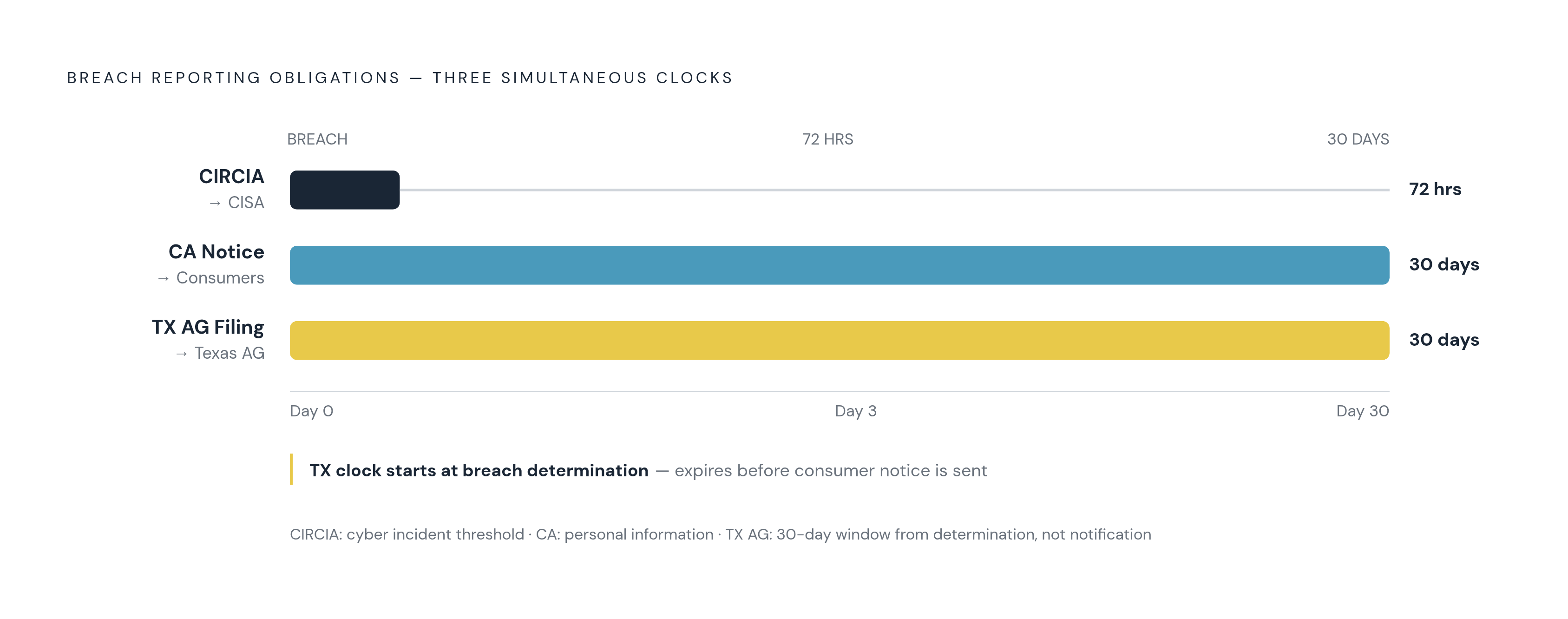
Texas has the least intuitive structure of the group, and it's the one most likely to trip up a startup building its timeline backward from the consumer notice. Business & Commerce Code § 521.053 gives 60 days to notify individuals once 250 or more Texans are affected, but only 30 days to notify the attorney general, and that 30-day clock starts from when the breach is determined to have occurred, not from when individual notice goes out. The regulator filing is the earlier deadline, not the later one. Treating the AG filing as a formality that follows customer notice runs out the Texas clock before the response plan even gets to that step.
How "personal information" is being redefined
States don't agree on what data actually triggers a notification duty. The same incident can go unreported in one state and require disclosure in the next. Twenty-two states explicitly cover biometric identifiers. Twenty-four cover medical or health information. Only nine states, about 18%, extend their breach laws to paper records at all, and it's tempting to read that as an exemption for a digital-native company. It isn't: printed onboarding forms or physical files left in a co-working space can still create exposure in those nine states.
Oklahoma's SB 626 shows how fast these definitions can move. A startup storing nothing but names and account numbers sat largely outside Oklahoma's old notification regime. Under the amended law, the same startup's database, if it now includes fingerprints, iris scans, unique electronic identifiers, or government ID numbers, triggers obligations that didn't exist before the amendment passed. Nothing about the company's data practices had to change. The law just redrew the boundary around it.
A related shift is happening outside the breach notification statutes entirely, inside a new wave of comprehensive privacy laws that took effect in 2025 in Delaware, Iowa, Nebraska, New Hampshire, Minnesota, Tennessee, New Jersey, and Maryland, and then in Indiana, Kentucky, and Rhode Island on January 1, 2026. These laws build in security obligations that exist independent of any breach notification requirement. Minnesota requires data mapping as part of a company's written security policy, a documentation obligation that has nothing to do with what happens after an incident. New Jersey doesn't require anything like it. A breach response plan built only around the applicable notification statute will miss obligations that now live in a separate privacy law entirely, and the two need to be read together, not treated as one project.
No small-business exemptions exist for early-stage startups specifically
None of the fifty state breach notification laws carve out an exemption for small business. Headcount, revenue, and funding stage don't appear anywhere in the statutory text. A three-person seed-stage company and a publicly traded enterprise face the same notification clock in the state where the breach happened.
That uniformity carries real financial weight. About 47% of states give affected individuals a private right of action, meaning people can sue directly instead of waiting for a regulator to act. Six states, 12%, require the breached company to cover free credit monitoring for affected consumers. Both sit on top of whatever fine the state imposes, and neither one scales down for a thin balance sheet.
Oklahoma's SB 626 penalty structure is the one partial exception here, tying civil penalties to whether a company both lacked reasonable safeguards and failed to notify, but the underlying duty to notify individuals doesn't go away regardless. The penalty exposure may differ. The notification obligation does not.
For a company running close to the edge financially, this isn't a line item to budget around later. Research has consistently found that a significant share of small and mid-sized businesses operate with little financial buffer against unexpected damages. Set that number against the fines in the next section, several of which run into six and seven figures, and the gap becomes the whole story: a poorly handled breach notification is an existential cost for an early-stage startup. It's an existential one.
Enforcement in practice: the penalties and cases that define real risk
Per-violation fines swing wildly by state, and the swing says something about how differently each legislature weighs this problem. California caps civil penalties around $7,988. New York allows up to $5,000 per violation, on top of AG enforcement power and a private right of action. Connecticut also imposes per-violation caps. Washington caps individual penalties at $2,000, but multiplies that by the number of affected residents, so a mid-sized breach touching tens of thousands of Washington residents turns into a six-figure liability fast.
Florida and Texas structure things differently, and both can get large fast. Florida allows fines up to $500,000, with $1,000 per day for the first 30 days of a late notification and $50,000 per day after that, a schedule built specifically to punish delay. Texas caps its per-violation penalty at $100 but allows total penalties up to $250,000. Oklahoma's SB 626 sets civil penalties at up to $150,000 for a company that both lacked reasonable safeguards and failed to notify properly, or $75,000 plus actual damages for one that lacked safeguards but did notify on time, another place where that affirmative defense changes the numbers materially.
Three recent enforcement actions show what these figures look like once a regulator actually pulls the trigger. The New York Department of Financial Services fined a company $2 million for failing to notify within 72 hours of a cybersecurity event, among other compliance failures. The Massachusetts Attorney General fined a property management company $795,000 for delayed notification and inadequate protection of personal information. The California Attorney General fined a software company $6.75 million, not for the breach itself, but for misleading the public afterward about its full scope and impact.
That last case is the one most startups get wrong in their own planning. The $6.75 million penalty wasn't a late-notice fine. It was a penalty for misleading the public about the breach's full impact, a failure that lived inside the company's public communication after the fact. A startup can hit every statutory deadline in every state where it operates and still walk into a seven-figure fine if its public account of the breach doesn't match reality.
These numbers track with the macro picture too. One vendor's Cost of a Data Breach Report 2025 put the average breach cost in one country. breach at $10.22 million, well above the global average of $4.44 million. That country has led the world in breach costs for fifteen straight years, and the report points to regulatory and legal costs as contributing factors to that gap.
A startup breach in practice: what the DeepSeek incident shows about operational failure
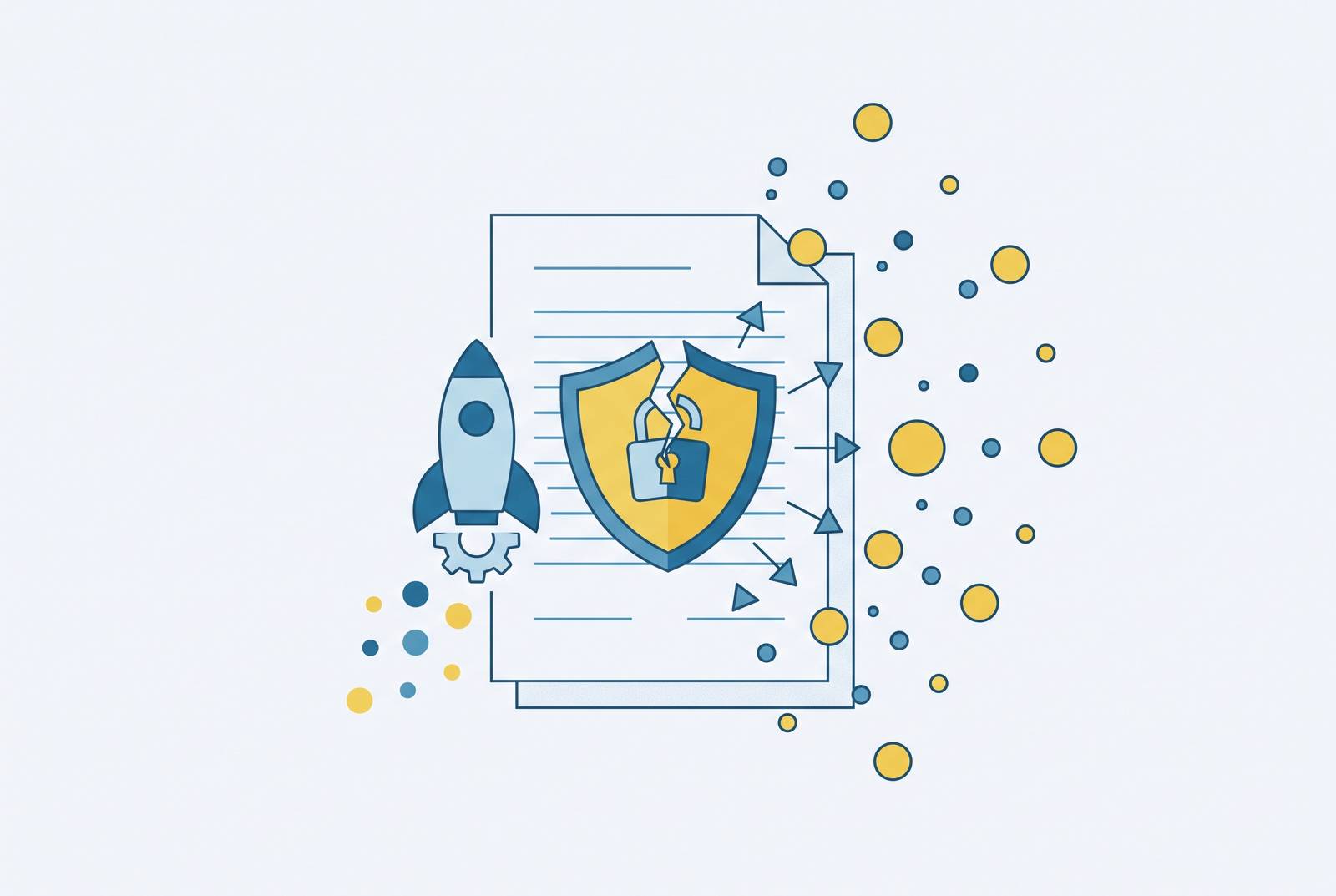
In January 2025, the AI startup DeepSeek suffered a breach that had nothing to do with sophisticated attackers or novel exploits. A database sat publicly accessible, no password required to reach it. Sensitive records were exposed, including user chat histories, API authentication tokens, backend credentials, and internal system logs.
The fallout arrived fast: platform-wide service interruptions, regulatory scrutiny, and a suspension of global signups while the company worked through the damage.
The mechanism is what makes the incident worth studying, not the record count. It's the mechanism. This was a misconfiguration, not a zero-day and not a novel attack technique, the kind of gap a documented security review would have caught before it ever became public, the same kind of proportionate control that Oklahoma's SB 626 rewards with an affirmative defense. For a startup racing to ship product, DeepSeek is a reminder that every notification clock and AG filing covered above only starts running after a failure that, in this case, basic configuration hygiene would have prevented.
The federal layer that overlays state obligations for startups in regulated sectors
No single federal breach notification statute preempts what the states are doing, and nothing moving through the national legislature suggests that changes soon. What federal law does is stack another layer of obligation on top of the state ones, not replace them.
The clearest example is the federal rule governing cyber incident reporting for critical infrastructure, known by its acronym, CIRCIA. CISA has announced the rule will be finalized in September 2026. Once it takes effect, covered entities, meaning critical infrastructure companies, will need to report substantial cyber incidents to CISA within 72 hours, and ransomware payments specifically within 24 hours. That covers a defined set of critical infrastructure sectors, directly relevant to companies in energy, financial services, healthcare IT, and adjacent fields.
HIPAA and GLBA layer their own carve-outs on top of that. One legal directory's State Data Breach Notification Laws Chart notes that compliance with laws covering health or financial information can create exceptions under certain state statutes, though the chart doesn't spell out how those exceptions actually work in practice. Any startup operating in a space touched by those health or financial privacy laws needs counsel who knows that overlap specifically.
When the pieces are placed next to each other, a health-tech or fintech startup facing a serious breach could be running a 72-hour federal clock, a 30-day California consumer notice clock, and a 30-day Texas AG filing clock, all at once, off the same incident, each with its own recipient, threshold, and regulator. These aren't three versions of one requirement. They go to different recipients, trigger at different thresholds, and answer to different regulators. Treating them as a single deadline turns one breach into three separate compliance failures.