Investor Pressure and D&O Insurance Requirements at Series A
VC board seats create personal liability that D&O insurance now treats as closing condition.

Series A is where D&O insurance stops being a line item founders can defer and becomes a closing condition that stops a wire transfer. This happens for structural reasons: the lead investor is placing a partner on the board, and that partner takes on personal fiduciary liability for every vote cast starting day one.
At pre-seed and seed, D&O sometimes shows up in a term sheet as a suggestion, something a lawyer flags and nobody enforces. Series A is different. Once a VC partner sits on the board, that person can be named personally in a lawsuit alongside the company's officers if a claim grows out of a board decision, a fundraising representation, or a failure the plaintiffs argue the board should have caught. The investor's insistence on coverage has nothing to do with protecting the founder. It protects the person the investor just put in the room. That's why the closing checklist usually requires a certificate of insurance naming the company and the investor as interested parties, with a guarantee of notice if the policy gets canceled. Even board observers, the non-voting attendees who just receive company information, face enough exposure in governance disputes that experienced ones now ask for coverage before they'll take the seat.
What the three coverage sides actually protect, and why all three matter at Series A
D&O policies split into three sides, and each one answers a different question about who gets paid and when.
Side A pays individual directors and officers directly when the company can't indemnify them, whether because it's gone bankrupt or because state law blocks the indemnification. This is the layer that matters most to the board member personally, since it's the only piece that survives the company's collapse.
Side B reimburses the company after it has already advanced defense costs for a covered director or officer. At private companies, this is a frequently triggered layer: the company fronts the legal bill, then the policy pays it back.
Side C covers the company itself, but only for securities-related claims, and at a private company that mostly means allegations tied to fundraising or an M&A process. This is the piece that matters specifically at Series A, because the round just created a new class of preferred shareholders. If a later investor or an acquirer claims they were misled about the company's financial condition or its governance, Side C is what responds. Side A alone does nothing for that claim.
Most institutional investors now ask for all three sides bundled together, not a stripped-down Side A-only policy. That bundling creates a real tension: all three sides typically share one limit, so a large Side C settlement eats into what's left for Side A protection on the individual directors. Larger companies sometimes buy a standalone Side A tower specifically so a corporate-level securities claim can't erode the personal protection. At Series A, the bundled package is the norm, and the premium quoted at closing already reflects all three sides purchased as one.
The actual claims landscape that makes this requirement rational
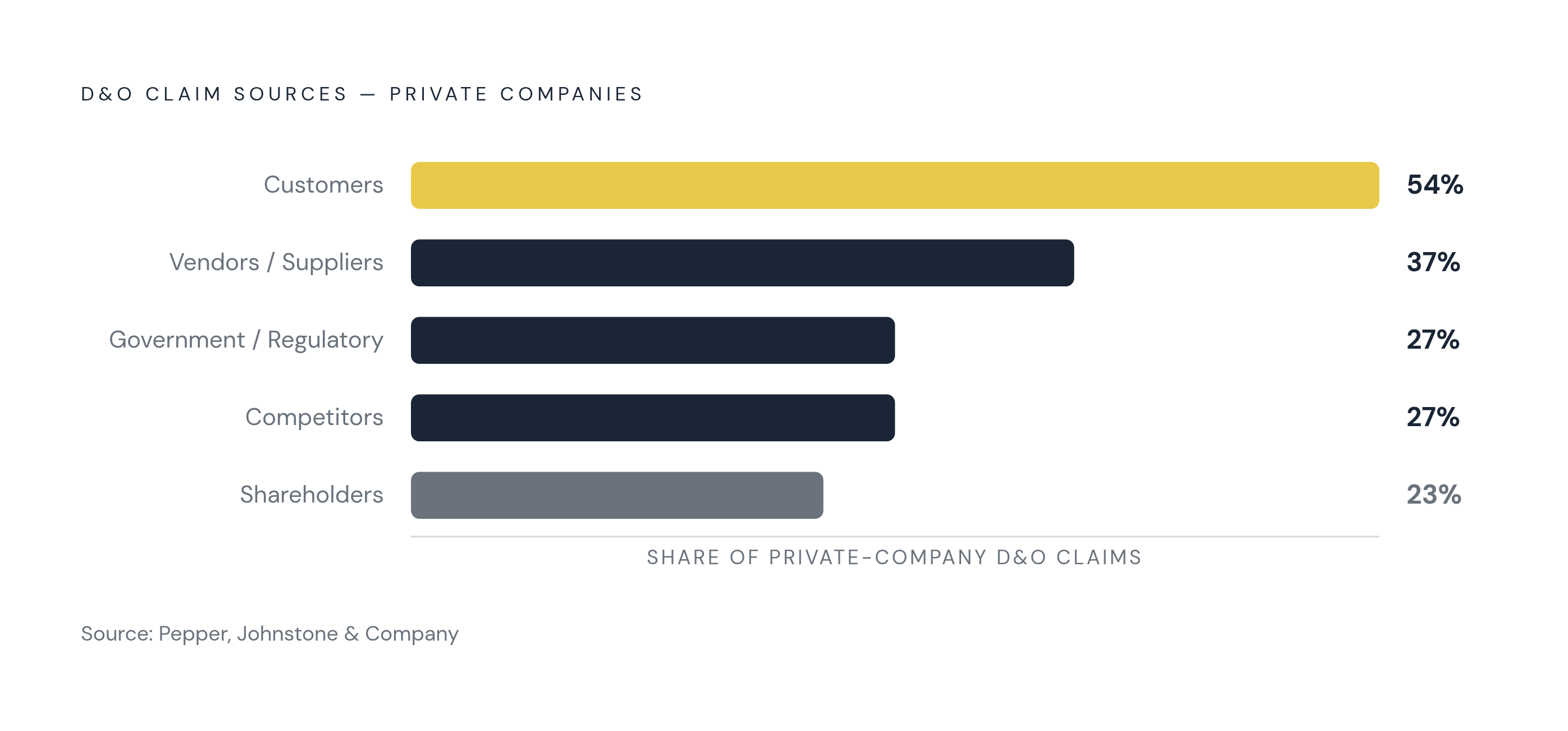
Founders tend to assume D&O exists for shareholder lawsuits. The data says otherwise. More than one in four private companies report a D&O-related loss within a three-year window, and shareholders account for a minority of those claims, roughly 23% according to Pepper, Johnstone & Company. Customers filed 54% of claims in that same survey, vendors and suppliers 37%, government and regulatory bodies 27%, and competitors another 27%. The shareholder lawsuit is the one everyone pictures. It's the smallest piece of the pie.
The claim triggers that actually show up at early-stage companies are more mundane and more frequent. Investor disputes happen: allegations of misleading projections, violations of preference rights, or claims that the board didn't diligence a deal properly before approving it. Employment claims, wrongful termination, discrimination, harassment, are the most common D&O claim at companies under 100 employees, and even a claim that gets dismissed outright can still cost around $50,000 to defend. Vendor and contract disputes catch officers who signed agreements personally, especially when performance falls short. Regulatory inquiries, an SEC informal inquiry, a state AG subpoena, an FTC investigation, pull personal liability straight into what looks like a corporate matter; the SEC barred 124 individuals from serving as officers and directors in fiscal year 2024 alone. And failure-to-supervise claims surface whenever a data breach or a fraud event happens, with plaintiffs arguing after the fact that the board should have caught it.
The broader trend backs up the urgency. Securities class action filings climbed to 222 in 2024, up from 212 the year before. Average settlements dipped to $26 million in the first half of 2024, down from $35 million in 2023, though the longer-run average sits closer to $34 million, more than enough to end most companies that walk into a claim uninsured. Even short of a settlement, a serious investor or securities dispute can rack up millions in defense costs before anyone talks numbers. The policy exists to protect conduct made in good faith. It's there because ordinary business activity at scale, every hire, every board resolution, every representation made to a fundraising investor, creates exposure that someone can second-guess later.
What limits to carry at Series A, and how investors think about the number
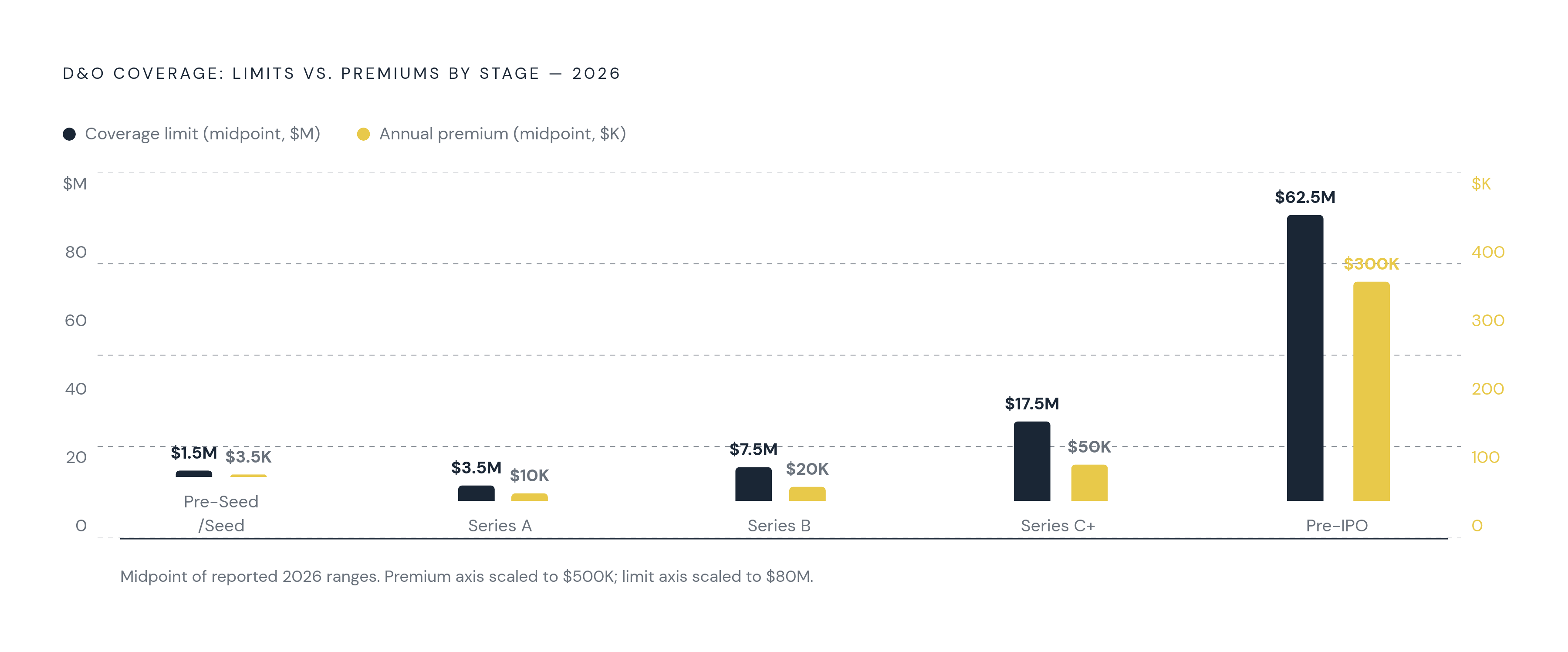
Current term sheet practice puts the Series A requirement at $3 million to $5 million in coverage. Premiums for 2026 track roughly like this: pre-seed and seed companies buy $1 million to $2 million in limits for $2,000 to $5,000 a year, with some carriers running promotional first-year pricing near $2,500 for low-risk SaaS businesses. Series A companies are in the $2 million to $5 million limit range, paying $5,000 to $15,000 annually, though the realistic broker quote for $1 million to $3 million of coverage runs closer to $5,000 to $10,000. Series B pushes limits to $5 million to $10 million with premiums of $10,000 to $30,000. Series C and beyond moves to $10 million to $25 million or more, at $25,000 to $75,000-plus, and pre-IPO companies carry $25 million to $100 million in limits, paying anywhere from $100,000 to $500,000 or more.
The number a specific company should target moves with investor intensity, not just headcount or revenue. Add $1 million to $2 million for factors like board control provisions, ratchets, or side letters, each of which raises the target. A Series A company with 12 months of runway, an independent director, and a control provision granted to the lead investor should be looking at something closer to $5 million, accounting for a base limit plus additional coverage for board composition and investor intensity.
Founders get caught off guard by the gap. If the existing policy carries a $1 million limit and the incoming investor expects $5 million, that gap doesn't get negotiated away at the table. It's a closing condition, and the policy upgrade has to be resolved before the close proceeds. Sector matters too: fintech, health tech, and anything AI-adjacent pays noticeably more than a comparable SaaS company at the same stage, because regulatory exposure changes the underwriting math. On the pricing side, the broader market has actually been getting more favorable: premiums softened through 2024 and into 2025 as capacity that entered the market starting in 2022 kept downward pressure on rates. Clean-history companies are seeing modest decreases at renewal. Companies with a prior claim, a regulatory inquiry, or headcount that grew too fast are seeing renewals stay flat or tick up.
How underwriters read governance quality, and why it affects both price and availability
The 2026 underwriting environment continues to evolve. Carriers are asking more detailed questions before quoting, and that shows up in the information they now require before quoting a policy.
Underwriters want to know who sits on the board and what track record those directors bring. They want related-party transactions documented and conducted at arm's length, not handled on a handshake. They ask whether financial controls exist, whether there's an audit committee, and whether board resolutions and material risks actually get written down instead of decided informally over email. Companies with gaps in any of that face higher premiums, and in some cases outright exclusions, which turns a pricing problem into a coverage problem.
Board composition itself reads as a signal to underwriters. Board composition and how well directors are documented matters to underwriters; an onboarding process that leaves no paper trail raises questions a carrier has to price in. There's a dependency here that catches founders off guard: if the D&O program isn't bound before the board actually takes shape, founders can find themselves unable to recruit the independent directors the next round will expect. The insurance problem turns into a governance problem, and the governance problem turns into a fundraising problem. Founders who clean up their governance documentation before they ever talk to a carrier, not after the term sheet lands, get better terms on both price and available capacity.
Where D&O sits inside the full insurance package investors require at close
D&O rarely closes a Series A alone. Investors typically bundle it with cyber insurance, which has become close to standard as startups accumulate larger user bases and bigger data footprints. Employment practices liability insurance, EPLI, often gets blended into the D&O program itself and covers discrimination, wrongful termination, and harassment claims, the same category that drives the bulk of claims at small companies. Crime insurance protects against fraud, embezzlement, or theft, and investors may ask for it as a company's financial profile grows. Some investors also require business interruption coverage if the company depends heavily on a single vendor or a single facility.
The covenant requiring all of this typically appears in the term sheet's investor protection provisions, not buried somewhere in operational boilerplate. The NVCA updated its model documents on October 2, 2025, to reflect recent legal and market developments, so the covenant language founders run into in 2026 carries those updates. At closing, the company has to represent that it maintains adequate D&O coverage in full force and effect, and inadequate limits or a hidden exclusion buried in the policy can delay or kill the close. Founders who wait until the week before closing to shop for a policy are shopping under time pressure, and it's the structure of the policy, the exclusions, the retention, whether EPLI rides along or stands alone, that decides whether a claim actually gets paid. Price is secondary to that.
What founders can do before the term sheet arrives to make the process faster and cheaper
Carriers underwrite on a specific set of company factors: revenue, headcount, stage, industry, claims history, board composition, and how well governance is documented. Founders who address the legible signals before they ever submit an application get better terms, plain and simple.
A short list of what to fix first: document every board resolution, since undocumented decisions look bad both to an underwriter and to a plaintiff's attorney later. Formalize how related-party transactions get reviewed, even the informal ones, so there's a paper trail. Put financial controls in writing, audit committee formation, signatory limits, expense policy. Go back through fundraising materials, the pitch deck, the projections shared with investors, the private placement documents, and make sure they're consistent with each other, since inconsistency there is a direct claim trigger. And get employment policies documented, because wrongful termination and discrimination claims are still the most common D&O claim at companies under 100 people.
Broker choice matters as much as carrier choice here. The structure of the policy, which exclusions apply, how the retention is set, whether EPLI is blended in or bought separately, decides whether a claim pays out, not just what the premium comes to. A broker who works regularly with venture-backed companies will know which carriers are asking harder questions this year and which ones still have appetite and capacity for a given sector.
Timing decides more than most founders expect. Binding coverage before the board actually forms isn't just tidy practice, it's a prerequisite for recruiting the independent directors a later investor will want to see. Waiting for the term sheet to show up is already too late to get ahead of any of this. And it pays to buy some headroom on the limit: a Series A company that buys exactly the minimum today will hit a gap the moment Series B closing conditions arrive, and starting slightly higher now is cheaper than re-underwriting later under time pressure. Investors who understand this process, and who can walk a portfolio company through it clearly, end up being more useful partners than ones who just pass along a checklist.
Sources
- Why Do Investors Demand D&O Insurance in 2026?
- Directors and Officers (D&O) Insurance for Startups in 2026: Coverage Limits, Premium Benchmarks, and When Investors Require It
- D&O Insurance for Tech Startups | The Coyle Group
- D&O Insurance for Startups: The Stage-by-Stage Risk Guide | Pepper, Johnstone & Company
- How Much D&O Insurance Is Enough? | Limits Guide
- D&O Insurance for Startups: The Stage-by-Stage Risk Guide | Pepper, Johnstone & Company