Employment Practices Liability Insurance for First Hires
Protect your first hire from employment claims that cost $75,000 to defend even when you win.

Bringing on a first employee triggers employment practices liability exposure well before any paycheck gets cut. The risk starts at the interview, and most new employers don't realize it exists until a claim lands on their desk. EPLI isn't optional risk management for a business with one or two people on payroll, it's closer to a cost of doing business, and skipping it is a bet against odds that don't favor the employer.
What EPLI actually is and what it pays for when a claim arrives
Employment Practices Liability Insurance covers a business against financial loss tied to claims of workplace misconduct: wrongful termination, discrimination, harassment, retaliation, wage and hour disputes, breach of an employment contract. The part that matters most when a claim actually shows up is the duty to defend. EPLI pays attorney fees, court costs, and investigation expenses before anyone determines fault. A frivolous claim that gets thrown out six months in still runs up legal bills, and without coverage, the business pays every dollar out of pocket.
Some covered claims sound obscure until they land. Negligent evaluation, where an employee argues a bad performance review unfairly damaged their career, is one. Failure to hire or promote is another: a rejected applicant or a passed-over employee alleges the selection process was biased. EPLI also covers other workplace-related disputes that fall outside standard general liability coverage.
Coverage extends past the people on payroll. Full-time, part-time, seasonal, and temporary staff are covered, along with recognized volunteers, independent contractors, and even applicants who never got the job. That last category matters for any first-hire employer building a team through gig platforms or short-term contracts. Carriers also sell an optional add-on for third-party claims, covering discrimination or harassment allegations from customers or vendors rather than employees.
Three exclusions are worth knowing from day one: intentional acts, on-the-job physical injuries (that's workers' comp territory), and criminal acts. EPLI sits alongside those other policies, not in place of them.
Most first-time buyers skip past the one structural detail that actually decides how a policy performs at claim time: EPLI is almost always written on a claims-made basis, meaning coverage triggers based on when the claim gets filed, not when the underlying conduct happened. A lapse in coverage can create exposure for incidents that occurred before the new policy took effect, and a first-hire employer comparing quotes needs to understand this before signing anything. Just as important, some carriers pay defense costs on top of the coverage limit, so a $1 million policy stays at $1 million even after a $300,000 legal defense. Others let defense spend eat into that same limit, which means the number on the declarations page isn't really the number that matters. Buyers who pick the cheaper policy without asking this question are choosing it for the wrong reason.
The claims environment that first-hire employers are walking into right now
The EEOC logged 88,531 new discrimination charges in fiscal year 2024, a 9% jump from the year before, and recovered close to $700 million for victims. The pace held into 2025: 88,201 new charges, $660 million secured for 17,680 people. These aren't edge cases. They're the baseline a first-hire employer is stepping into, whether or not they've priced that in.
Retaliation, the single largest category and making up roughly 48% of all EEOC charges in fiscal 2024, is the category most likely to catch an unprepared employer off guard. Disciplining an employee two weeks after they file a complaint, even for a completely unrelated reason, is enough to invite a retaliation charge. The employer doesn't need to have acted in bad faith. Timing alone does the damage.
Small businesses carry more than their share of this exposure. They're more than twice as likely as larger companies to face an employment-related lawsuit, and roughly one in five companies deals with an employment claim in any given year. That gap traces directly back to what a first-hire employer lacks: no dedicated HR person, no documented procedures, no in-house counsel to catch a problem before it turns into a charge.
Three forces are reshaping this landscape heading into 2026, according to Vouch. Pay transparency laws now cover 16 states plus a major jurisdiction, and non-compliance can trigger both administrative penalties and private claims that may fall under an EPLI policy depending on its language. Remote and hybrid arrangements are surfacing new dispute patterns around inconsistent treatment, return-to-office mandates, and accommodation requests. And AI-driven hiring tools are generating a growing category of bias claims that EPLI policies are still catching up to, which gets its own section below because it deserves one.
One more risk belongs on this list: the Pregnant Workers Fairness Act, in force since June 27, 2023. The EEOC brought seven PWFA lawsuits in 2025, with settlements reaching $100,000 per case. EPLI policies now cover PWFA claims, which makes this one of the clearer reasons to have a policy in place before the first hire, not after the first complaint.
What a claim actually costs a small employer without coverage
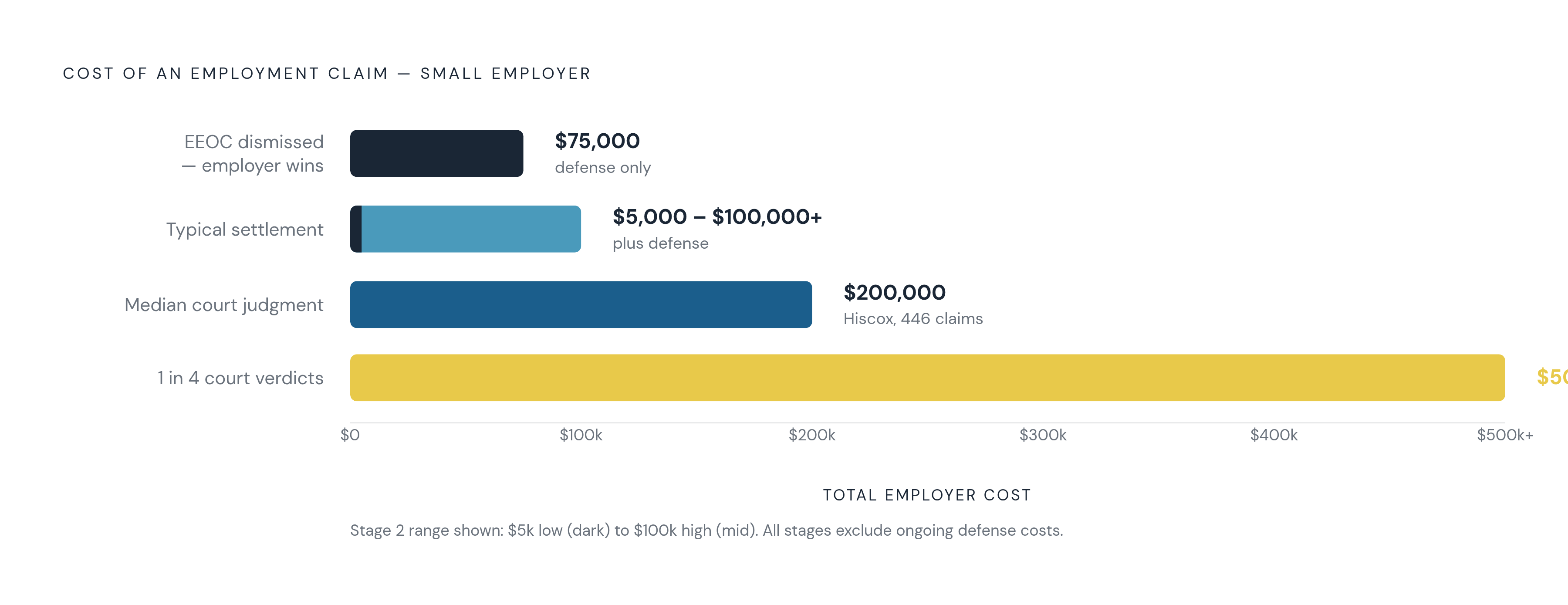
Even a claim that gets dismissed costs money. The average defense in an EEOC claim runs around $75,000. Winning doesn't mean walking away clean. It means paying the legal bill anyway, in full, with no EPLI to absorb any of it.
Settlements vary widely, from $5,000 to more than $100,000, depending on the allegations, the jurisdiction, and the specific facts. That spread says something on its own: outcomes are hard to predict, which is exactly the kind of risk insurance exists to smooth over. When a case goes to trial, the numbers get worse. A Hiscox study of 446 claims, cited by ADP, found a median judgment around $200,000, not including defense costs, and about a quarter of court cases ended in a judgment of $500,000 or more.
Munich Re and HSB put employment practices claims for small businesses at $27,000 to $54,000 per case on average, with legal defense alone averaging $10,000. Against the revenue of a business with one or two employees, those numbers aren't background noise. They're existential.
A one-employee operation faces the same plaintiff's attorneys and the same court system as a 500-person company. The claim doesn't shrink because the employer is small, and the attorney on the other side isn't discounting the case because the defendant runs the business out of a spare bedroom. A single mid-range settlement can absorb months, sometimes years, of operating margin for a micro-business. This is not a catastrophic edge case built to scare a buyer into coverage. It's the statistically ordinary outcome that first-hire employers simply aren't budgeting for.
What EPLI costs for a business with its first few employees
Premiums for businesses with fewer than 10 employees often land around $1,200 a year. A startup with 10 employees typically pays somewhere between $500 and $3,000 annually, with most falling in the $1,000 to $2,000 range. Zoom out to small businesses generally and the range runs $1,000 to $3,000 a year, with a national median near $2,665, or about $222 a month. Insureon's customer data puts the average at $257 a month across all small businesses, with 38% paying under $200 monthly and 33% paying between $200 and $400.
A useful back-of-envelope number for a first-hire employer: roughly $50 to $150 per employee per year. Policy limits generally run from $100,000 up to $1 million, and a standard $1 million policy for a business with five to twenty employees runs $1,500 to over $2,500 a year on average.
Location moves the number too. California and New York carry the highest premiums, with California businesses paying 25% to 40% above the national average. Texas and Florida employers see more moderate rates by comparison.
Timing is worth considering. Market conditions for EPLI have been relatively stable for small employers, which makes this a reasonable window for a first-time buyer to lock in a policy.
Two levers bring the cost down further, and neither requires waiting until the business can afford a full HR department. Basic risk management, an employee handbook, documented complaint procedures, anti-harassment training, can lower premiums by 10% to 25%. Working through an independent broker with access to wholesale carriers can run 20% to 30% below buying direct. On the deductible side, Insureon's data shows an average of $10,000; choosing a higher deductible is a straightforward way to cut the premium when cash is tight at the first-hire stage.
How EPLI is packaged and what to look for when buying it for the first time
EPLI comes packaged two main ways. A BOP endorsement adds it onto an existing Business Owners Policy: cheaper and easier to get, but narrower in scope. A standalone policy costs more but covers more ground, and it makes more sense once headcount grows past a handful of people. A first-hire employer buying purely on price usually ends up with the endorsement. That's fine for year one, but it's worth revisiting by the second or third hire, not the tenth.
Beyond the premium, a handful of details actually decide what a policy is worth. Whether defense costs sit inside or outside the coverage limit determines how much money is left for a settlement after a long legal fight. The claims-made structure, and what happens to prior-acts coverage if a policy lapses, can leave gaps nobody notices until a claim shows up. Wage and hour claims are excluded from many standard policies, though some carriers offer limited coverage by endorsement. Third-party EPLI, covering claims from customers or vendors rather than employees, is worth asking about depending on how customer-facing the business is.
Some carriers bundle in resources that matter a lot to an employer with zero HR infrastructure. Nationwide's EPLI includes a Workplace Risk Solutions website with sample forms, self-audit checklists, and training modules, plus a legal hotline staffed through Jackson Lewis LLP for guidance before a termination decision gets made. Travelers' EPL+ includes an online loss prevention program, Risk Management Plus+ Online, with manager training and model workplace policies, along with an EPL+ helpline staffed by Jackson Lewis LLP employment attorneys. Munich Re and HSB's EPL Plus gives policyholders access to EmployerProtection.net, with a sample employee handbook, forms, and training guidelines, plus critical incident response coverage for counseling, communications, and security if a workplace situation turns volatile.
EPLI can also sit inside a broader management liability package alongside Directors and Officers coverage and Fiduciary Liability, which matters for a first-hire employer that expects to scale fast.
Some first-hire employers assume EPLI comes bundled through a PEO or payroll platform. That assumption is wrong more often than not. Coverage through those arrangements varies a lot, tends to run narrow, and in some cases isn't there at all. Vouch's guidance on this is direct: confirm exactly what's covered before treating it as a substitute for a standalone policy.
Why AI-driven hiring tools are creating a new category of exposure first-hire employers may not anticipate
If an automated screening tool or an AI-driven performance evaluation produces biased outcomes, whether the bias was intentional or not, a rejected applicant or disadvantaged employee can file a discrimination claim. The tool doesn't need to have been built with any bad intent for the outcome to create legal exposure. That distinction matters, because a lot of first-hire employers assume liability requires intent, and it doesn't.
The EEOC launched an Initiative on Artificial Intelligence and Algorithmic Fairness in 2021 specifically to make sure AI used in employment decisions complies with federal civil rights law, and state-level enforcement activity in this area has continued to develop since. EPLI carriers are starting to write AI-driven bias claims directly into policy language, but that coverage isn't consistent across the market yet. Treating it as a given is the mistake most first-hire employers will make exactly once.
Industry observers note that EPLI policies haven't fully caught up to this risk, even as insurers pay closer attention to it. Any first-hire employer using hiring software or automated screening should ask, in plain terms, whether the policy actually reflects that exposure or quietly excludes it.
Pay transparency adds another layer. With 16 states and a major jurisdiction. requiring salary range disclosure as of 2026, algorithmic compensation tools that generate those ranges can create compliance exposure if the outputs get challenged as discriminatory or inconsistent.
The liability doesn't transfer to the software vendor. Using an off-the-shelf hiring tool doesn't change who the named defendant is in an EEOC charge or a civil lawsuit, and that responsibility sits with the employer no matter which platform ran the screening. Before signing on with any insurer, ask directly: does the policy cover claims arising from automated or algorithmic employment decisions, and are there exclusions or sublimits buried in the fine print that apply to them?
The risk management steps that reduce both claim likelihood and premium cost at the first-hire stage
Underwriters in 2025 are looking harder at company culture and HR policy when they price EPLI for small employers, according to Pepper, Johnstone & Company. A clean submission earns better terms, and that distinction matters most at the first-hire stage, when every dollar of premium counts against a thin budget.
Underwriters want to see four things in particular: a current employee handbook with signed acknowledgment from the employee, documented complaint procedures that give employees a clear internal path before they escalate to the EEOC, evidence of anti-harassment training for managers and staff, and a clean claims history, or at minimum, clear remediation steps if something has already gone wrong.
Putting these in place can cut premiums by 10% to 25%. That makes basic HR infrastructure a direct financial return, not just a box to check for compliance, and any first-hire employer treating it as the latter is leaving money on the table.
Retaliation deserves specific attention here, given that it accounts for roughly 48% of EEOC charges. The single most effective behavioral fix available to a first-hire employer costs nothing and takes discipline, not money: document every disciplinary action, consistently and in writing, regardless of whether that employee has ever raised a complaint. That habit alone closes off the most common path a routine personnel decision takes toward becoming a claim.