D&O Insurance Gaps During a Startup Acquisition
Founders often miss coverage gaps that hit them personally years after a sale closes.

A D&O policy pays out based on when a claim gets filed, not when the underlying conduct happened. That distinction sits quietly in the background during normal operations, but an acquisition breaks it wide open. The break creates predictable, well-documented coverage gaps that hit former directors and officers personally, sometimes years after they've left the board. Founders and boards who treat D&O as a closing-day checkbox, rather than a deal-table issue negotiated alongside price and indemnification caps, are the ones who end up paying defense costs out of pocket.
The three policy sides, and which one carries the most personal risk at a deal close
Every D&O policy is built from three components, and they stop carrying equal weight the moment a deal closes.
Side A pays defense and settlement costs directly to individual directors and officers when the company can't or won't indemnify them. It's the last line of protection for personal assets, mattering most once the company itself is gone. Side B reimburses the company after it indemnifies its own directors and officers, which makes it the layer used most in day-to-day operations, since most claims against a healthy, functioning company get indemnified without incident. Side C covers the entity itself, usually for securities claims, and for private companies the entity-level coverage is generally more limited in scope than for public companies.
Here's what changes at acquisition: the corporate entity that Side B and Side C depend on often gets absorbed into the buyer or dissolved outright. Once that happens, Side B and Side C go quiet for the target's former leadership. There's no company left to indemnify anyone, and no company left to reimburse.
Side A Difference-in-Conditions coverage, known as Side A DIC, exists for exactly this moment. It protects individuals when corporate indemnification isn't available, and it drops down when the underlying program fails to respond because of exhaustion, rescission, or some other coverage gap. Most early-stage startups skip it as a standalone policy and rely on the bundled program instead, which is the wrong call: a standalone policy keeps individual protection separate from the limits shared across the rest of the program.
Series A term sheets typically call for $3 million to $5 million in D&O coverage within 60 to 90 days of closing. That number sounds reassuring, but it describes the bundle as a whole, not Side A personal protection specifically. A well-funded bundle can still leave individuals thinly covered, and most founders never ask the follow-up question that would reveal it.
How tail coverage is supposed to work, and the timing failures that undermine it
A tail policy extends the window in which claims can be reported for acts that happened before closing. It does not, under any circumstance, extend coverage for anything that happens after the policy ends. That single distinction, which trips up a surprising number of deal teams, is the assumption most likely to cost someone money later.
When a company gets acquired, the buyer usually swaps the target's D&O policy for its own. Without a negotiated tail, former directors and officers lose coverage for decisions they made before the acquisition, even though those are exactly the decisions that tend to surface in litigation two or three years out.
Tail elections have to happen before or at closing in most cases. Insurers set firm notice deadlines, and missing one is grounds to deny the election altogether, no exceptions. Confusion about when to elect, how long the reporting period runs, and who's actually responsible for buying the policy ranks among the most common errors made at the deal table.
The Coyle Group has documented a case that lays the failure out cleanly. A seller's directors assumed the buyer's new D&O policy would cover them going forward. It didn't. The buyer's policy excluded pre-acquisition acts entirely, and the former directors had already canceled their original policy at closing without buying a tail. Legal defense costs topped $400,000, paid out of the directors' own pockets, for conduct that predated the sale.
Who funds the tail is a negotiating point, and rarely a friendly one. Sellers want the buyer to pay for it, buyers resist, and the compromise that emerges is sometimes a tail that's underpriced and underspecified, covering less than anyone in the room realized at signing. Tail period length matters just as much as who pays for it: a two-year tail is shorter than the six-year survival periods standard for fundamental representations in a purchase agreement. Anyone negotiating a two-year tail because it's cheaper is negotiating against the actual timeline of when these claims surface.
The straddle claim problem, the gap that persists even when a tail policy exists
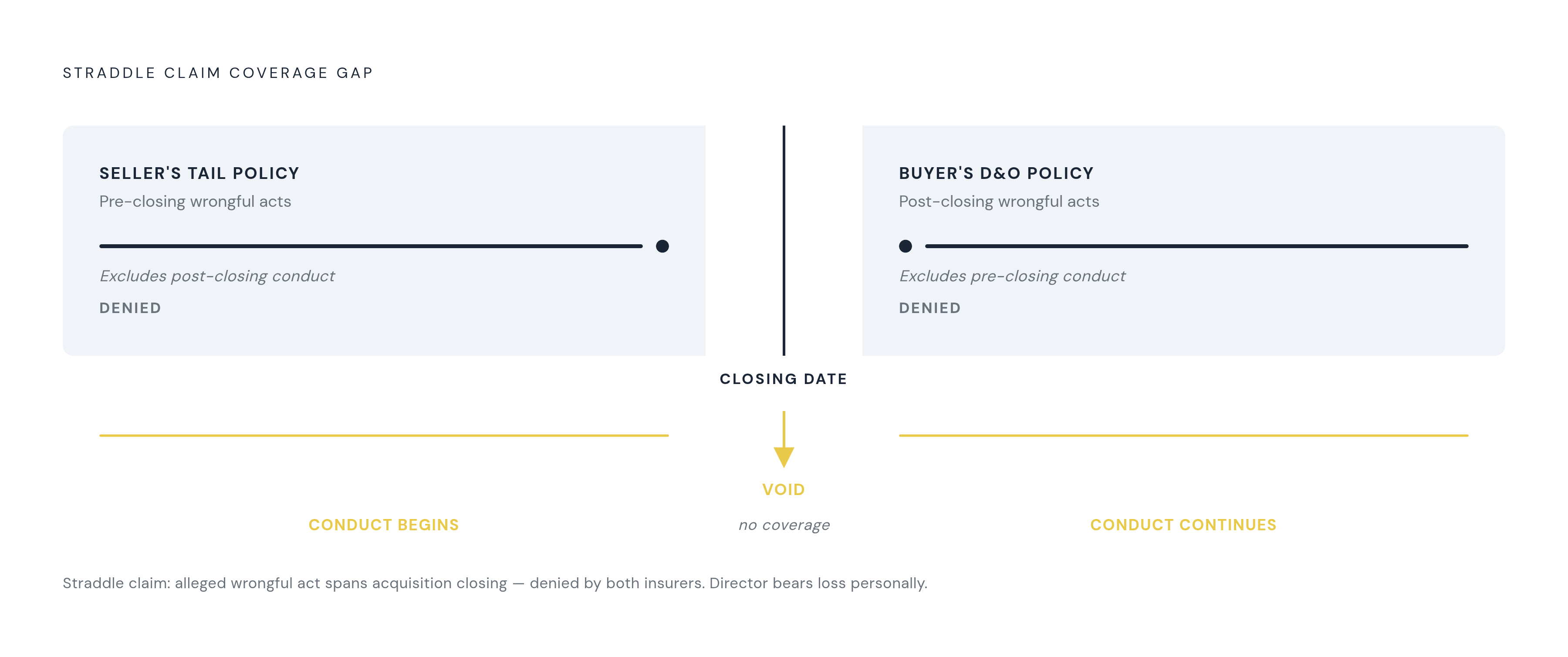
Straddle claims allege misconduct that started before closing and kept going afterward, and they are among the most frequently litigated coverage gaps in post-acquisition D&O disputes. Buying a tail doesn't make this problem disappear. It just moves the fight somewhere else.
Tail policies are written to respond only to claims alleging pre-closing wrongful acts. A single post-closing act, alleged in the same complaint, can trigger an exclusion that knocks out the entire claim, not just the post-closing portion. Some tail exclusions are written broadly enough to eliminate coverage entirely, even for conduct tied exclusively to pre-closing decisions, the moment any post-closing act shows up anywhere in the complaint.
Meanwhile, the buyer's own going-forward D&O policy usually carries a mirror-image exclusion: no coverage for any claim involving pre-closing wrongful acts. Put those two exclusions side by side and the claim lands in the space between them, denied by both insurers, each one pointing at the other, with the individual director stuck in the middle. This has played out in real disputes, not just as a hypothetical drawn up to scare deal teams. It's the coverage no-man's-land that opens up whenever a plaintiff's lawyer alleges conduct spanning the closing date, which happens often, because it's an efficient way to defeat coverage on both sides at once.
The American Bar Association's Business Law Today, in a piece published December 2025, recommends that buyers and sellers map the pre-closing and post-closing insurance regimes before a transaction closes, specifically to find where straddle claims would fall through. That mapping, done at the term sheet stage rather than after a demand letter arrives, is the only fix that actually works. Waiting until a claim shows up means negotiating with a plaintiff already in the room, and by then the language is fixed.
The right move is to negotiate straddle exclusions out of the tail policy, or narrow them sharply, while the deal is still being papered. Doing this after a claim arrives amounts to something else entirely. It's litigating, and litigating from the weaker seat.
Assumptions compound the risk further. Some executives assume a bankruptcy filing automatically triggers change-in-control runoff. Others assume the opposite, that emergence from bankruptcy leaves the original policy untouched. Neither assumption holds reliably, and betting on either one without reading the actual form is a mistake. Only the policy language controls what happens, and that language varies by carrier and by form.
The pre-acquisition funding-round gap that arrives before any deal is on the table
The gap problem doesn't start with the acquisition. It starts earlier, at the last funding round, and most founders never notice it until it's too late to fix.
Most startups update D&O coverage at annual renewal, which can land six to twelve months after a funding round actually closes. Governance liability shifts the day the wire clears and new board seats fill, not the day the insurance policy catches up. Every board decision made in that gap, every governance dispute, sits in a window where coverage hasn't been adjusted to reflect who's actually on the board or what the company looks like now.
Claims-made retroactive dates make the problem worse. Let coverage lapse and buy a new policy, and the retroactive date resets, potentially leaving earlier decisions uncovered even though the company never went a day without some policy in force.
A startup that walks into acquisition talks with a stale policy, one still reflecting an older cap table, lower limits, or a board from two rounds back, is negotiating from a weaker position before the term sheet is even drafted. Institutional investors push for higher limits and broader terms as a condition of taking a board seat. If the existing policy carries a $1 million limit while the incoming investor expects $5 million, that mismatch is a serious problem in its own right. It's a closing condition, full stop.
The cost of staying current is low compared to what a gap can cost later. Premium benchmarks for 2026 put pre-seed and seed companies at roughly $3,500 to $6,000 a year for $1 million of coverage, while Series A companies pay $5,000 to $10,000 a year for $1 million to $3 million. Measured against a six-figure personal defense bill like the one in the Coyle Group case, the trade isn't close.
What D&O does not cover, and where representations and warranties insurance fills the void
D&O policies standardly exclude breach of contract claims, and that exclusion matters enormously in M&A, because many post-deal disputes center on exactly that: arguments over representations made in the purchase agreement. A founder who assumes the tail policy will handle an indemnification dispute is, in most cases, simply wrong, and finding that out after a demand letter arrives is the expensive way to learn it.
Other standard exclusions round out the picture: antitrust violations, prior-knowledge claims, regulatory fines and penalties, wage-and-hour claims unless paired with employment practices liability coverage, and claims brought by one officer against another inside the same company.
Representations and warranties insurance, known as R&W, is built to cover what D&O leaves out. It protects buyers and sellers from losses tied to breaches of representations made in the purchase agreement, and it's become a standard feature of mid-market M&A. Coverage limits and policy terms vary by deal, but R&W policies are structured to cover the window that D&O tails often leave exposed.
R&W has gotten more accessible for mid-market deals, with carriers offering broader terms and more flexible structures in 2025 than in prior years. D&O and R&W are not interchangeable, and treating them as such is the kind of mistake that only surfaces after a claim is filed and neither policy responds.
Smaller deals have historically had more limited access to R&W coverage, though that is shifting as the market expands. That's shifting as the market expands into smaller deal sizes, and it's worth pricing out even for founders selling companies at the smaller end of the range, rather than assuming it's out of reach.
The five decisions founders and boards need to make before a deal closes
Five decisions, made before signatures go on the purchase agreement, determine whether this whole set of gaps stays theoretical or turns into a personal liability for someone on the board.
First, audit the current policy before the LOI is even signed. Confirm the retroactive date, check whether the change-in-control provision triggers automatic runoff, and find out whether individual directors carry adequate protection if the bundled program is exhausted or fails to respond.
Second, negotiate tail coverage directly into the deal documents, not as an afterthought bolted on at signing. Specify who purchases it, who pays for it, the minimum tail period, and language that eliminates or narrows straddle exclusions. Fixing any of this after closing is not an option, no matter how the conversation goes.
Third, map the straddle claim exposure specifically. Identify any ongoing disputes, regulatory inquiries, or employee claims that touch the closing date, and confirm in writing which policy, tail or successor, is supposed to respond to each one.
Fourth, decide whether standalone Side A DIC coverage makes sense for this deal. It matters most when corporate indemnification may not be available to former officers after the deal closes.
Fifth, check whether R&W insurance covers the contract-breach gap that D&O won't touch, and coordinate the R&W policy with the D&O tail so neither program quietly assumes the other is handling indemnification claims tied to the purchase agreement.
Notice deadlines sit underneath all five decisions, and none of them are negotiable. Miss the insurer's notification window for a change-in-control event or a tail election, and the ability to secure that coverage can be lost, with insurers treating late notice as grounds to deny the election.
None of this works if the D&O broker, the M&A counsel, and the deal team are having separate conversations about it. The gaps described here rarely come from bad policy language. They come from insurance getting treated as a back-office closing condition instead of what it actually is: a deal-table issue, decided by people who understand both the transaction and the coverage, in the same room, before the ink dries.
Sources
- Directors and Officers (D&O) Insurance for Startups in 2026: Coverage Limits, Premium Benchmarks, and When Investors Require It
- americanbar.org
- businesslawtoday.org
- What Is a D&O Tail Policy And When Do You Actually Need One?
- Coverage Cutoffs in M&A Transactions: Five Things to Know About D&O Insurance “Tail” Coverage