Personal Liability Exposure of Startup Founders
Incorporation alone won't shield your personal assets from liability.

Incorporating does not make a founder's personal assets untouchable. The corporate veil is a conditional shield, not a guarantee, and the decisions that determine whether it holds start on day one, long before a company has revenue, customers, or a lawsuit to worry about.
Most founders assume that filing articles of incorporation draws a clean line between the business and their own bank account. That assumption is wrong often enough that courts have a whole doctrine built around correcting it. What actually determines exposure is a sequence of choices: entity type, how expenses get handled, whether agreements exist before disputes do, and whether insurance is in place before it's needed under pressure. Delay narrows the options and raises the price of fixing any of it later.
How courts decide to pierce the corporate veil
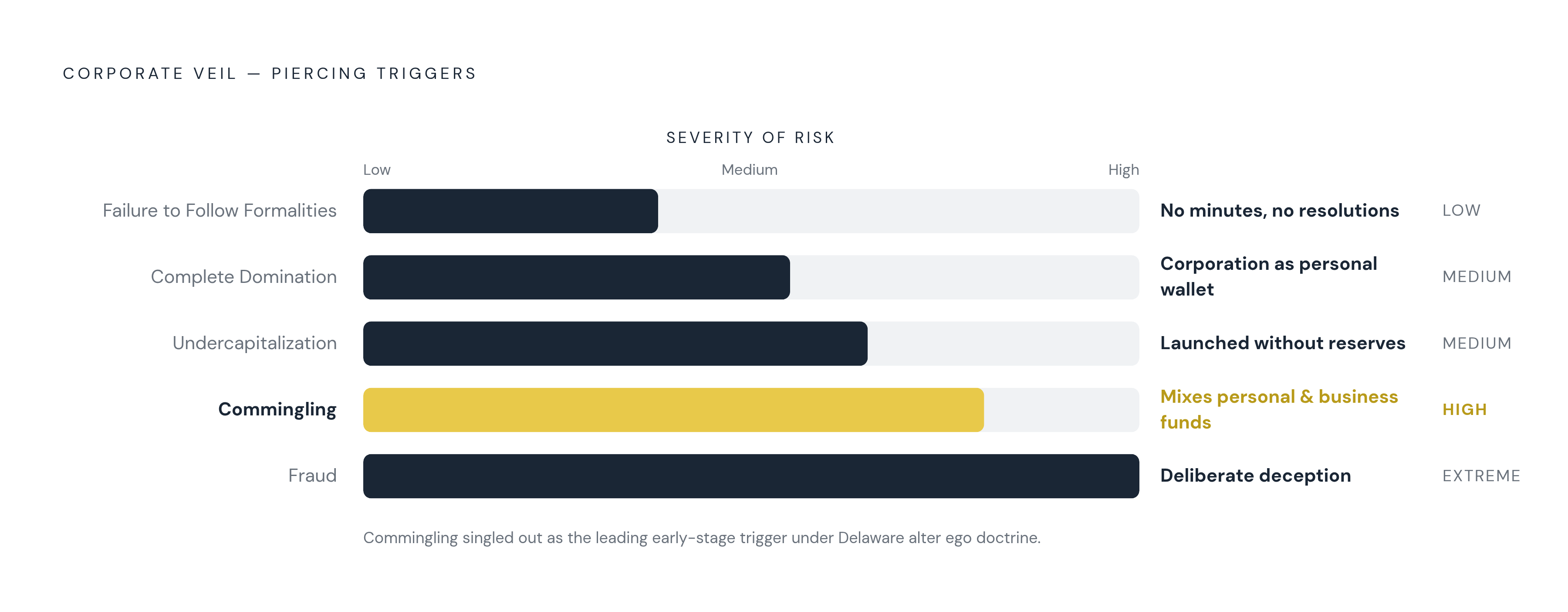
Limited liability is a privilege the law grants to entities that behave like separate legal persons. It is not an absolute right, and courts take it away when the entity form gets abused instead of used. The legal test for "piercing the corporate veil" differs slightly by state, but the underlying triggers repeat across jurisdictions with remarkable consistency.
Courts look for complete domination, meaning the founder has treated the corporation less like a company and more like a personal wallet with a nicer name on it. They look for commingling: personal and business funds mixed together without a clear line between them. They look for undercapitalization, where a founder launches an entity without enough money behind it to cover the liabilities anyone could have foreseen. They look for a failure to follow corporate formalities, meaning no board meetings, no written resolutions, no minutes. And they look for outright fraud, where the entity exists mainly to dodge an obligation or mislead someone who relied on it.
One habit trips up early-stage founders more than any other: covering a startup's expenses out of pocket, or dropping personal funds into the company account whenever cash gets tight. It feels harmless, even generous. But to a court, it looks exactly like commingling, and commingling is one of the clearest paths to alter ego liability, including under Delaware law, where many venture-backed companies incorporate. The board meetings and separate bank accounts that feel like paperwork for paperwork's sake are, in a dispute, the actual proof that the entity was real. Without that proof, the veil is just a filing fee.
Nor is the risk confined to one type of adversary. Creditors can bring a piercing claim. So can an injured customer, an unpaid employee, or an investor who feels misled. The exposure runs in every direction the company touches.
Fiduciary duties founders owe, and the claims that follow when they breach them
Separate from the veil question, founders who serve as officers or directors owe the company fiduciary duties: care and loyalty. These duties exist whether or not the veil ever comes up, and breaching them creates liability that piercing doctrine doesn't even need to reach.
Duty of loyalty is where most of the real trouble lives, because it bars a founder from putting personal interests ahead of the company's. Self-dealing and related-party transactions draw investor scrutiny fast. Diluting early investors without a defensible reason invites a claim. Withholding material information from the board, or from investors during a raise, is another common trigger, and so is quietly moving company funds toward personal use. Even something as unglamorous as stonewalling due diligence, refusing to hand over accurate financials during a fundraise, can expose the company to liability and kill the deal outright.
The people who can bring these claims are not limited to employees or customers. Investors holding preferred shares or board seats have direct standing, and they use it. Co-founder disputes add another layer: a founder pushed out in violation of a governing agreement can bring a wrongful removal claim, and minority owners have their own path to argue unfair treatment.
At the far end sits criminal exposure. When representations to investors cross from optimistic into materially false, civil liability is no longer the ceiling. The prosecution of Elizabeth Holmes following the collapse of Theranos illustrates how investor communications and product capability claims can turn into criminal charges rather than a settlement. Founder disputes tend to run hot on both money and control, which is exactly why the governance agreements signed at formation, not after a falling-out, are the first and often only real defense.
How AI startups inherit a distinct and compounding liability profile
AI companies carry liability categories that a standard SaaS business simply does not have to think about. The model itself becomes a source of third-party harm in ways traditional software rarely is.
Hallucinations are the clearest example: if a tool generates a false legal citation and someone relies on it to their detriment, the startup can be on the hook for the consequence. Algorithmic bias is another, showing up as discriminatory outputs in hiring tools, lending models, or healthcare AI, and triggering regulatory and legal exposure that older tech liability frameworks were never built to catch. Training data adds a third layer: a model built on ingested datasets carries IP infringement risk, copyright exposure, and privacy violations baked into it, and the company needs to be able to account for where its training data came from and whether it was clean to use.
Layer onto that the practical dependency most AI startups have on third-party platforms, building on top of OpenAI's or Anthropic's APIs, for instance, which introduces downtime and output risk the founder cannot fully control even with the best engineering team in the building.
D&O exposure compounds right alongside it. A founder who fails to supervise algorithmic risk, or who overstates what a model can actually do in front of investors, is exposed to a D&O claim, and without coverage in place, that exposure lands on the founder and board members personally, not just the company. Making it harder still, the regulatory landscape for AI is genuinely unsettled: founders are operating ahead of case law, which means there's no deep well of precedent to tell them exactly where the line sits.
The practical gap shows up at the insurance desk. Standard tech E&O policies were designed around traditional software, and coverage for claims arising from autonomous model outputs rather than conventional code is far from guaranteed. Founders need to check, explicitly, whether their policy covers hallucinations, agentic actions, and training data disputes. Assuming legacy coverage transfers is how a company finds out, mid-claim, that it doesn't.
The entity structures that give founders the most protection, and what each one requires to maintain it
A sole proprietorship offers no separation at all. The owner is personally liable for every debt and every claim the business generates, and it's worth naming mainly as the baseline for what zero protection looks like. A partnership spreads liability across partners, and without a formal partnership agreement, any one partner can bind the others to obligations they never agreed to.
An LLC protects members from personal liability for the business's debts and lawsuits, offers flexible management, and lets founders choose pass-through or corporate tax treatment. What it demands in return is real: Articles of Organization filed with the state, annual compliance filings, and the operating discipline to actually keep the business and the owner's finances apart.
A C-Corp provides liability protection too, but requires a board of directors, officers, and formal bylaws to function as intended. It's the structure venture investors prefer, because it allows preferred stock issuance and makes capital raising far more straightforward, and it has perpetual existence regardless of who owns it later. The requirements scale with the protection: Articles of Incorporation, bylaws, board meetings, written resolutions, and documentation of every major decision.
The choice isn't neutral, and it isn't permanent in its consequences even if the paperwork is. Whatever structure gets picked determines exactly what formalities a founder has to keep up, and exactly what a court will go looking for if the veil is ever challenged. Talking to an attorney before formation isn't overhead, it's how a founder avoids landing in a structure that fits neither the investor base they're courting nor the state they're incorporated in. And regardless of which entity gets chosen, the operational discipline is the same everywhere: separate bank accounts, documented decisions, board resolutions for anything significant, and no personal use of business funds, ever.
What contracts and shareholder agreements actually protect founders from
Strong contracts do one job well: they set expectations clearly enough that a disagreement has less room to turn into litigation. That means clear definitions, a real scope of work, actual payment terms, and a dispute resolution process spelled out in advance. A generic template pulled off the internet carries generic gaps, and those gaps are exactly where disputes grow.
Shareholder agreements carry the highest stakes of all. They define ownership, voting rights, and who actually has authority to make which decisions, from the very start rather than after a disagreement forces the question. They set out how disputes between founders and investors get resolved, and they include buyout, dilution, and exit provisions so that a departing co-founder's stake doesn't turn into a governance crisis for everyone left standing. Without one, the default rules under state statute apply, and those defaults were never written with any particular founder's intent in mind.
Much of the fiduciary duty litigation described earlier traces back to exactly this gap: no written agreement ever spelled out what a founder could and couldn't do with the authority they held. Employment agreements and IP assignment clauses carry the same risk in a quieter form. A founder who never gets employees or contractors to formally assign their work product to the company is sitting on an ownership ambiguity that tends to surface at the worst possible time, usually during due diligence or right in the middle of a dispute.
The earlier these documents exist, the cheaper and cleaner they are to negotiate. Once a dispute is already live, every party's leverage changes, and not in the founder's favor.
The insurance policies that cap personal exposure when structure and contracts are not enough
Insurance doesn't prevent a claim from happening. It limits what a founder personally has to absorb once the claim arrives, which makes it the backstop, not the strategy.
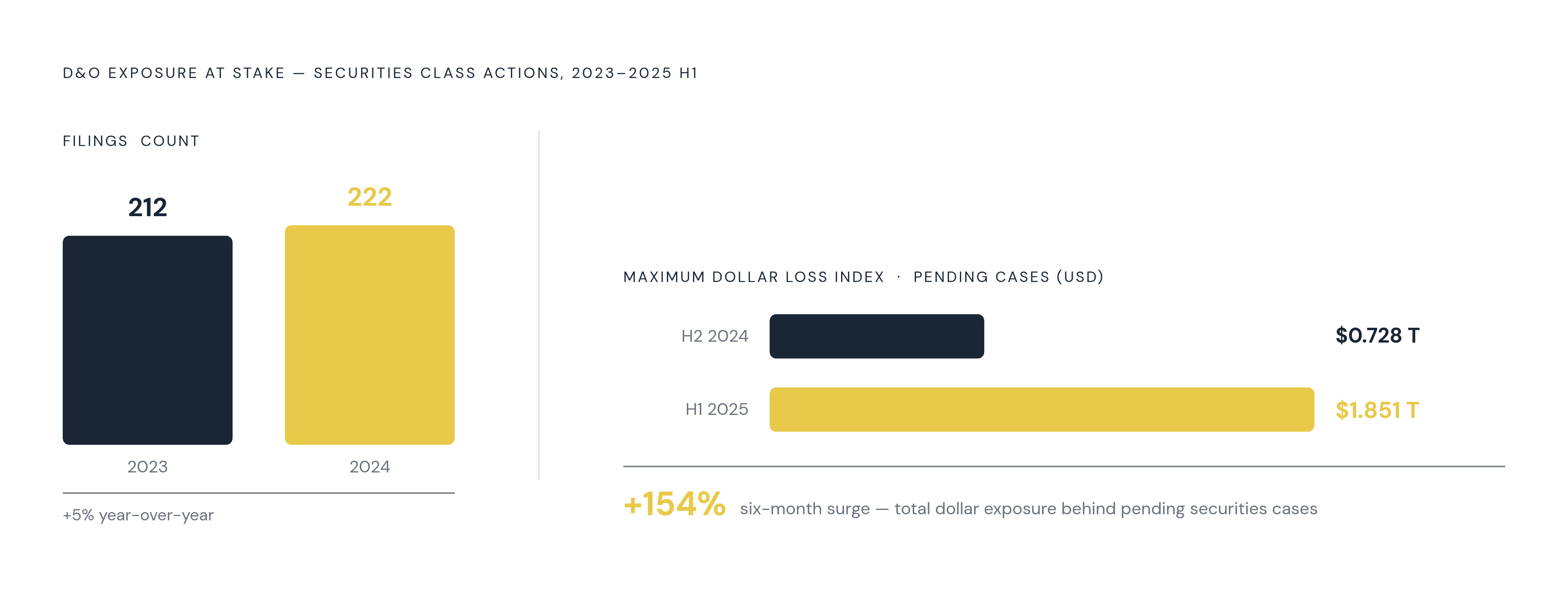
D&O insurance is the investor-required baseline. It covers claims of mismanagement, breach of fiduciary duty, misleading investors, and regulatory noncompliance, and it protects founders, executives, and board members personally, not just the company as an entity. Most investors won't take a board seat without it in place, and for good reason: securities class action filings climbed to 222 in 2024, up from 212 in 2023, and in the first half of 2025 the Maximum Dollar Loss Index, a measure of the total dollar exposure behind pending securities cases, hit $1.851 trillion, a jump of 154% over the prior six months. Defense costs alone can run into the millions before a case ever reaches settlement, and top defense counsel rates have climbed sharply in recent years.
EPLI, Employment Practices Liability Insurance, covers claims tied to discrimination, harassment, retaliation, and wrongful termination, and it pays legal defense costs even when the underlying claim turns out to be baseless, which a meaningful share of them are. This exposure grows with headcount and matters from the very first hire, not once the company hits some later scale.
Cyber liability covers breach response, regulatory defense, and third-party claims tied to compromised data, and the number that anchors why it matters comes from IBM's Cost of a Data Breach Report: the global average cost of a data breach hit $4.4 million in 2025. That's not a number a founder-stage company absorbs comfortably without coverage behind it.
For AI startups specifically, tech and AI liability coverage addresses model failures, hallucinations, and algorithmic bias, the exact categories a standard tech E&O policy tends to exclude. Founders building on large language models or agentic systems need to confirm, in writing, that their policy covers these outputs rather than assuming a legacy tech policy quietly extends to cover them.
Fiduciary liability insurance protects the company and whoever administers employee benefit plans from claims alleging mistakes in that administration, relevant as soon as a startup starts offering benefits. General liability sits underneath all of it as the foundational layer, the policy required to sign an office lease, a vendor agreement, or a partnership contract, covering bodily injury, property damage, and basic third-party claims.
Timing changes the price. Insurance is cheapest and most customizable before a founder is racing a deadline, before an enterprise contract is signed, before a fundraise closes and suddenly requires proof of coverage on file. Coverage tends to scale with the company's stage: pre-revenue founders usually start with general liability, and D&O, EPLI, and cyber come online as the company raises capital, hires staff, and starts handling customer data.
The insurance market built for venture-backed founders has grown alongside this need. Corgi, an AI-native carrier founded in 2024 by Nico Laqua and Emily Yuan, raised $108 million at a $630 million valuation as of January 2026, and received regulatory approval as a licensed carrier in 2025. Its product line spans D&O, cyber, commercial general liability, fiduciary liability, and AI liability, with modular coverage built around AI startup risk profiles specifically. Vouch and Embroker also serve the venture-backed startup market with staged coverage approaches that scale as a company grows.
The sequence of decisions that determines how much liability actually sticks
No single layer of protection does the job on its own. An entity with no formality discipline behind it fails at the veil the moment someone challenges it. Contracts with no insurance behind them leave a founder covering defense costs out of pocket even when the underlying claim is weak. Insurance sitting on top of the wrong entity structure may not protect personal assets at all, because the structural gap it's meant to backstop was never actually closed.
Sequence matters more than any individual choice. The right entity gets chosen before contracts get signed, before hires get made, before investment gets accepted. The formalities that keep the veil intact get maintained continuously, not treated as a one-time task handled at formation and forgotten. Shareholder and co-founder agreements go in place before a dispute is even foreseeable, not after one erupts. And insurance gets bound before it's demanded under pressure, while the founder still has room to shop terms and price rather than accept whatever's available on a deadline.
The founders carrying the most risk aren't the ones who ignored all of this. They're the ones who did one piece well and skipped the rest, a well-formed LLC with no insurance and no formality discipline behind it offers a founder far less protection than the paperwork suggests. AI founders need one more pass on top of all this: confirming tech policies actually name AI-specific outputs, and getting D&O bound before investors take board seats, not after.
Incorporation doesn't erase exposure. It gets managed, layer by layer, through structure, documentation, agreements, and coverage, and only when each of those choices gets made early enough for the next one to actually hold.