Occurrence vs Claims-Made Policy Differences
Understand when coverage kicks in to avoid costly gaps.
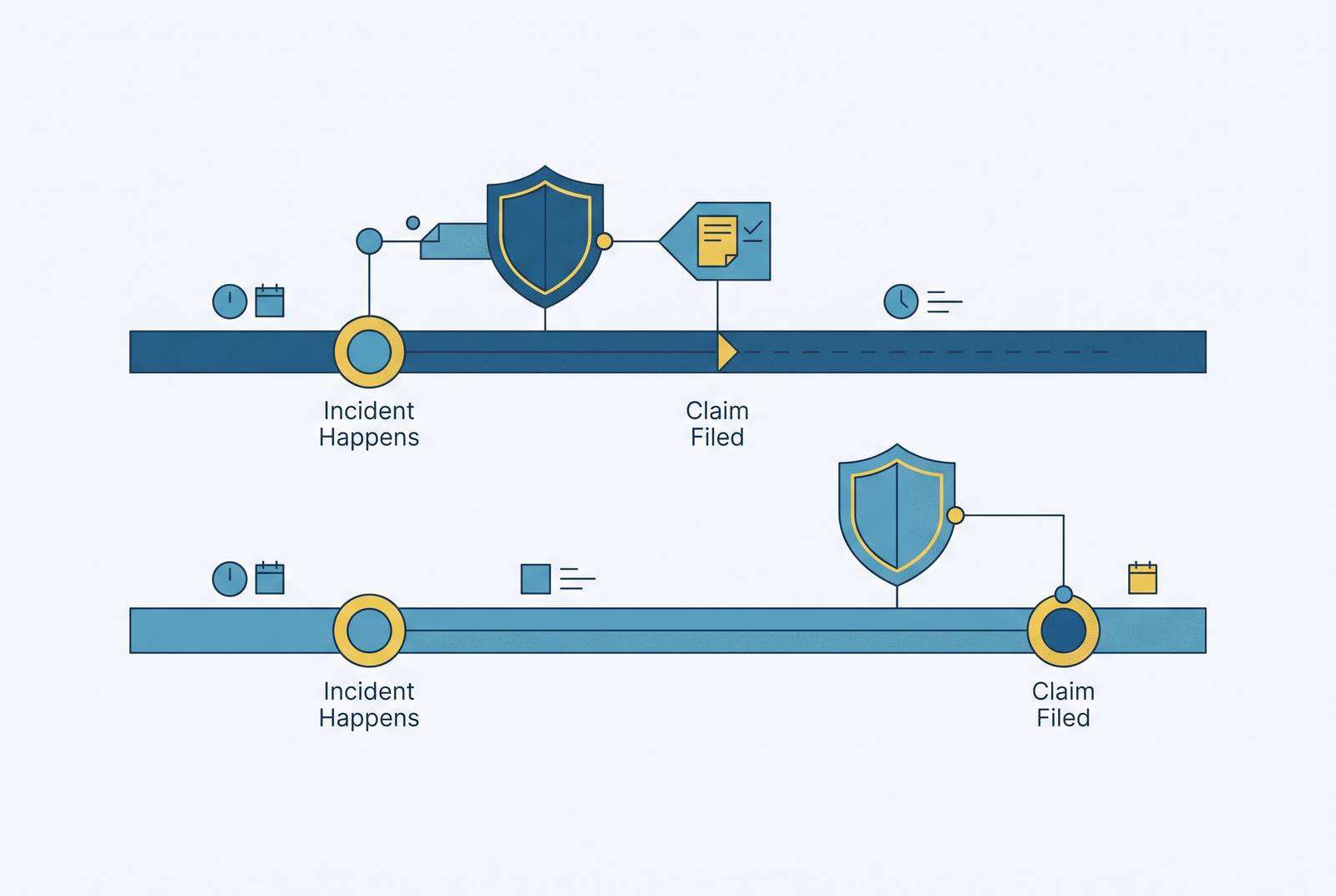
The whole occurrence-versus-claims-made debate comes down to a single question that most people never think to ask until it's too late: when, exactly, does an insurance policy decide it's on the hook for something? Get that answer wrong and a business can end up with a claim, a lawsuit, and no coverage to show for years of paid premiums. This piece breaks down the timing mechanics behind both policy forms, and why the gap between them is where most uninsured losses actually live.
What "trigger timing" actually looks like in practice
Picture a contractor who causes property damage on a job site in 2022. The client doesn't notice the problem, or doesn't decide to sue, until 2024. Under an occurrence policy, the 2022 policy responds, even though it expired two years ago and the contractor has since switched carriers twice. The trigger is the act itself, and where the policy stands today doesn't matter.
Now run the same scenario under a claims-made policy. Same contractor, same damage, same 2024 lawsuit. But this time, the claims-made policy wasn't renewed in 2023, so there's no active policy in 2024 for the claim to land on. Coverage gap, full stop. The contractor is paying legal bills out of pocket for an incident that happened while insured, simply because the claim showed up after the policy lapsed.
That's the entire distinction, reduced to its mechanics: an occurrence policy needs to be active at the time of the act, while a claims-made policy needs to be active at the time of the claim. Everything else in this article, the retroactive dates, the tail coverage, the step factors, exists because of that one structural difference.
Why does this split exist at all? Occurrence carriers are effectively agreeing to cover a "long tail," meaning claims can surface years or even decades after a policy lapses. That's difficult territory for an actuary. Reserves have to account for losses that haven't been reported yet and might not surface for a decade. Claims-made policies were built to solve that problem for carriers: they know precisely when their exposure ends, because a claim has to be reported while the policy is live. The tradeoff lands on the insured. Continuity of coverage under claims-made isn't automatic; it requires ongoing attention, and that responsibility falls squarely on whoever holds the policy.
The two structural features that make claims-made coverage continuous: retroactive dates and prior acts
Two mechanisms do the heavy lifting in a claims-made policy, and neither works without the other.
The first is the retroactive date, the earliest point in time from which a wrongful act can be covered. For coverage to apply, two conditions have to be true simultaneously: the act occurred on or after the retroactive date, and the claim was made and reported while the policy was active. Miss either one and there's nothing to pay the claim.
Retroactive dates exist so a brand-new carrier isn't suddenly holding responsibility for a problem that predates their involvement entirely. A new insurer isn't going to write a policy that inherits every prior liability from a decade earlier; that's an actuarial risk and no underwriter would price it sanely.
But here's where continuity gets fragile. If a business switches carriers and the new carrier sets its own, later retroactive date instead of matching the old one, a gap opens up, and anything that happened between the old retroactive date and the new one is now uncovered, with no occurrence policy, no claims-made policy, nothing to respond.
The fix, when it's available, is called nose coverage, sometimes labeled prior acts coverage. The new carrier agrees to adopt the same retroactive date as the expiring policy, so there's no seam between the two. If a company has never set a retroactive date at all, meaning full prior acts coverage, the policy reaches all the way back to the company's founding. That's the broadest version of claims-made protection that exists.
Nose coverage might sound like a straightforward benefit: same protection, no extra tail premium. It isn't guaranteed, though. Not every carrier offers it, and not every new employer negotiates for it on a departing or incoming professional's behalf. It's a negotiating point, not a standard feature, and treating it as automatic is exactly how gaps happen.
Where coverage goes when a claims-made policy ends: tail insurance
Tail coverage, formally called an Extended Reporting Period, is priced at roughly 200% to 250% of the expiring annual premium, according to the Cunningham Group, with some carriers charging as much as 300%. That's the number worth sitting with before anything else, because it's the cost of closing the exact gap described above.
Here's why tail exists at all. Professional errors have a habit of surfacing long after the fact. An accounting mistake made in 2024 might not generate a lawsuit until 2027, once an audit or a tax dispute brings it to light. A claims-made policy stops covering newly reported claims the instant it terminates, regardless of when the underlying act occurred. Tail coverage plugs that hole by keeping the door open for claims tied to acts that happened while the policy was in force, even after the policy itself is gone.
Run the numbers on a physician paying $40,000 a year for malpractice coverage. At the 200% benchmark, tail costs roughly $80,000, as a one-time expense, to cover claims that might not surface for years. That's a significant, planned-for expense in most retirement budgets.
Tail duration comes in a few flavors, ranging from short-term policies to longer-term or unlimited options that cover claims reported indefinitely. Which one makes sense depends heavily on how long claims typically take to surface in a given profession, and how long the relevant statute of limitations runs.
Tail becomes necessary any time a claims-made policy ends without something else stepping in to cover prior acts: retirement, a career change, disability, or a carrier switch where nose coverage wasn't on the table. It's often unnecessary when moving between two claims-made carriers who agree on the retroactive date, since the new policy just picks up where the old one left off. But "often unnecessary" isn't "guaranteed unnecessary," which is precisely the distinction that catches people off guard.
There's also a wrinkle worth flagging: employer-funded tail isn't as solid a promise as it sounds. When an employer goes bankrupt, a contractual commitment to fund tail coverage for departing professionals can become little more than an unsecured creditor claim. A promise on paper is not the same as money in an account, and that gap becomes very real when the employer funding it disappears.
Occurrence policies sidestep all of this by design. The policy in force at the time of the incident stays responsible for that incident, no matter what happens to the policyholder afterward. There's no tail, no retroactive date to track, no expiration anxiety, and no added administrative burden.
Why claims-made premiums rise steeply in early years before leveling off
Claims-made pricing doesn't hold flat year to year the way a lot of buyers expect. It climbs on what actuaries call step factors: scheduled annual adjustments that reflect the growing pile of prior acts sitting in the coverage window as each policy year passes.
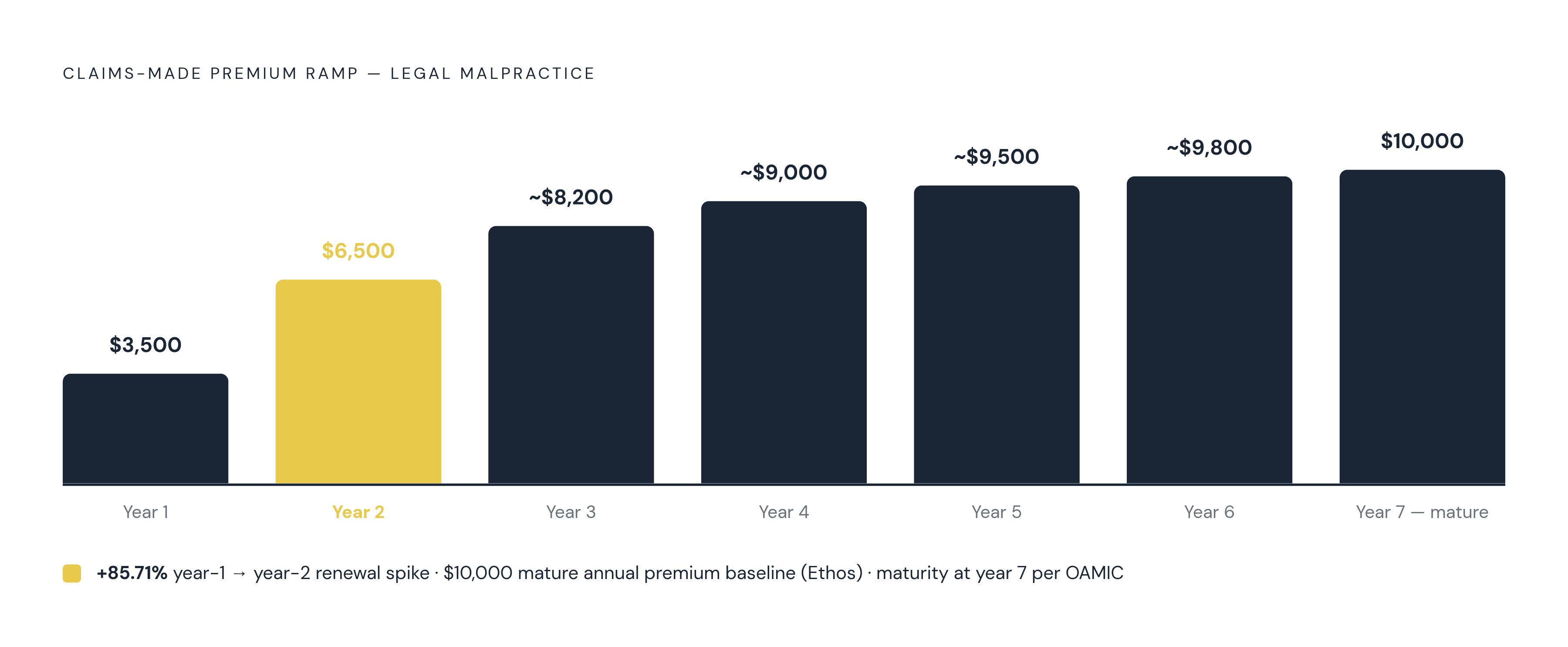
Year one is inexpensive because there's almost nothing to cover yet. Barely any prior acts exist inside the retroactive date window, so the exposure is minimal and the premium reflects that. Using a mature annual premium of $10,000 as a baseline, per Ethos Insurance step-factor data, a first-year factor of.35 produces a premium of $3,500. The second-year factor jumps to.65, producing $6,500. That's an 85.71% increase in a single renewal, which tends to catch first-year buyers completely off guard when the second bill arrives.
It doesn't stop there. Year two to year three can bring increases of up to 50% on top of that, as the step factor keeps climbing toward maturity. Maturity, meaning the point where new exposure being added roughly balances exposure rolling off, typically arrives within a handful of years for most professional lines. Legal malpractice runs slower: OAMIC's data puts maturity at year seven for that line specifically.
So what does this mean for anyone shopping a claims-made quote? A low year-one number tells almost nothing about what the policy will actually cost once it matures, and budgeting for the staircase isn't optional if the goal is avoiding sticker shock three renewals in.
Occurrence premiums skip the staircase entirely. They price in the full long-tail exposure right from the first policy period, which is why they start higher. But they don't climb the way claims-made premiums do, since there's no accumulating window of prior acts to account for. Higher up front, flatter over time; that's the tradeoff.
Which policy form governs each major line of business
Here's a detail that simplifies the whole decision for a lot of buyers: in most lines of business, there isn't actually a choice to make, since the market decides.
Claims-made is the standard, often the only available form, for professional liability and errors-and-omissions coverage, where mistakes routinely surface years after the work was done. It's also standard for directors and officers coverage, given how much long-tail exposure sits behind corporate decision-making, and for employment practices liability. Cyber liability is almost universally written claims-made. Medical malpractice has shifted heavily toward claims-made as well, to the point where occurrence versions are increasingly scarce, though not entirely extinct. Architects, engineers, and contractors buying professional liability coverage will find claims-made as the default there too.
Occurrence dominates the other side of the ledger. Commercial general liability runs on occurrence logic because it fits third-party bodily injury and property damage claims well; the incident-at-the-time model makes intuitive sense when a delivery truck hits a pedestrian or a ceiling tile falls on a customer. Commercial auto and workers' compensation follow the same occurrence logic.
Occurrence medical malpractice still exists in pockets and offers strong long-term simplicity where it can be found, but availability keeps narrowing. A few lines, media liability among them, get written either way depending on the carrier's appetite.
The practical value here isn't philosophical. Knowing which form governs a given line answers, almost instantly, whether tail coverage, retroactive dates, and step factors are things to actively manage, or whether the incident-date rule under occurrence just handles it in the background.
The coverage gaps that open when policies switch, lapse, or end
Four moments create the vast majority of coverage gaps, and each one is preventable if caught early enough.
The first: switching claims-made carriers without matching retroactive dates. If the new carrier sets a later retroactive date than the old policy carried, and tail wasn't purchased from the outgoing carrier, everything from the old policy period falls into the gap between the two dates.
The second: moving from claims-made to occurrence coverage. It sounds like an upgrade, and in some ways it is, but a retroactive date gap can open here too. The occurrence policy only covers incidents going forward from its start date; anything that happened under the old claims-made policy that hasn't generated a claim yet has no home, since the claims-made policy is gone and the occurrence policy wasn't in force when the act occurred.
The third: letting a claims-made policy lapse outright, with no tail purchased. Every prior incident that hasn't yet turned into a reported claim becomes uninsured the moment the policy lapses, not eventually, but immediately.
The fourth, and probably the most overlooked: retirement or career exit. A physician who closes the practice, an attorney who retires, a consultant who simply stops taking clients, none of them are thinking about insurance anymore. But if tail wasn't purchased and no successor policy picked up prior acts, that person is fully exposed to any claim that surfaces later, for as long as the relevant statute of limitations allows. Coverage obligations don't end just because the professional's career did.
There's a compounding wrinkle worth understanding here too: claims-made policy limits don't reset annually the way people sometimes assume. The limits in effect at the time a claim is actually made are what govern that claim, and those limits don't stack across prior years of coverage. A large late-surfacing claim can burn through limits that were set years before the claim ever appeared, with no reserve from prior years available to cushion it.
A short mental checklist helps here. Confirm retroactive date continuity before signing anything with a new carrier. Ask directly whether nose coverage is on the table before assuming tail is the only option. Match tail duration against the actual statute of limitations for the profession and jurisdiction involved, since a 12-month tail does nothing if claims in that field routinely surface five years out. And never take an employer's contractual promise to fund tail at face value; verify there's actual financial backing behind it, because employer insolvency can turn that promise into an unsecured creditor claim overnight.
How to weigh the two forms when you do have a choice
When a genuine choice exists, and it doesn't always, the comparison often comes down to simplicity weighed against upfront cost.
Occurrence is easier to live with over the long run. No tail to buy, no retroactive date to track, no step-factor staircase to budget around. The policy that was active when the incident happened stays responsible, indefinitely, and that's the end of the story. The catch is availability: occurrence coverage keeps getting harder to find in exactly the high-risk professional lines where long-tail exposure is worst, medical malpractice being the clearest example.
Claims-made looks cheaper walking in the door, and for the first year or two, it genuinely is. But the honest total-cost comparison has to include the step-factor climb toward maturity and, eventually, the tail expense whenever that policy ends. A policy that costs $3,500 in year one and $6,500 in year two isn't the value it appeared to be at signing, and that's before factoring in an $80,000 tail bill down the road.
Realistically, market availability narrows the decision before financial modeling ever gets a say. Confirm what's actually offered in a given line before spending time comparing hypothetical premiums that don't exist as real options.
Whether the decision is being made by an individual professional or by a business managing risk internally, the underlying discipline is the same one that applies to any decision judged on a headline number: look at the full lifecycle cost, not the number stamped on the first invoice. Before signing anything, it's worth putting a handful of direct questions to whoever is selling the policy. What's the retroactive date, and does it match prior coverage exactly? What will tail cost once the policy reaches maturity, and who's actually responsible for paying it? At what year does this specific carrier consider the policy mature? And is occurrence coverage even available in this line, with a real premium comparison at maturity, not just at signing?
Answer those four honestly, and the choice between occurrence and claims-made settles into something closer to arithmetic, with a timing problem attached.