Ransomware Claims Process for Small Businesses
Most small businesses lose ransomware claims by missing filing deadlines and documentation rules.
Ransomware insurance does not fail small businesses because the coverage is fake or the industry is predatory. It fails them because filing a claim is a multi-stage process with strict timelines and documentation rules, and most owners never read those rules until the day they need them, by which point the mistakes that sink a claim have usually already been made https://beancount.io/blog/2026/05/09/cyber-insurance-small-business-2026-mfa-requirements-ransomware-coverage-premium-benchmarks. That is the argument of this piece, and the claims data backs it up without much ambiguity.
Small firms take the brunt of ransomware for a reason that has nothing to do with bad luck. They tend to run without the network segmentation, endpoint detection, and offline backup discipline that larger firms built up over years of dedicated security spending. Attackers, meanwhile, have stopped caring about company size or sector. They hunt by the network appliance a target runs. A business with a vulnerable VPN or firewall is in the blast radius regardless of what it sells or how many people it employs. Nearly three in four ransomware attacks in 2025 began with a VPN, and one vendor's appliance, SonicWall, was linked to more than a quarter of all ransomware claims tracked in that period https://www.insurancebusinessmag.com/us/news/cyber/one-ransomware-crew-now-drives-half-of-all-cyber-claims-atbay-573139.aspx. The front door, increasingly, is not the firewall.
Insurance was supposed to be the backstop for all of this, and it is not, at least not automatically. A policy is a contract with conditions attached, and those conditions, if missed, unmet, or misread, turn what should be a payout into a denial letter. Getting this wrong has real consequences: an estimated 60% of small businesses shut down within six months of a major cyberattack, and 75% say they could not keep operating at all if ransomware hit them https://deepstrike.io/blog/ransomware-recovery-costs-2025. This is not an enterprise problem trickling down to smaller companies. Among small and medium-sized businesses, 88% of breaches involved ransomware, and across all confirmed breaches in 2024, ransomware appeared in 44% of cases, a 37% jump year over year.
The Cost of a Ransomware Attack (and the Ransom as the Smallest Line Item)
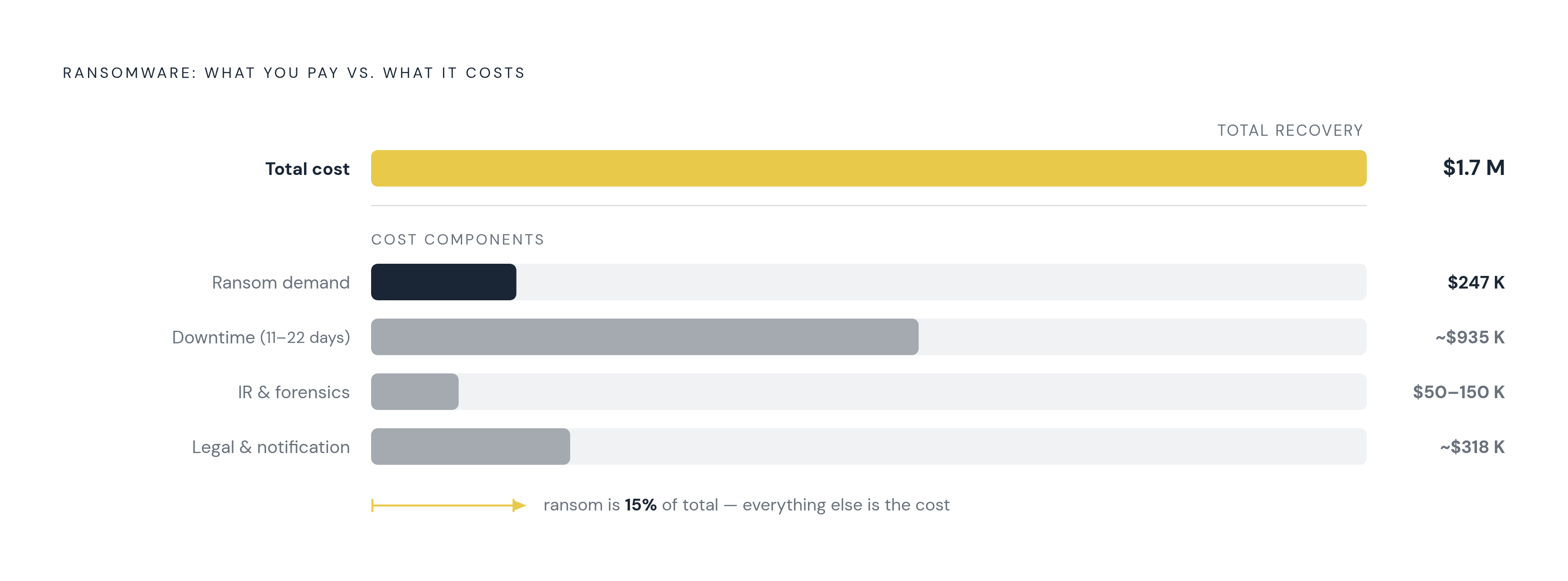
Ransom demands have climbed sharply since 2018, when the average sat around $5,000. By 2025 the average SMB demand had reached roughly $247,000, with some individual demands running past a million dollars https://defendmybusiness.com/ransomware-protection-small-business-2026/ https://truescho.com/en/blog/cyber-insurance-small-business-2026. Those figures alone should worry any owner. But they understate the real damage, because the ransom is frequently the smallest number in the entire affair.
Total recovery cost now averages $1.7 million per incident, up 11% in a single year and more than double the median ransom demand https://www.cloudsecuretech.com/insights/ransomware-recovery-cost-small-business/. What the attacker actually asks for often runs as little as 15% of what the incident costs the business once everything is tallied https://www.acronis.com/en/blog/posts/cost-of-ransomware/. The rest comes from downtime, and downtime is the real multiplier here. A ransomware event keeps a small business offline for 11 to 22 days on average, and the revenue lost during that stretch can dwarf the ransom figure itself https://beancount.io/blog/2026/05/09/cyber-insurance-small-business-2026-mfa-requirements-ransomware-coverage-premium-benchmarks.
The claims data for smaller companies confirms this pattern directly. Among businesses under $25 million in revenue, average ransomware claim severity jumped 40% to $422,000, a figure that folds in incident response, forensics, legal fees, and notification costs rather than just the extortion payment https://www.insurancebusinessmag.com/us/news/cyber/one-ransomware-crew-now-drives-half-of-all-cyber-claims-atbay-573139.aspx. Frequency rose too, up 21% for that same segment https://www.insurancebusinessmag.com/us/news/cyber/one-ransomware-crew-now-drives-half-of-all-cyber-claims-atbay-573139.aspx. The ransom gets the headline. It was never the real bill, and treating it as the main expense to plan around is the first mistake most owners make.
Policy coverage, sublimits, coinsurance clauses, and exclusions that shrink the payout
First-party coverage pays for the business's own losses, including forensics, the ransom itself, business interruption, data restoration, notification costs, and public relations work. Third-party coverage kicks in when someone outside the business, a customer, a vendor, a regulator, comes after it over the breach, covering defense costs, settlements, and regulatory penalties. Buying only the first layer to save on premium looks reasonable at renewal time and looks like a serious error mid-claim.
Even a policy that covers the right categories gets whittled down by structural features that rarely get read closely. Sublimits do the most damage: a policy with a headline limit of $2 million might cap ransomware-specific payouts at $250,000, a detail sitting in a schedule most owners never open. Coinsurance clauses force the policyholder to absorb a real share of the loss directly, no matter what the stated limit says. Retentions, the small-business version of a deductible, typically run from $2,500 to $25,000. None of this is hidden exactly. It is just easy to skip past when the headline number on page one looks reassuring.
Exclusions cause the sharper surprises. Social engineering fraud, wire transfer fraud, and nation-state attacks are commonly carved out of basic cyber policies entirely. Some policies will not cover a ransom payment at all unless the business bought a specific extortion endorsement on top of the base coverage. Carriers also write in exclusions for incidents that "could have been prevented with basic security controls," language that turns into an active dispute the moment MFA was only partially rolled out or EDR had gaps when the breach happened. Many policies also require the business to use the carrier's own panel of negotiators and forensics firms, and hiring an outside firm without approval first can leave those costs entirely unreimbursed. The fix is not complicated in theory, even if it takes real work in practice: map every cost category a ransomware event could generate against the specific coverage section and sublimit that would apply, before an attack happens. Mismatches caught during that exercise are fixable. Mismatches discovered mid-claim are not. Every SMB needs two policy layers.
The underwriting controls insurers require (and why gaps in them become denial grounds at claim time)
Underwriting has changed shape. Insurers used to take an applicant's word for its security posture. They no longer do. Self-reporting has given way to documentation, and that documentation gets checked again, after the fact, once a claim lands on someone's desk.
The controls underwriters expect are specific, and each one has to hold true at the moment of the incident, not just when the policy was purchased. MFA needs to be enforced, not merely available, across email, VPN access, cloud platforms, every admin and privileged account, accounting systems, and backup systems. "Mostly enforced" does not clear the bar anymore. EDR has to sit on every endpoint, since a single unmanaged device can disqualify an application outright, and plain antivirus no longer counts as sufficient. Backups need to be offsite or air-gapped and immutable, tested on a real schedule rather than stored and assumed to work. On top of that, insurers want a documented and tested incident response plan, a patch management program with actual written schedules, and security awareness training for staff.
The At-Bay 2026 data makes the point sharply: 60% of Akira ransomware victims had a well-regarded EDR tool deployed and were breached anyway, and only the firms pairing EDR with round-the-clock managed detection and response avoided full encryption. That is where underwriting is heading: proof of monitoring, not proof of installed software. The gap that trips businesses up most often is between "adopted" and "enforced."" MFA might be switched on for Microsoft 365 but skipped for a legacy accounting application nobody thought to touch, and a post-incident investigation checks for exactly that gap, verifying the control is enforced everywhere in the environment, not just present somewhere in it.
Ransomware claims resulting in no payout
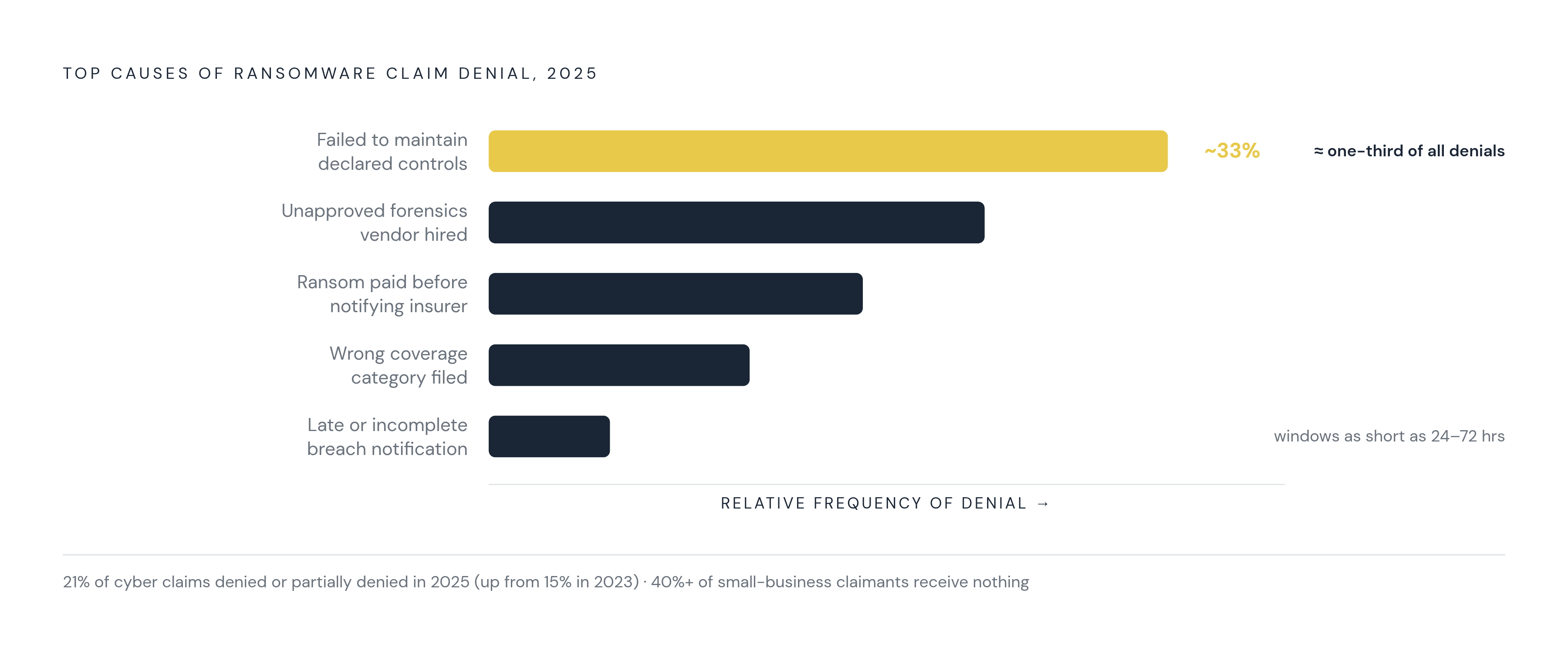
Among small businesses that hold a policy and file a claim, more than 40% get nothing back, and the coverage purchased simply did not match the loss that occurred https://beancount.io/blog/2026/05/09/cyber-insurance-small-business-2026-mfa-requirements-ransomware-coverage-premium-benchmarks. The trend is getting worse, not better: roughly 21% of cyber insurance claims were denied or partially denied in 2025, up from 15% in 2023. Separately, 27% of data breach claims carried exclusions that led to partial or zero payouts.
One failure pattern accounts for roughly a third of all denials on its own: failing to maintain the security controls declared on the original application. Insurers now verify, after the fact, whether MFA, EDR, and backup practices were genuinely in place at the time of the breach, not just at the time the policy was signed. A handful of other missteps recur constantly beyond that. Businesses hire outside forensics firms or negotiators without carrier pre-approval, and those costs simply never get reimbursed. Businesses pay the ransom before notifying the insurer, a sequencing error that voids extortion coverage under many policies outright. Losses get filed under the wrong coverage category, wire fraud or social engineering claimed against a ransomware section that excludes them by design. Notification itself arrives too late or too thin, missing notice windows that often run as short as 24 to 72 hours.
None of these failures are exotic. They are procedural, almost clerical in nature, which is what makes them so common and so avoidable at the same time. A business does not need better luck to avoid them. It needs a checklist written before the attack, not during it.
Step one: what to do in the first hours after ransomware hits (before paying, before calling IT, before anything else)
One rule outranks every other instinct in the room: do not pay the ransom before notifying the insurer. Paying first, even out of panic to get systems back online faster, can void extortion coverage entirely, turning a covered loss into an uncovered one in the space of a single wire transfer.
Containment comes next, and it has to be done with some restraint. Isolate the infected device or the affected network segment, but resist the urge to shut down the entire network. That instinct feels protective, and it destroys the forensic artifacts that both the insurer and any later investigation will need. Do not run a decryption tool or a removal utility before forensics gets involved either, since doing so erases the evidence trail the claim depends on. Photograph or screenshot the ransom note, the demand screen, and any attacker communication in full, before anything on screen changes.
Then make three calls, within the first hour if at all possible. Using the policy number and the contact listed in the incident response plan on file, call the cyber insurer's claims line first. Call legal counsel next, since attorney-client privilege can shield forensic findings and internal messages from later use in litigation or a regulatory proceeding. Call IT support or a managed security provider last, and only after confirming with the insurer which vendors are actually approved, since engaging the wrong outside firm at this stage is one of the surer ways to end up eating costs later.
One documented case shows what good timing looks like in practice. An insurer's incident response team engaged within two hours of the claim being filed, negotiated the ransom down substantially, ran a full forensic investigation, and restored systems from backup within five days. The final payout covered the ransom, the lost revenue from downtime, and the cost of notifying affected customers. What made that outcome possible was not negotiation skill or backup quality. It was the speed of that first phone call.
Step two: formal claim filing, the documentation the insurer will scrutinize
The verbal call to the insurer needs a written follow-up as soon afterward as possible. Most policies carry strict notice windows, and late written notice is itself grounds for denial, independent of anything else in the claim.
What follows is a documentation exercise, and insurers scrutinize every piece of it. The claim file needs a timestamped incident timeline covering when the attack was first detected, which systems were affected, and what actions were taken in what order. It needs the ransom demand preserved exactly as received, screenshots, attacker communications, wallet addresses, deadline notices, nothing altered or summarized. It needs proof that the security controls declared on the original application were actually in place when the incident happened: MFA logs, EDR deployment records, backup test results, patch management reports. It needs business interruption figures quantified against the equivalent prior period: revenue records, lost contracts, payroll costs for staff sitting idle during the outage. And it needs invoices from every vendor engaged during the response, but only from vendors the insurer pre-approved.
That last point carries real weight through this whole phase. Ransom payments generally require pre-approval before the business sends anything. The forensics firm doing the investigation is often required to be the carrier's own panel firm, and bringing in an outside firm without consent leaves those costs unreimbursed. Ransom negotiation itself should run through the carrier's extortion services rather than being handled independently, however tempting it might be to move fast on that front.
Government reporting runs alongside all of this, not after it. Every ransomware incident should be reported to the FBI, CISA, or the U.S. Secret Service, and a single report through CISA's reporting portal or by phone is enough to notify the relevant agencies at once. Some policies, and some state regulations, actually require this reporting as a condition of the claim itself. It is one more box to check, not an optional extra step for the civic-minded.
Step three: the forensic investigation and ransom negotiation phase (what happens while the business is still down)
Forensic investigators serve two purposes at once, and both shape what gets asked and documented during this phase. For the insurer, the investigation establishes cause, scope, and whether the loss actually falls within what the policy covers. For the business itself, the same investigation establishes something separate and just as consequential: what data was actually accessed, and what breach notification obligations follow from that, obligations that exist independent of anything the insurance policy says.
This is the stretch where the business is still down, revenue is still not coming in, and every day adds to a downtime figure that already runs 11 to 22 days on average https://beancount.io/blog/2026/05/09/cyber-insurance-small-business-2026-mfa-requirements-ransomware-coverage-premium-benchmarks. Negotiation and forensics happen in parallel with that clock still running. This is why the earlier steps, the first-hour calls, the pre-approval on vendors, the written notice inside the policy's window, matter as much as they do. A business that got those early steps right walks into this phase with a claim that has a real shot at paying out in full. A business that did not is negotiating with the insurer nearly as hard as it is negotiating with the attacker, and that is a far harder position to climb out of. In 2024, 44% of all confirmed data breaches involved ransomware https://www.getastra.com/blog/security-audit/cyber-insurance-claims-statistics/. Ransomware breaches increased 37% year-over-year in 2024 https://www.getastra.com/blog/security-audit/cyber-insurance-claims-statistics/. Among SMBs, 88% of breaches involved ransomware https://www.getastra.com/blog/security-audit/cyber-insurance-claims-statistics/. 79% of ransomware attacks now start with a stolen login https://www.cloudsecuretech.com/insights/ransomware-recovery-cost-small-business/. S&P Global Ratings is forecasting a 15–20% premium increase across the market in 2026 https://beancount.io/blog/2026/05/09/cyber-insurance-small-business-2026-mfa-requirements-ransomware-coverage-premium-benchmarks. Ransomware drives 60% of large claim value https://www.getastra.com/blog/security-audit/cyber-insurance-claims-statistics/. US cyber claims surged to nearly 50,000 in 2024 https://www.getastra.com/blog/security-audit/cyber-insurance-claims-statistics/. US cyber claims increased approximately 40% year-over-year in 2024 https://www.getastra.com/blog/security-audit/cyber-insurance-claims-statistics/. Incident response and forensics often costs $50,000–$150,000 for a mid-sized incident https://beancount.io/blog/2026/05/09/cyber-insurance-small-business-2026-mfa-requirements-ransomware-coverage-premium-benchmarks. First-party claims now make up about 62% of all actively managed cyber claims in major reinsurer portfolios https://beancount.io/blog/2026/05/09/cyber-insurance-small-business-2026-mfa-requirements-ransomware-coverage-premium-benchmarks. 73% of small businesses fail their underwriting assessments https://beancount.io/blog/2026/05/09/cyber-insurance-small-business-2026-mfa-requirements-ransomware-coverage-premium-benchmarks.