Technology E&O vs Cyber Liability Policy Differences
Tech E&O covers your mistakes; cyber covers when attackers strike your systems.
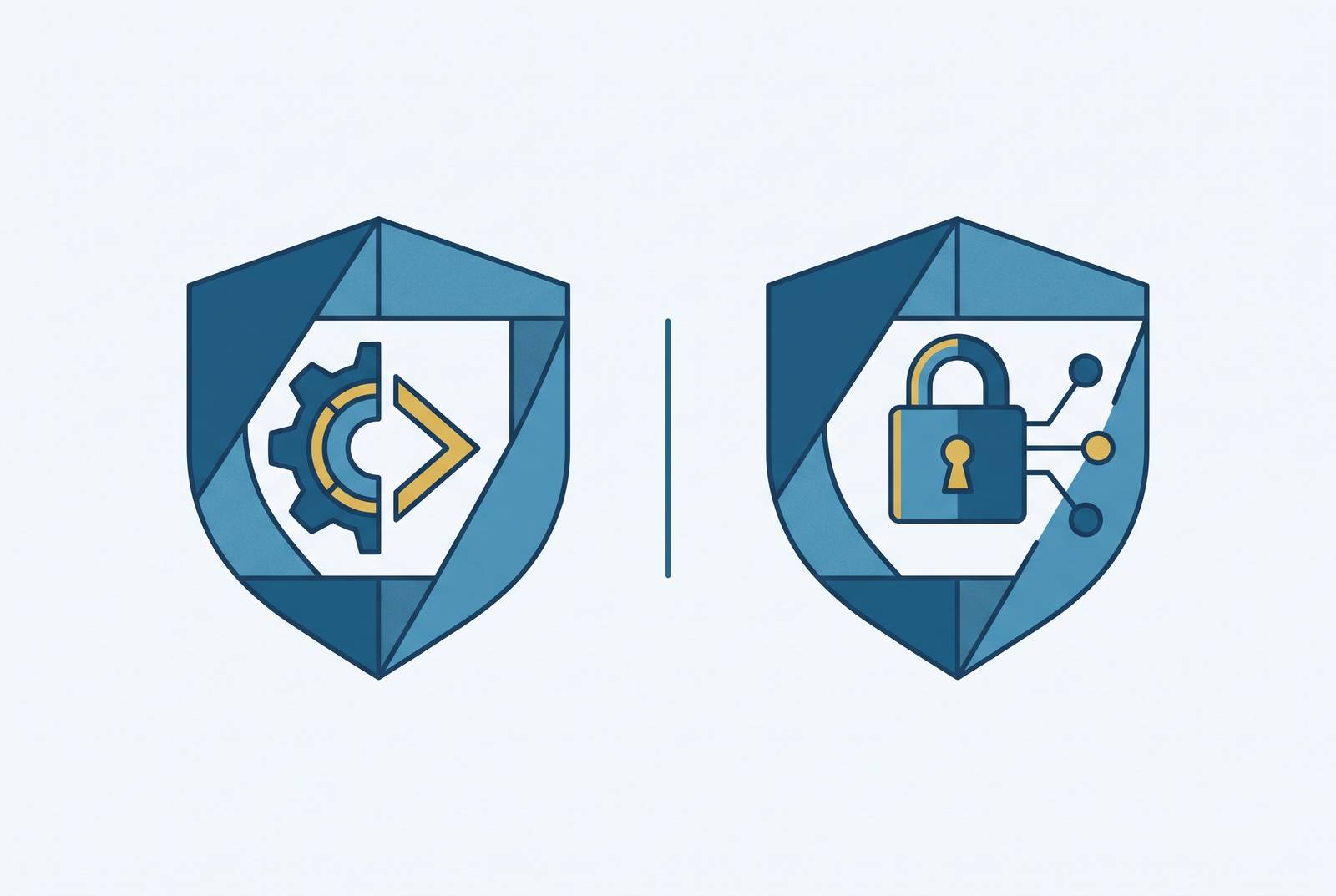
Two policies cover technology risk, and businesses mix them up constantly. Tech E&O pays when your work fails. Cyber pays when your systems get compromised. That's the whole split, and almost every coverage dispute in this corner of insurance traces back to which side of it an incident actually landed on.
Most technology companies already carry general liability, commercial property, or business interruption coverage. None of it responds to a bad software release or a data breach. Those forms were built for slip-and-fall claims and fire damage, not for a bug that corrupts a client's financial reporting or a ransomware note that locks up an organization's critical records. The two policies that were built for that, Tech E&O and Cyber Liability, get treated as interchangeable because both have "technology" stamped somewhere on the declarations page. They're not interchangeable. No attacker has to show up for Tech E&O to pay a claim. No professional mistake has to occur for Cyber to pay one. What follows breaks down what each policy actually does, where they overlap, where they leave gaps, and where AI is now creating losses that neither one was written to handle.
What Tech E&O is built to cover
Technology Errors and Omissions insurance, sometimes called Technology Professional Liability, triggers when a technology product or service fails to perform as promised and a third party loses money because of it. It's third-party coverage only: it pays out when a client sues, not when the insured company eats its own losses. Professional negligence, missed SLAs, breach of contract, failure to deliver on a stated scope, these all sit inside the box.
The coverage isn't limited to human error, either. A coding bug that corrupts output data, a bad database migration that locks users out for a weekend, faulty advice from a consultant who recommended the wrong security tool: all of it falls under the same trigger, because the common thread is a technology product or service that didn't do what it was supposed to do. That covers both products (a vulnerability baked into an app) and services (a firm's own staff giving advice that turns out to be wrong).
What the policy actually pays for is fairly standard across carriers: attorney fees, court costs, settlements, judgments, and the litigation costs that pile up around all three. Coverage usually extends to breach of contract, IP infringement claims, and contractual indemnity obligations the company signed up for in a master services agreement.
What it almost never covers: forensic investigations, breach notification, ransomware payments, regulatory fines, or the PR firm you hire after a breach makes the news. Those live in Cyber. And a word of caution on labeling: a generic professional liability form written for accountants or management consultants often doesn't address software failures or data-handling errors at all, even if someone slaps "technology" into the policy title. What matters is the actual wording of the form, not what's printed on the cover page.
What Cyber Liability is built to cover
Cyber Liability triggers on a cyber event: ransomware, a data breach, business email compromise, an attacker-driven outage. The line that separates it structurally from Tech E&O is that Cyber covers both first-party losses (the company's own costs from the incident) and third-party liability (claims from people whose data or systems got caught in the blast radius).
First-party coverage does most of the heavy lifting in a real breach. Digital forensics and incident response, legal counsel, customer notification (often a legal requirement under applicable breach notification laws), credit monitoring for affected individuals, ransom payments, income lost during the outage, PR and reputation cleanup, and the cost of actually rebuilding the systems and restoring the data. Third-party liability picks up privacy lawsuits from people whose data got exposed, network security liability claims, and regulatory defense costs tied to frameworks like HIPAA, GDPR, or PCI-DSS.
Those same compliance frameworks are a big part of why Cyber demand has grown the way it has. HIPAA and GDPR create real financial exposure on their own, separate from any lawsuit, and a growing number of enterprise contracts now require vendors to show proof of cyber coverage at a stated limit before they'll even sign. Common exclusions to watch for: incidents the insured already knew about before binding coverage, losses tied to unpatched systems the company knew were vulnerable, and certain categories of regulatory fines that policies may not cover. Cyber gets sold as a standalone policy, as a rider bolted onto a general liability or BOP form, or bundled together with Tech E&O in a single package.
How the two policies behave when a single incident triggers both
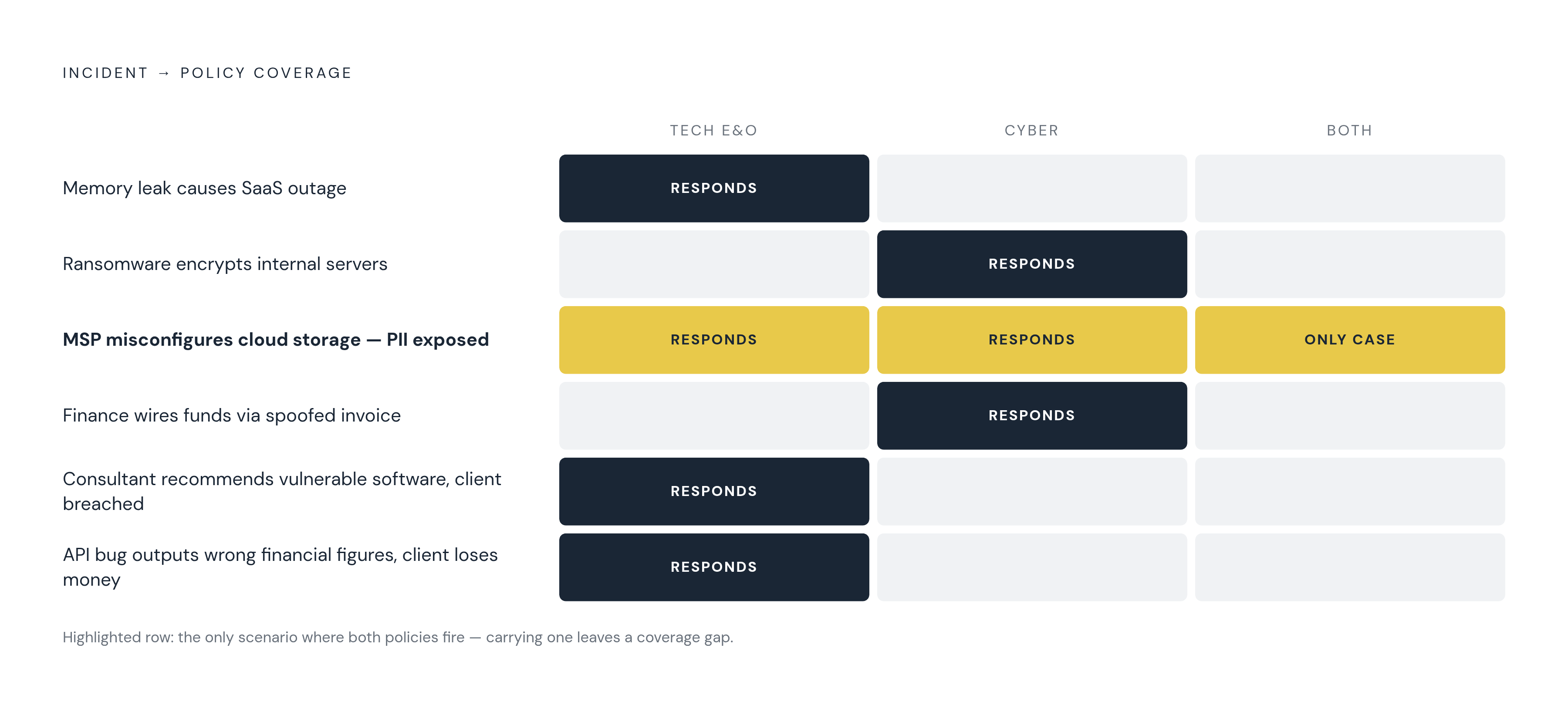
The clean split between the two starts to blur the moment an incident has both a professional-failure component and a security-compromise component baked into it. Working through any incident means asking a short sequence of questions in order.
Was there an attacker involved, and did the loss flow directly from that attack? If so, Cyber is primary. Was the loss caused by something the company's own team did or failed to do? Then Tech E&O takes the lead. Did both contribute, an insecure configuration that a vendor's staff built and an outside party then exploited? Then both policies may respond, and the coordination language sitting inside each policy determines who pays first and how the limits stack on top of each other. Is a client actually asserting damages? If so, Tech E&O is almost always in play regardless of whether an attack happened at all, because a client claim is a client claim. And finally: does the specific wording of the policy in hand actually cover this scenario? The trigger described in marketing material tells you design intent. The endorsements and exclusions buried in the form tell you what actually pays.
The real danger appears in companies carrying only one of the two. A Tech E&O-only company that gets breached has coverage for a client's negligence claim but nothing for forensics, notification costs, or a ransom demand. A Cyber-only company facing a lawsuit over a botched implementation has breach response covered and no defense at all for the professional liability claim sitting right next to it. Buying both through the same broker determines which carrier steps up first through the coordination clauses written into adjacent policies, and whether the limits actually stack instead of leaving a gap between them.
Six incident types and the policy that responds to each
A weekend deploy introduces a memory leak, and a multi-tenant SaaS platform goes down for an extended outage. No attacker touched anything. The loss traces straight to a performance failure in code the company shipped. Tech E&O responds: client downtime claims, contractual SLA penalties. Cyber sits this one out entirely, because there's no breach and no attack.
Ransomware encrypts a company's internal file servers. The outage is entirely the company's own operational disruption, and there's no client professional-services failure anywhere in the chain. Cyber responds: forensics, the ransom itself if paid, business interruption income, system restoration. Tech E&O stays out, since no client is alleging the company's work product failed them.
An MSP's engineer deploys a client's cloud environment with a storage bucket left open to the public, and customer PII spills out. This one has both a professional failure (the misconfiguration) and a resulting breach sitting in the same incident. Both policies respond: Tech E&O covers the client's negligence claim over the botched setup, and Cyber covers the breach response costs, assuming the MSP's own policy carries third-party cyber coverage.
A finance staffer gets a spoofed vendor invoice and wires funds to a fraudulent account. That's a security-related financial loss, not a failure of professional services. Cyber responds, but only if the policy specifically includes social engineering and funds-transfer fraud coverage, which not every form does by default. Tech E&O has nothing to say here unless the fraud traced back to a failure in services the company owed a client.
An IT consultant recommends a piece of software to a client, and that software turns out to carry a known vulnerability; the client gets breached later using that exact hole. The failure sits in the advice, not in an attack on the consultant's own systems. Tech E&O responds: negligent professional recommendation, client harm downstream.
An API integration bug spits out incorrect financial figures, a client acts on those numbers, and loses money as a result. No attack, no compromised data, just a pure performance failure in a delivered technical service. Tech E&O responds. Cyber has nothing to do with it.
Across all six, the operative question is never whether something counts as a "technology problem," but whether the loss traces to a failure of professional work or to a security compromise." It's whether the loss traces to a failure of professional work or to a security compromise. Everything else is downstream of that one distinction.
Where AI is creating claims that neither policy was written to handle
The Gallagher Re, MIT, and Testudo Global report Smart Systems, Blind Spots: Rethinking Insurance for the AI Era frames the core problem this way: AI adoption has moved faster than the insurance industry's ability to build products that respond to it, and that gap leaves companies holding a growing pile of liabilities nobody insured. The loss data backs that up. Stanford's AI Index tracked 362 incidents logged in the AI Incident Database in 2025, up from 233 in 2024, and that kind of climbing incident count is exactly what underwriters watch when they decide whether to tighten terms or exclude a risk outright.
What makes AI hard to fit into the existing split is that a single AI failure often carries both flavors of loss at once, and sometimes neither cleanly. A biased AI recommendation that damages a client looks like a straightforward Tech E&O trigger, a performance failure in a delivered product. A deepfake used to trick a finance team into a fraudulent wire looks like a Cyber trigger, a security compromise. But an AI model that hallucinates a false statement, one that then causes real financial or legal harm, doesn't obviously belong to either bucket. It wasn't an attack, and it's not quite a conventional professional service failure either; it's a new kind of failure mode the older policy language never anticipated.
Most Tech E&O forms currently in force simply don't mention AI at all, and that silence already raises friction in enterprise sales cycles and investor due diligence, where buyers now ask directly whether AI-related claims are covered or excluded. Standard Cyber forms have the same blind spot for a different reason: most of them were drafted before generative AI existed as a named commercial risk. ISO, which builds the standardized policy language most of a national property and casualty market runs on, introduced optional generative AI exclusions for 2026 commercial general liability forms in 2025. property and casualty market runs on, introduced optional generative AI exclusions for 2026 commercial general liability forms in 2025. Those endorsements carve out coverage for bodily injury, property damage, or personal and advertising injury "arising out of generative artificial intelligence," and the definition is broad enough to sweep in almost any machine-based system that produces text, images, audio, video, or code.
The result is coverage fragmenting across Cyber, Tech E&O, D&O, and EPLI lines, with each insurer narrowing its own AI exposure independently and no single policy left holding the full picture. Specific AI risk categories now demanding dedicated coverage include hallucinations, algorithmic bias, IP infringement, regulatory inquiries, AI-enabled social engineering, and losses tied to deepfakes or voice cloning. Three forces are converging on this gap at the same time: new regulation like the EU AI Act and a wave of state AI bills creating fresh legal exposure, real AI litigation starting to land on insurer balance sheets, and generative AI exclusions stripping away coverage that used to exist by default simply b... state AI bills creating fresh legal exposure, real AI litigation starting to land on insurer balance sheets, and generative AI exclusions stripping away coverage that used to exist by default simply because nobody had written an exclusion for it yet.
How carriers are beginning to respond with AI-specific endorsements and products
Demand for generative AI risk coverage is well ahead of what's actually on the shelf, but a handful of carriers have started closing the gap.
Coalition added an Affirmative Artificial Intelligence Endorsement to its cyber policies, which widened its breach trigger to include AI-caused security failures and extended funds-transfer-fraud coverage to cover deepfake-enabled fraudulent instructions specifically. Its Active Cyber Policy, issued on all new and renewal U.S. surplus-lines business starting April 15, 2025, builds that affirmative AI coverage in as a default rather than an optional add-on, and a December 2025 Deepfake Response Endorsement layered in dedicated incident response for deepfake events on top of that.
Embroker took a similar path: an Artificial Intelligence Coverage Endorsement effective August 5, 2025, included on every technology E&O and cyber quote the company issues rather than sold separately as an upsell.
Relm Insurance went further and built three standalone AI-specific products, all launched in January 2025. NOVAAI combines cyber and Tech E&O coverage aimed at AI platform companies and firms building AI-based products or services. PONTAAI is an excess difference-in-conditions wrap for organizations carrying third-party liability from their own AI use or development, designed for the exact situation where an existing policy already excludes AI. RESCAAI is a first-party response policy built for businesses that use someone else's AI tools rather than build their own.
The Lloyd's Market Association has also issued guidance on how AI risk touches the international E&O market, which signals that the specialty and surplus-lines side of the industry is starting to build formal frameworks around this rather than treating it case by case. Some of these products expand an existing Cyber or Tech E&O trigger to affirmatively pull AI in, while others exist purely as wrap policies for buyers whose current coverage already excludes it. A buyer has to know which gap they're actually sitting in before picking one. And because these products are still new, the forms vary a lot by carrier: a policy marketed as "AI coverage" might handle deepfake fraud cleanly and say nothing about hallucination liability, or the reverse. Reading the actual wording still matters more than the label on the cover page.
How to reason through which businesses need which combination
The right starting question is where the risk actually lives: in what gets delivered, in the data being held, or in both at once." It's where the risk actually lives: in what gets delivered, in the data being held, or in both at once.
Tech E&O earns its premium for any company that builds or sells software, SaaS, or technology products clients depend on to run their own operations, and for any IT consulting or managed-services firm whose professional judgment directly shapes what happens to a client afterward. If the deliverables carry contractual performance obligations, or if a mistake in the work could cost a client real money, that's a Tech E&O company.
Cyber Liability earns its premium for any company storing, processing, or moving sensitive customer data, and for any company whose operations would stop generating revenue the moment its digital infrastructure went down. Add in anyone bound by HIPAA, GDPR, PCI-DSS, or a client contract that specifies security requirements, and anyone for whom a ransomware event or a mandatory breach notification would generate costs the balance sheet couldn't absorb on its own.
Most technology companies of any real size end up needing both, not because a broker is upselling them, but because the two policies protect against two genuinely different failure modes that occur inside the same business every day. The software can fail without ever being attacked. The systems can be attacked without the software ever failing. Betting on only one of those two things never happening is not a risk management strategy, it's a hope.
Sources
- Technology Errors and Omissions (E&O) vs. Cyber Insurance | Insureon
- Tech E&O vs. Cyber Insurance | TechInsurance
- Technology E&O and Cyber Insurance: How Each Policy Responds Across 6 Real-World Scenarios
- Technology Errors and Omissions vs. Cyber Insurance
- Vouch: Tech E&O vs Cyber Insurance: Understanding the Difference
- testudo.co
- wtwco.com
- relminsurance.com