Product Liability Insurance for Hardware Startups
Physical products can't be patched like software when they harm someone.
Product liability insurance for hardware startups covers a different set of risks than the standard tech insurance package most founders buy at incorporation. Software companies ship code into the cloud and can patch a bug overnight. Hardware companies ship a physical object into someone's home, car, or body, and once that object is out the warehouse door, the exposure to injury, property damage, and recall is live and can't be rolled back with a software update.
The dollar figures involved aren't small. Vouch has reported that the average product liability jury award topped $7 million in 2020, and that figure doesn't even count pre-trial settlements or the legal fees that pile up whether a case goes to trial or not. A single bad lawsuit can also make future investors and customers nervous in a way that outlasts the settlement check. None of this is a reason to panic-buy every policy on the market. It's a reason to understand, specifically, what a hardware company needs covered before the first unit ships, and why the standard business owner's policy most founders start with wasn't built for any of it.
California's strict liability rule and its effect on the risk calculation for Bay Area hardware companies
California runs on strict liability for product claims. That means an injured party doesn't have to prove a company was careless, negligent, or cut corners. They generally just need to show the product was defective, the defect existed when it left the company's control, and the defect caused harm. Intent and diligence don't factor into the legal standard the way they would in a negligence claim.
That standard matters enormously for hardware startups working with overseas contract manufacturers, which is most of them. If a defect originates on a factory floor in an overseas manufacturing hub, and that manufacturer has no domestic presence and no domestic insurance, the importer of record can end up holding 100% of the liability. Golden Benchmark has flagged this exact dynamic: the company that designed the product and put its name on the box absorbs the exposure the overseas manufacturer can't be made to answer for.
The market already prices this risk in. Insurance Canopy's State of Product Liability Insurance Report, cited by Golden Benchmark, found California has the highest product liability insurance adoption rate in the country at 18.1%. That reflects how aggressively California plaintiffs' attorneys pursue these cases, and how wide the net gets cast when they do. It reflects how aggressively California plaintiffs' attorneys pursue these cases, and how wide the net gets cast when they do.
Lawsuits in this space rarely name just one defendant. They tend to name the designer, the importer, the distributor, the wholesaler, and the retailer that sold the unit. Product liability attorney Jason Turchin, cited in a national Chamber of Commerce guide, said many state laws hold everyone in the chain of commerce responsible, "from the company that designed and produced the product to the distributor to the store that sold the product." A hardware startup based in one city with a factory in an overseas manufacturing hub and a retail partner in another state can get pulled into the same suit as all three.
Once the legal exposure is clear, the next question is what a policy actually pays for when a claim like this lands.
The core coverage stack: what product liability insurance covers and where it stops
Product liability insurance pays out for three main things: bodily injury caused by a defective or dangerously designed product, property damage from a malfunction or a missing warning label, and the legal fees and settlement costs that come with defending the claim. That's the core of it.
What it doesn't pay for is just as important to know going in. Recall coordination, software-driven failures, cyber incidents, and data breaches all sit outside a standard product liability policy and need their own coverage entirely.
Most founders assume general liability, the GL policy every startup gets when it signs an office lease, already handles this. It doesn't, at least not fully. GL covers everyday bodily injury and property damage tied to business operations: a customer slipping in the lobby, a contractor's crew damaging a client's floor. It was not written to handle a defective-product claim the way a dedicated product liability policy is, and treating GL as a substitute is one of the more common and costly assumptions a hardware founder can make.
The national Chamber of Commerce guide recommends a minimum of $1 million in coverage, with higher-risk product categories needing $5 million or more. Vouch's benchmarks show seed-stage companies typically starting around $1 million in GL, with Series A and B companies moving up to several times that amount as they scale. The more units in the field, the higher the odds one of them fails, and the higher the potential severity if it does. Coverage limits should track sales volume.
This is the base layer. Everything else in a hardware insurance program sits on top of it, and the next gap is one most founders don't find until it's already too late.
The recall gap: why GL leaves hardware startups exposed when a CPSC recall is triggered
2025 was a record year for CPSC recalls: 339 through the third quarter, beating 2024's previous record of 333, according to CPSC data cited by Newsweek and referenced in Golden Benchmark's reporting. Recalls overall rose 40% between 2020 and 2024, a trend the ETQ Pulse of Quality in Manufacturing Survey attributes to supply chain strain, tariff-driven shifts in where and how products get made, and gaps in quality control. That same survey found 75% of manufacturers had experienced at least one recall within a five-year window. The largest single 2025 recall, nearly 4 million units of exercise equipment, gives a sense of scale at the top end. But scale cuts both ways here.
For an early-stage hardware company, a recall of even 10,000 units can be a company-ending event if there's no recall expense coverage in place. And GL simply doesn't cover recall costs. It covers bodily injury and property damage, full stop. It explicitly excludes the operational side of a recall: notifying every customer who bought the product, arranging retrieval logistics, disposing of defective units, manufacturing and shipping replacement inventory, and managing the reputational fallout that follows. All of that has to come from a separate endorsement or a standalone recall expense policy, and most hardware companies don't have one until after their first recall forces the issue.
There's a related blind spot on the equipment side. Golden Benchmark's research found roughly 60% of manufacturers that experienced a production equipment breakdown had no coverage for it at all, since mechanical and electrical failure is excluded from standard commercial property policies. Repair costs and lost output from a breakdown like that commonly run anywhere from $50,000 to over $500,000.
Recalls are one gap. Connected hardware opens up a second one, and it's more tangled than most founders expect.
Connected and IoT hardware: the dual liability problem that standard policies miss
Very little hardware ships today as a purely mechanical object. Smart home devices, wearables, AI-enabled products, robotics: nearly all of it blends a physical shell with firmware, embedded software, and a cloud backend. That blend creates two separate liability categories running at the same time, and Golden Benchmark's framing on this is useful: product liability covers the physical device, while Tech E&O covers the software and firmware controlling it.
The distinction plays out concretely. A firmware bug that bricks a device or causes it to malfunction is a Tech E&O claim. A hardware defect, like a battery that overheats and burns someone, is a product liability claim. Standard GL sits outside both categories and covers neither one properly.
Layer cyber liability on top of that. Vouch's FAQ guidance states that a connected device gathering GPS coordinates, health metrics, or behavioral data creates its own cyber exposure, separate from whatever risk sits on the company's internal network. If that device gets hacked, the fallout can be both digital and physical at once, so a cyber policy needs to explicitly extend to the device itself. A cloud platform outage or a bad mobile app update can also open the door to cyber liability or breach-of-contract claims if it knocks out a business customer's operations. Vouch gives a clean example: if a connected device's software update crashes a business client's critical systems, E&O is what covers the resulting financial damages, not product liability and not GL.
AI integration adds a newer wrinkle. Cyber insurers are grappling with autonomous AI agents, systems that hold legitimate access credentials but can behave in ways nobody fully predicted, and existing policy language often doesn't contemplate that exposure yet. Hardware startups building AI into their devices should check, specifically, whether their current policies address that exposure, because a lot of existing wording doesn't contemplate it yet.
Vouch has structured its own hardware offering around exactly this overlap, combining product liability, E&O, and cyber into one program built for connected products, on the reasoning that traditional, siloed policies leave gaps between them.
A complete hardware insurance program in practice
Putting it all together, a full hardware insurance program tends to stack up in layers.
The foundation is Commercial General Liability, which most landlords and suppliers require before they'll sign a contract, paired with a dedicated Product Liability policy that has to be added explicitly rather than assumed to already live inside GL.
On top of that sits the connected-product layer: Tech E&O, covering software, firmware, and service failures that cause a customer financial harm, and Cyber Liability, covering breaches, ransomware, regulatory fines, and customer notification costs. Vouch's benchmark data shows roughly half of startups buy cyber coverage, with a median premium around $2,968. Pro Insurance Group's 2026 figures put mid-size manufacturers, in a mid-range annual revenue band, paying $3,500 to $10,000 a year for a substantial amount of coverage, while smaller manufacturers typically pay $2,000 to $4,000 annually.
Then comes the governance and employment layer. Directors & Officers insurance is usually a hard requirement from investors before a funding round closes; Vouch puts the median D&O premium at $6,369, with costs climbing past $16,000 depending on how much capital gets raised. Employment Practices Liability, relevant once headcount starts growing, carries a median premium of $4,291.
Last is the recall and operational layer: Recall Expense coverage, either as an endorsement or a standalone policy, addressing exactly what GL leaves out; Property and Business Interruption coverage, where coverage with adjustable limits can fit companies with seasonal demand swings better than a flat number; and Equipment Breakdown coverage, since mechanical and electrical failure sits outside standard commercial property policies and needs its own line.
On cost, Corgi's pricing puts a pre-seed or seed-stage foundational package at $2,000 to $5,000 a year. By Series A, as coverage needs broaden, Corgi's expanded package runs $5,000 to $15,000 a year. Vouch separately reports a median E&O premium of $3,782 across its tech startup book.
None of this gets bought in one sitting. Knowing what belongs in the stack is one problem. Finding a provider that'll actually write it for an early-stage hardware company is the next one.
Where hardware startups get these policies and how to evaluate providers
Golden Benchmark's 2026 reporting shows product liability, Tech E&O, cyber, D&O, and workers' comp for hardware startups get placed mostly through a familiar set of carriers: Hartford, Travelers, Chubb, Liberty Mutual, and Berkley, plus California Specialty Market carriers for the more complicated product liability and hardware risk profiles. Chubb specifically markets technology coverage built for electronics and hardware manufacturers, not just software developers, spanning everything from early-stage startups to multinationals.
Vouch, founded in 2018, focuses on insurance for companies building things that don't fit neatly into legacy underwriting boxes. In August 2025, global insurer Hiscox agreed to acquire Vouch's underwriting division, which includes Corix Insurance Services and Vouch Insurance Company, a move that brings Vouch's underwriting division under the umbrella of a global insurer. Vouch reports 81% of its quotes get turned around same-day, and says it has insured more than 6,000 companies through a network of over 500 partners. Vouch's own hardware page states the pitch: it doesn't penalize a startup for having a thin production history, and it structures product liability, E&O, and cyber as one integrated program rather than three separate purchases.
Corgi positions itself as an AI-native, full-stack carrier offering instant quotes and same-day binding, with modular packages aimed at AI and tech startups, including those building hardware with AI baked in. Specialty brokerages focused on startups in AI, robotics, space, and defense have emerged to address sectors where the gaps in traditional coverage first appear. Armilla AI, a YC W22 company, describes itself as the first YC-backed MGA and Lloyd's Coverholder built specifically for AI-related risk, covering developers and deployers of generative AI and AI agents against errors, hallucinations, data leakage, and regulatory violations, all relevant for a hardware company shipping AI-enabled devices. Unbridled Insurance takes a founder-and-operator angle, offering stage-based coverage roadmaps and contract review, with same-day response built around getting a company board- and investor-ready.
The broker-versus-direct question comes down to tailoring. Brokers like Golden Benchmark, which specializes in the Bay Area market, along with Vouch and Unbridled, give founders access to multiple carriers at once and help sort through what a given investor or enterprise contract actually requires. Direct carriers can move faster in some cases but tend to offer less flexibility for a company whose risk profile doesn't look like a typical SaaS business.
Regardless of which provider a founder picks, the evaluation questions to ask are consistent: does the underwriter actually understand hardware exposure, or are they applying a software-company template? Can they place product liability, Tech E&O, and cyber under one program instead of three disconnected policies? How fast is quoting and certificate-of-insurance turnaround when an enterprise deal is on the clock? And do premiums scale with production volume, rather than punishing a company simply for being early? Legacy carriers often want years of operating history before they'll write a policy, and they can flatly decline to cover newer hardware categories, which is the exact friction point Vouch and Corgi both built their offerings to get around.
Triggers that mean you're already late on buying coverage
The most common mistake founders make is treating insurance as a fundraising checklist item instead of a pre-shipment necessity. By the time a physical product is sitting in a customer's hands, the exposure already exists. There's no retroactive fix for that.
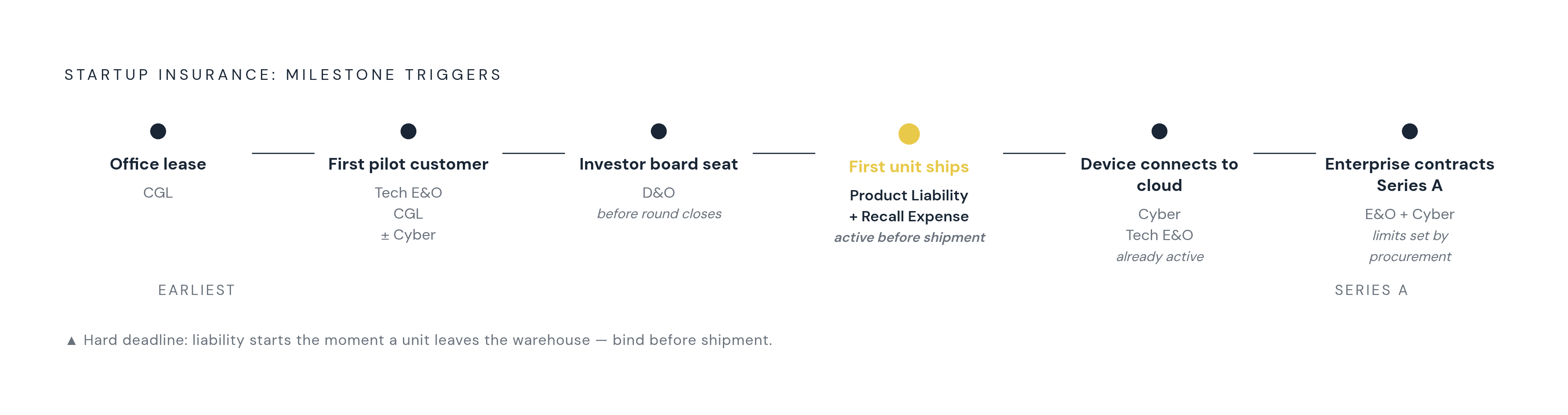
A handful of triggers at the pre-seed and seed stage make coverage non-negotiable, not optional. Signing an office lease requires CGL. Landing an early pilot customer usually comes with contractual requirements for Tech E&O, CGL, and sometimes cyber. And an institutional investor taking a board seat means D&O has to be in place before the round closes, full stop.
Product shipment is the hard deadline that matters most. The moment a unit leaves the warehouse headed for a customer, product liability exposure starts, which means recall and product liability coverage need to be bound before that shipment goes out, not scrambled together afterward.
By Series A, the trigger list grows. Corgi and Unbridled both note that enterprise contracts bring procurement teams that specify exact Tech E&O and cyber limits, and a slow certificate-of-insurance turnaround can stall a deal that's otherwise ready to sign. Hiring across state lines makes EPLI relevant as headcount climbs. And every new distribution partner added to the supply chain widens the pool of parties a future lawsuit could name.
Connected hardware adds its own trigger point: the moment a device starts collecting user data or talking to a cloud service, cyber liability and Tech E&O need to already be active, not queued up for later. Reuters reports that insurers are still updating their policy language around autonomous AI agents, which means any hardware startup integrating AI should be reviewing its policy specifically for that language right now.
The throughline across all of this is timing. Coverage needs to be in place before the event that creates the exposure, not after: before the product ships, before the board seat fills, before the enterprise contract closes. None of this gets bought in one lump sum. It gets built layer by layer, as each of these milestones actually arrives.
Sources
- Hardware Company Insurance California - Golden Benchmark
- Vouch: Why Product Liability Insurance Is Essential for Hardware Companies
- What Insurance Do AI Startups Need, and Which Companies Provide It? | Corgi Insurance
- Insurance for Hardware | Vouch
- vouch.us
- Tech Company Insurance, D&O, E&O, Cyber | Unbridled