Cyber Liability Insurance Requirements in Enterprise SaaS Contracts
Unmet insurance requirements now stall enterprise SaaS deals regardless of product quality.
Procurement doesn't care that the product is approved and the price is settled. It sends a coverage list, and nothing moves until every line on that list is satisfied. That list, more than the product demo or the pricing call, decides whether a SaaS contract signs on schedule or sits in limbo for another quarter.
An insurance clause exists to back a vendor's promises with money that's actually collectible. Alton Risk, citing Marsh's framing of the issue, calls it a risk-transfer mechanism that only works if the funds behind it are real and payable. That's why it sits next to the indemnification clause in every enterprise contract: indemnity says who pays when something breaks, and insurance is what makes that promise collectible instead of theoretical.
Proof of coverage has become a compliance checkpoint, not a courtesy. Alton Risk says enterprise vendor-risk teams now treat a certificate of insurance the way they treat a SOC 2 report: a standard gate, driven by HIPAA, GDPR, and PCI-DSS obligations that flow downstream from client to vendor. If a vendor misses it, the deal stalls no matter how good the product is. The cost of getting caught flat-footed is concrete: 67% of vendors lost contract opportunities in 2024 because their coverage didn't meet what procurement required.
For a SaaS company hitting the enterprise tier for the first time, this lands as a jolt. The $1M policy that carried years of SMB sales was never built for this. What follows is a breakdown of what enterprise buyers actually ask for, why they ask for it, and where the real negotiating room sits.
The standard coverage stack enterprise contracts require
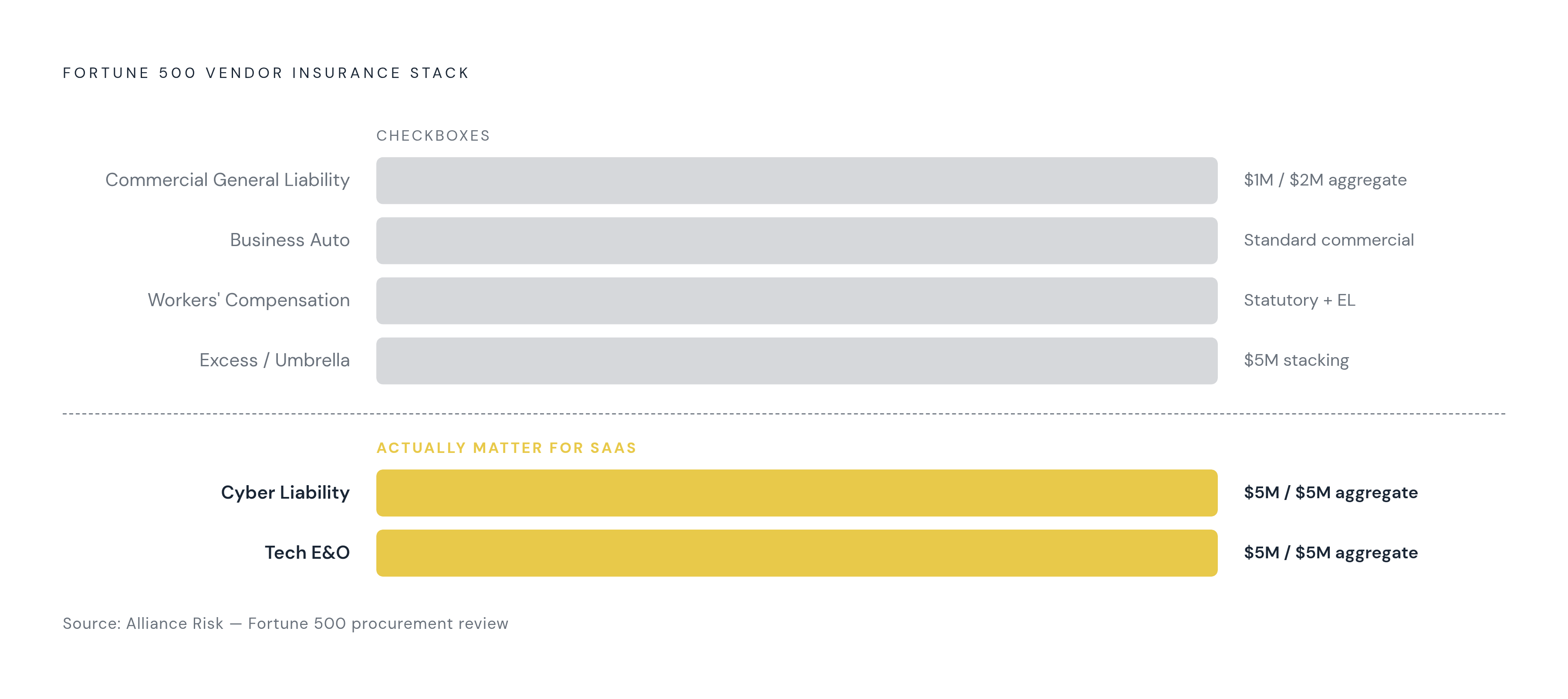
Alliance Risk reviewed actual Fortune 500 vendor agreements and found a fairly consistent list. Commercial General Liability runs on an occurrence form, $1M per occurrence and $2M aggregate. Business Auto, or Hired and Non-Owned Auto coverage, is required at standard commercial limits. Workers' Compensation follows statutory state limits, paired with Employers Liability at standard minimum limits. Excess Liability, or umbrella coverage, adds $5M, stacking on the GL and auto layers to extend total protection on any single claim.
Then come the two policies that actually matter for a software company: Cyber Liability at $5M per claim and $5M aggregate, and Tech E&O (professional liability) at the same $5M per claim and $5M aggregate. Cyber numbers often open much higher in a first draft, and that negotiation gets its own treatment below.
Additional Insured requirements vary by policy type. Cyber and Tech E&O typically handle coverage differently from GL-based lines, because those policies attach to the vendor's own professional services and data handling, not to a shared physical risk like a car accident or a slip-and-fall. Waiver of subrogation is broadly required across policy lines. And "primary and non-contributory" wording isn't something a broker can talk a client out of: it means the vendor's policy pays first, full stop, without waiting on the client's own carrier to chip in.
All of it gets proven through a Certificate of Insurance. Missing one line item on the COI, a missing endorsement, the wrong aggregate limit, stalls the deal regardless of what the underlying policy actually covers.
General Liability, by design, excludes professional services and technology errors. A CGL policy protects against a visitor tripping in the office or a piece of equipment causing property damage. It does nothing for a platform outage or a data breach. The claims most likely to hit a SaaS company, security incidents and service failures, sit entirely outside GL's scope. Procurement teams know this. Cyber, Tech E&O, and crime/fidelity coverage get scrutinized far more closely than the rest of the stack. The other lines are checkboxes. These three are where underwriters and buyers actually dig in, and where a vendor's real exposure lives.
What cyber liability and Tech E&O cover, and why both are necessary
Cyber liability splits into two buckets. First-party coverage pays for the vendor's own response costs: forensic investigation, legal counsel, breach notification (a legal requirement in all 50 states), credit monitoring for affected individuals, business interruption, and data recovery. Third-party coverage handles claims from outside the building: customer lawsuits alleging negligent data handling, and regulatory fines under HIPAA, PCI-DSS, CCPA, GDPR, and the growing patchwork of state privacy statutes.
Tech E&O covers something else entirely: financial harm a client suffers because the software didn't do what it was supposed to do. A platform outage that causes a client to miss a contractual deadline. A bug that generates bad output the client then acts on. A feature failure that corrupts or wipes client data. A botched implementation that breaks a client's internal workflow. None of that needs a hacker. No breach, no attacker, no stolen credentials, just software failing at its job while someone downstream loses money because of it.
Cyber covers security and privacy events. Tech E&O covers professional failure and platform performance. Vendors who treat the two as interchangeable are the ones who find out the hard way that a massive Tech E&O claim can land without a single byte of data ever being exposed.
SaaS architecture makes the cyber side worse than it looks on paper. Multi-tenant systems mean a single security failure can compromise every customer sharing that infrastructure at once, not one customer in isolation. SeedPod Cyber's April 2026 underwriting commentary frames this as a fundamentally different loss scenario than single-tenant software, and carriers price it that way. There's a structural wrinkle specific to SaaS on top of that: the vendor is a data processor, and breach notification duties belong primarily to the clients whose end-user data got exposed. That means the cyber policy has to explicitly cover the vendor's contractual duty to notify those clients promptly. A policy silent on data-processor obligations leaves that gap wide open.
Carrying cyber without Tech E&O, or the reverse, leaves one of the two largest exposure categories completely unaddressed. Underwriters who specialize in technology risk treat the pair as a single decision, not two line items a vendor can shop separately, and splitting them leaves a significant gap in a vendor's protection.
How limits are set and what enterprise tiers demand
Most startups buy $1M to $2M in cyber and Tech E&O limits because that's the default a seed-stage broker quotes. Enterprise contracts start the conversation at $5M per claim and $5M aggregate for both lines, and that's the floor, not the ceiling.
Alliance Risk's review of negotiated Fortune 500 agreements found first drafts routinely opening at $20M per claim and $20M aggregate, with final signed terms settling around $5M and $5M. An opening number on a procurement term sheet is a negotiating position, not a requirement carved in stone. But $5M is where negotiations tend to land, not lower, and vendors who assume they can talk their way under that number are wasting a sales cycle finding out otherwise.
Limit sizing should track exposure, not company size. Small businesses can often get by on $1M to $2M. Enterprises handling sensitive data, health records, payment information, regulated personal data, are looking at $10M to $50M or more. The right way to size a limit isn't the vendor's own annual revenue; it's the aggregate data exposure across the entire customer base the vendor serves, since that's what a court or regulator looks at once a breach touches every tenant at once.
The math behind why $1M limits fail at enterprise scale isn't complicated. IBM's 2023 figure put the average cost of a US data breach at $4.45M, and for SaaS companies, that number is better understood as a floor than a ceiling, not a ceiling. Other estimates land even higher, north of $9M once forensic investigation, legal defense, breach notification, credit monitoring, and regulatory fines all get added up. A $1M policy gets exhausted by legal fees alone before notification costs even start.
SaaS companies also pay more for the same coverage than a typical small business would. SeedPod Cyber's underwriting data and broker benchmarks from 2025 and 2026 put the premium at 40 to 88 percent above the national SMB average, driven by data sensitivity, the scope of client contract exposure, and claims frequency in the sector. Hotaling Insurance's 2025-2026 benchmarks lay out what a full SaaS insurance program costs: $15,000 to $75,000 a year in total, split between Tech E&O at $5,000 to $25,000, cyber at $3,000 to $15,000, D&O at $5,000 to $20,000, and general liability at $1,000 to $5,000. Costs scale with ARR, headcount, and how sensitive the data is.
One lever moves the price more than any other, and it isn't limit size or claims history: SOC 2 Type II certification. Underwriters give a 10 to 20 percent premium discount for it, because the audit itself demonstrates security controls that lower the odds of a claim happening. Skipping it means expecting cyber quotes 15 to 25 percent higher, assuming a carrier is even willing to write the policy. Carriers increasingly factor it into their willingness to write a policy at all.
The endorsement and proof requirements that trip up even well-insured vendors
Additional insured status goes on GL, auto, and umbrella. It doesn't go on cyber or Tech E&O, and that's standard market practice rather than an oversight on the vendor's part; those coverages tie to the named insured's own operations and can't be extended the same way. Waiver of subrogation applies across every line and, in practice, is effectively non-negotiable. The client wants assurance that if it shared some fault for whatever went wrong, the vendor's insurer won't turn around and sue the client to claw back the payout.
"Primary and non-contributory" needs to be printed on the Certificate of Insurance itself, not buried somewhere in the policy wording procurement never sees. If it isn't printed on the COI, a risk manager reviewing the document has no way to confirm it exists, and the deal stalls on a technicality that has nothing to do with actual coverage adequacy.
For higher-limit policies, underwriters sometimes ask to see the vendor's actual contracts, standard MSAs and negotiated enterprise agreements alike, underwriting commentary notes. The review typically covers: a liability cap tied to the policy's own limits, how broad the indemnification obligations the vendor has already agreed to actually run, and whether the contract clearly spells out what the product is and isn't responsible for. A contract that accepts unlimited indemnification with no liability cap on security events isn't a legal risk sitting quietly on a shelf somewhere. Underwriting reflects it, and it raises the premium.
None of this happens overnight. Upgrading limits or adding an endorsement takes meaningful lead time to move through a carrier, not a same-day turnaround. Waiting until the enterprise contract lands on someone's desk to find out what the current policy actually says is how deals lose a full sales cycle.
Underwriter requirements for SaaS vendors before binding or renewing a policy
Multi-factor authentication has moved from recommended to effectively mandatory. Coalition's 2024 Cyber Threat Index found that 82 percent of claims involved organizations without MFA in place, and underwriters have priced accordingly ever since. Endpoint detection and response, ongoing employee security training, and a written incident response plan round out the baseline most carriers won't bind a policy without.
The underwriting application itself works as an informal security audit. Questions about MFA rollout, endpoint monitoring, backup practices, and access controls aren't box-checking; they decide both whether a carrier writes the policy at all and what it charges for it.
SOC 2 Type II remains the single most efficient lever for cutting friction and cost at the same time. The 10 to 20 percent discount already mentioned is well documented, and some specialty carriers simply won't quote a SaaS company without one on file.
Underwriters also read contracts, and they flag what they find there. A master services agreement with sweeping indemnification language and a liability cap set above the proposed policy limit gets noticed, and it gets priced. If the biggest client contract on the books carries indemnification exposure larger than the policy being requested, that mismatch becomes the underwriter's problem to solve through pricing, not something that quietly slides through.
Market conditions currently favor the prepared. Market conditions in cyber and D&O have been trending in a buyer-friendly direction heading into 2026. A vendor with strong existing controls, MFA, SOC 2, a documented incident response plan, negotiates from stronger footing than it would have two or three years back. The baseline has shifted from clearing a minimum bar to earning a real discount for work already done.
The limit itself should track one number: the maximum a vendor could owe under its largest client contract's indemnification clause. Those two figures are rarely the same, and confusing them is how a company ends up underinsured relative to what it's actually promised to pay.
The AI coverage gap that standard policies no longer close automatically
For years, AI-related claims quietly fell under existing cyber and Tech E&O policies without anyone naming them, an arrangement the industry calls "silent AI" coverage. That arrangement is ending. Insurers are moving to explicitly exclude AI risk from standard forms rather than leave it ambiguous, and each line of coverage is narrowing on its own timeline rather than as part of one coordinated shift.
The Insurance Services Office introduced generative AI exclusion endorsements, forms CG 40 47 and CG 40 48, for commercial general liability in January 2026. They exclude bodily injury, property damage, and personal or advertising injury arising from generative AI, and similar exclusion language is spreading into D&O and E&O forms too. Berkshire Hathaway, Chubb, and Travelers have filed AI exclusions across GL and related lines. W.R. Berkley went furthest, confirming an "absolute" AI exclusion spanning D&O, E&O, and fiduciary liability, broad enough to exclude any actual or alleged use, deployment, or development of AI connected to the insured in any way, not limited to generative AI tools specifically.
That leaves a real gap, and it's the one vendors keep missing. GL now excludes AI-related events outright, while Tech E&O and cyber forms haven't been uniformly rewritten to explicitly include them. A SaaS vendor shipping AI features can end up with no single policy that clearly covers a claim arising from a model's output, discovering the hole only after a claim is already in the works.
The claims data explains why insurers are moving this fast. Stanford's AI Index recorded 362 incidents in the AI Incident Database in 2025, up from 233 the year before, and Testudo Global's Generative AI Litigation Overview found US generative AI lawsuits rose 137 percent in 2025. Underwriters price off exactly that kind of frequency trend.
Check the Tech E&O policy language directly and confirm claims arising from AI outputs are actually covered. Don't assume they are just because the policy predates the exclusion wave. Exclusion pressure is pushing AI exposure toward cyber and Tech E&O policies by default, but not every form on the market has caught up to reflect that yet.
Standalone and affirmative AI liability products now available
The market's answer to the exclusion wave is affirmative coverage: policies or endorsements that state, in plain terms, that AI-related events are covered rather than leaving it to inference.
Armilla wrote what's described as the first standalone AI liability policy at Lloyd's of London in April 2025, with limits reaching $25M per organization. In February 2026, Armilla and Chaucer structured a product called Vanguard AI at Lloyd's that bundles $25M or more in dedicated AI liability limits with $10M in cyber limits, a combined structure rather than two separate purchases. HSB launched an AI Liability Insurance product in March 2026 aimed at small and mid-size businesses. Coalition, Embroker, Relm, and Munich Re have each rolled out AI-specific endorsements or standalone policies since 2024 that state that AI-related events are covered, rather than leaving the question open to interpretation later.
Underwriters are starting to reward governance work the same way they reward SOC 2. Vendors with documented model governance and bias-testing frameworks are seeing better terms as carriers build pricing models specific to AI risk. That governance work isn't only a legal best practice anymore; it's a lever on the insurance bill, the same way MFA and SOC 2 already are for cyber.
Ask the broker directly whether the current Tech E&O form affirmatively covers AI outputs, and if it doesn't, whether an AI endorsement or standalone policy is available from the existing carrier or a specialty market. This corner of the industry moves fast enough that form language worth relying on today can be stale in six months, so confirming current wording with a broker beats assuming last year's policy still holds.
How indemnification language in MSAs creates or caps the vendor's actual exposure
Indemnification language and insurance coverage are the same conversation viewed from opposite ends. They're the same conversation viewed from opposite ends. The indemnification clause in a master services agreement decides who's financially responsible when something goes wrong. The insurance policy decides whether that responsibility can actually get paid. A vendor can sign a client contract promising to cover an enterprise client's losses without limit, but if the cyber and Tech E&O limits sitting behind that promise cap out at $5M, the gap between what's promised and what's fundable becomes the vendor's own balance sheet problem the day a real claim lands.
That's why underwriters read the client contract before finalizing pricing. A liability cap tied explicitly to the policy limit keeps the vendor's maximum exposure aligned with what the insurance can actually pay. A liability cap set higher than the policy, or no cap, means the vendor is contractually on the hook for more than any policy in force can cover, and a carrier pricing that risk either raises the premium or declines to write the policy.
Vendors who close enterprise deals without friction are the ones who treat the MSA's indemnification language and the insurance program as one decision, made together, before procurement ever sends the coverage list. That alignment is what turns the insurance clause from a last-minute scramble into a formality that clears in a day.
Sources
- SaaS Startup Insurance 2026: E&O, Cyber & VC Requirements
- Startup Insurance for Enterprise Contracts: $5-10M Coverage Guide | Alliance Risk
- Cyber Insurance for SaaS Companies: What Your Platform's Risk Profile Actually Looks Like to an Underwriter
- Insurance Requirements in Enterprise Contracts: What Customers Actually Demand
- Cyber Insurance Requirements: Contracts, Regulators, and Carrier Demands | Alliance Risk
- The End of ‘Silent AI’? Emerging AI Exclusions, Coverage Fragmentation, and Practical Implications for Policyholders | Fenwick
- Client Alert: The New AI Coverage Fight: Exclusions, Endorsements, and Denied Claims - Shumaker, Loop & Kendrick, LLP