Business Owner Policy Coverage for Startups
A bundled policy cuts insurance costs but leaves startups vulnerable to industry-specific gaps.

A Business Owner's Policy bundles property, liability, and business interruption coverage into one policy with one premium and one renewal date. For founders juggling a lease, a laptop fleet, and a payroll they can barely make, that bundling is the entire point. Skip it, and the alternative is three separate contracts, three separate renewal dates, and three separate chances to discover a gap only after something has already gone wrong. The question worth asking up front, and the one this piece keeps circling back to, is what that bundle actually buys and where it quietly stops.
What a BOP actually is and what it bundles together
Strip away the jargon and a BOP is three contracts stapled into one. Commercial property insurance covers the physical stuff, the building if the startup owns one, the office equipment, the inventory sitting in a warehouse corner, against fire, theft, and the usual list of covered disasters. General liability picks up the third-party claims: someone gets hurt on the premises, someone's property gets damaged, someone claims the startup's ad campaign defamed them. Business interruption, sometimes called business income insurance, replaces lost income and covers ongoing costs like rent and payroll if a covered loss shuts the business down for a while.
The BOP is widely treated as the default starting package for small businesses, and that's worth sitting with. A lot of founders assume insurance works like an a la carte menu, coverage bought as problems show up. A BOP works differently: buy the base package first, then find out what's still missing.
Most modern BOPs also extend property coverage to laptops and mobile equipment, which matters more than it sounds for a five-person startup with no office and everyone working from a kitchen table in a different city. The bundling carries a real cost advantage too: buying property, liability, and business interruption as three separate policies typically runs 10 to 15% more than buying them as one BOP. One renewal date also means fewer gaps slipping through because nobody noticed two policies had overlapping or contradictory terms.
Which startups qualify and which are typically turned away
Insurers screen BOP applicants on employee count (usually under 100), annual revenue (some carriers cap eligibility at $1 million, though NerdWallet notes others go as high as $5 million), the size of the physical space involved, the industry's risk profile, and how long the business could plausibly stay shut after a loss, generally capped at 12 months.
Service providers, retailers, professional offices, trade contractors, wholesalers, and IT or tech services firms tend to sail through underwriting. Manufacturers, construction companies, auto dealerships, and any business with a sprawling footprint or genuinely complicated operations usually get steered toward a commercial package policy (CPP) instead, where each coverage line gets negotiated on its own rather than bundled.
Here's the part that actually matters for a founder reading this: most tech startups under 100 employees and under $5 million in revenue clear the bar without much trouble. That's the sweet spot, and it's a wide one. But eligibility isn't a permanent status symbol. Grow the headcount, grow the revenue, or grow the operational complexity, and a startup can age out of BOP eligibility entirely. The practical move is to get the policy in place while the door is open, before the company outgrows the product, before underwriting starts asking harder questions.
What a BOP costs for a typical early-stage startup
Numbers vary by source, but they cluster in a useful range. Among Progressive's new commercial customers in 2025, the median monthly cost sat at $80, with the average pulled up to $127 by pricier outliers. Insureon reports an average of $83 a month across its small business customers, with a quarter paying under $50. For most early-stage companies, a BOP amounts to a modest two-digit monthly line item.
Most startups opting for standard limits land on a $1 million per occurrence / $2 million aggregate policy, with an average deductible around $500. For a two-person tech startup carrying a BOP alongside professional liability coverage, total monthly insurance spend usually lands somewhere between $100 and $180, a decent benchmark for a founder trying to build a first-year budget without guessing.
What moves the needle up or down? Industry risk is the biggest lever: a quiet software consultancy pays a fraction of what a restaurant pays, because foot traffic itself is a liability magnet, and more visitors just means more chances for a slip-and-fall claim. Geography matters too; dense urban markets and states with heavier litigation activity push premiums higher. Claims history follows a startup around like a shadow it can't shake for a few renewal cycles. And the 10 to 15% bundling discount isn't a one-time thing; it compounds year over year, which adds up meaningfully across a startup's first three or four years.
How each core coverage addresses a specific startup risk
Liability risk isn't hypothetical for any company that lets people through the door. Roughly 2.6 million nonfatal workplace injuries and illnesses occurred in private industry in 2024, a number made up mostly of mundane slips and falls rather than dramatic accidents. Picture a client visiting a coworking space the startup lists as its office address, slipping on a wet lobby floor, and filing a claim: general liability handles the legal costs and damages. Or picture a startup engineer accidentally knocking over a client's server rack during an on-site visit; the property damage piece of general liability covers that too.
Business interruption is the coverage founders forget exists until they need it, and it's usually the one that matters most for a company running on thin cash reserves. It covers net income, payroll, and even temporary relocation costs if a covered event, a fire in a shared office building, say, forces an unplanned closure. Without it, a fire that would otherwise be an inconvenience becomes an existential threat, because payroll doesn't pause just because the office did.
Property coverage earns its keep for startups holding physical inventory or specialized hardware, and it stretches to cover laptops and mobile devices for hybrid teams too. But for a fully distributed startup with no office, no inventory, and nothing more physical than a shared Notion doc, the property slice of a BOP is doing almost no work. That's the founder who should skip the bundle and buy standalone general liability instead. Paying for property coverage on assets that don't exist is simply waste, and a lease or a warehouse is what actually justifies the bundle in the first place.
What a BOP does not cover and why those gaps matter specifically for startups
Here's where founders get into trouble: they assume the BOP covers more than it does. Standard BOP exclusions include professional liability (errors and omissions), cyber liability, workers' compensation, directors and officers liability, commercial auto, and flood or earthquake damage. Each needs its own separate policy, full stop.
The cyber gap deserves the most attention, because it's the one most likely to actually detonate. IBM's 2025 Cost of a Data Breach Report put the average global cost of a breach at $4.4 million, a figure that would wipe out the overwhelming majority of early-stage companies outright. Some older BOPs used to fold in a limited cyber endorsement, but carriers have been pulling those back, and even where a sliver of coverage remains, the sublimits rarely come close to funding a real breach response: forensics, notification costs, legal fees, the works. For any startup handling customer data, processing payments, or shipping software, which is nearly all of them, this is the single biggest hole a BOP leaves wide open, and it's the gap that should get closed first, before EPLI, before D&O, before anything else on the wishlist.
E&O is the runner-up gap, particularly for service-based startups. General liability doesn't respond to a deliverable that ships late, breaks, or costs a client money; it was never built to. A founder needs to know exactly what got bought, the same way a driver should know car insurance doesn't cover the bicycle in the garage, so the next section on endorsements reads as a fix rather than an upsell.
Endorsements that can extend a BOP without rebuilding the program
A BOP isn't fixed in stone once it's issued. Carriers let founders attach endorsements, add-on coverages that bolt onto the base policy without requiring a new carrier relationship or a renegotiation of the whole thing.
A cyber endorsement adds a slice of cyber coverage faster than shopping for a standalone policy, though the sublimits stay tight; think of it as a bridge, useful for a while but no replacement for real breach coverage. Equipment breakdown covers mechanical or electrical failure that standard property coverage typically ignores. Inland marine protects equipment that travels, whether that's gear at a client site or hardware in transit. Hired and non-owned auto liability responds to bodily injury or property damage claims when an employee drives a personal car for work, though it doesn't cover damage to the vehicle itself and is no substitute for a real commercial auto policy. Employment practices liability, or EPLI, covers wrongful termination, harassment, and discrimination claims, sometimes bundled in limited form, sometimes sold separately. Crime coverage handles employee theft, forgery, and fraud.
The upside is obvious: a startup adds coverage as new risks show up without switching carriers or relearning a policy structure from scratch. The limit shows up just as fast, in the sublimits, which run lower than a standalone policy would offer. Once a risk becomes material, once a startup starts actually processing real volumes of customer data, say, a standalone policy is the smarter structure, and staying on the endorsement past that point is a false economy. Stretching an endorsement past what it was built for is how founders end up finding out the hard way what a sublimit actually means.
How the coverage stack should evolve as a startup grows
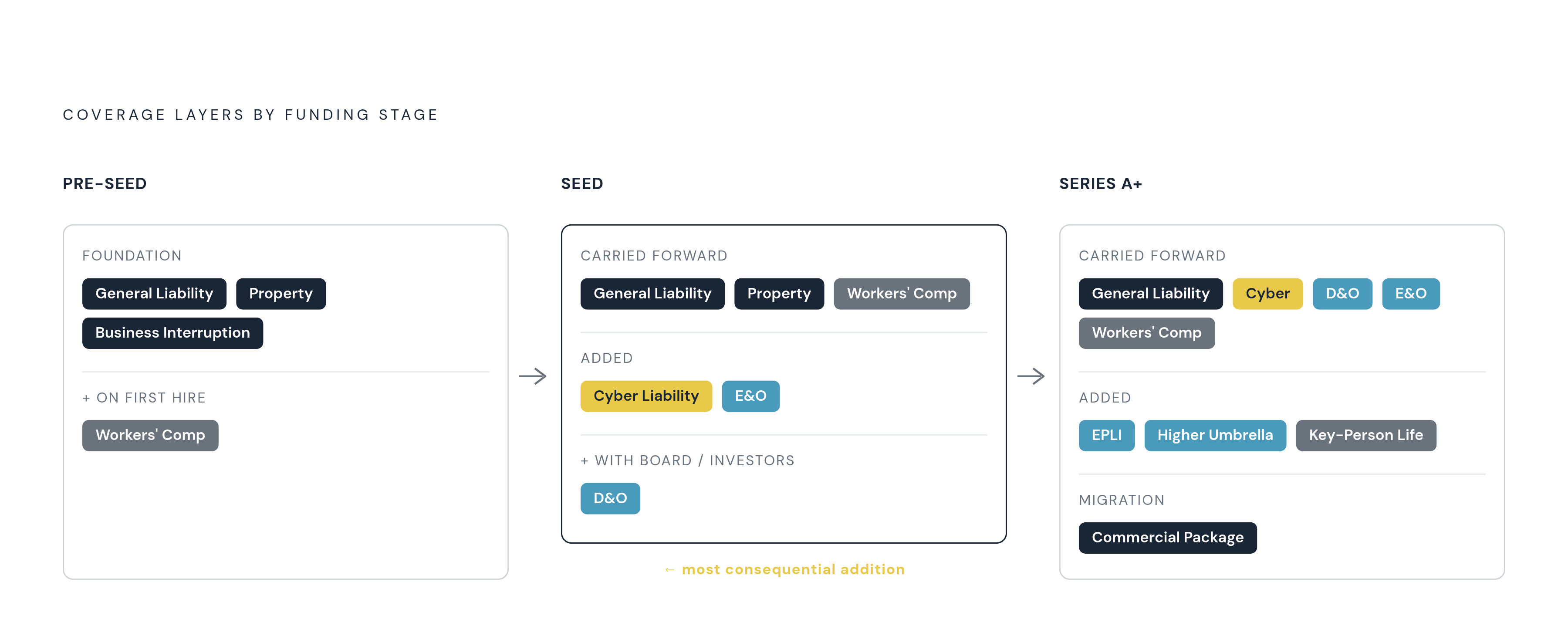
At the pre-seed stage, a BOP alone (general liability, property, business interruption) usually covers what needs covering, with workers' compensation added the moment anyone goes on payroll. By seed stage, the BOP stays as the foundation, but E&O and standalone cyber liability get added, and D&O starts to matter once a board forms or outside investors show up at the table.
Series A and beyond tends to bring a fuller buildout: a real D&O program, EPLI, higher umbrella limits sitting on top of the base policies, expanded cyber coverage, and sometimes key-person life insurance depending on how much the business depends on one or two specific people. At some point the BOP itself becomes the wrong tool, less because anything about it broke and more because the business outgrew it; once revenue or complexity crosses carrier thresholds, a commercial package policy with individually negotiated lines fits better.
Regular policy reviews sound like busywork, another item on the founder's to-do list nobody wants to touch. But they're the mechanism that catches the exact moment the coverage on paper stops matching the risk on the ground. Research consistently finds a large share of small businesses underinsured, a gap that doesn't close on its own as a company matures; if anything, it widens right alongside growth, a strange kind of penalty for succeeding. Start with a BOP, learn exactly what it covers and what it leaves exposed, layer in endorsements as specific risks show up, and treat the whole arrangement as a document to reopen every time the business changes shape, not a form to file away and forget.