Named Insured vs Additional Insured in Startup Policies
Being listed on a policy isn't the same as being covered by it.

Named insured and additional insured sound like variations on a theme. They're not. One holds every right a policy can grant, and the other holds a narrow slice of protection defined entirely by a piece of paper called an endorsement. Mixing them up is how a startup discovers, mid-lawsuit, that a policy it thought covered a landlord or an enterprise client actually didn't cover anyone but itself.
Where additional named insured fits between full ownership and limited extension
Start with the named insured, because everything else in this piece is measured against it. The named insured is whoever's name sits on the declarations page, the cover sheet of the policy that lists who bought it. For most startups that's the legal entity itself, the LLC or C-corp, not a founder personally and not an investor.
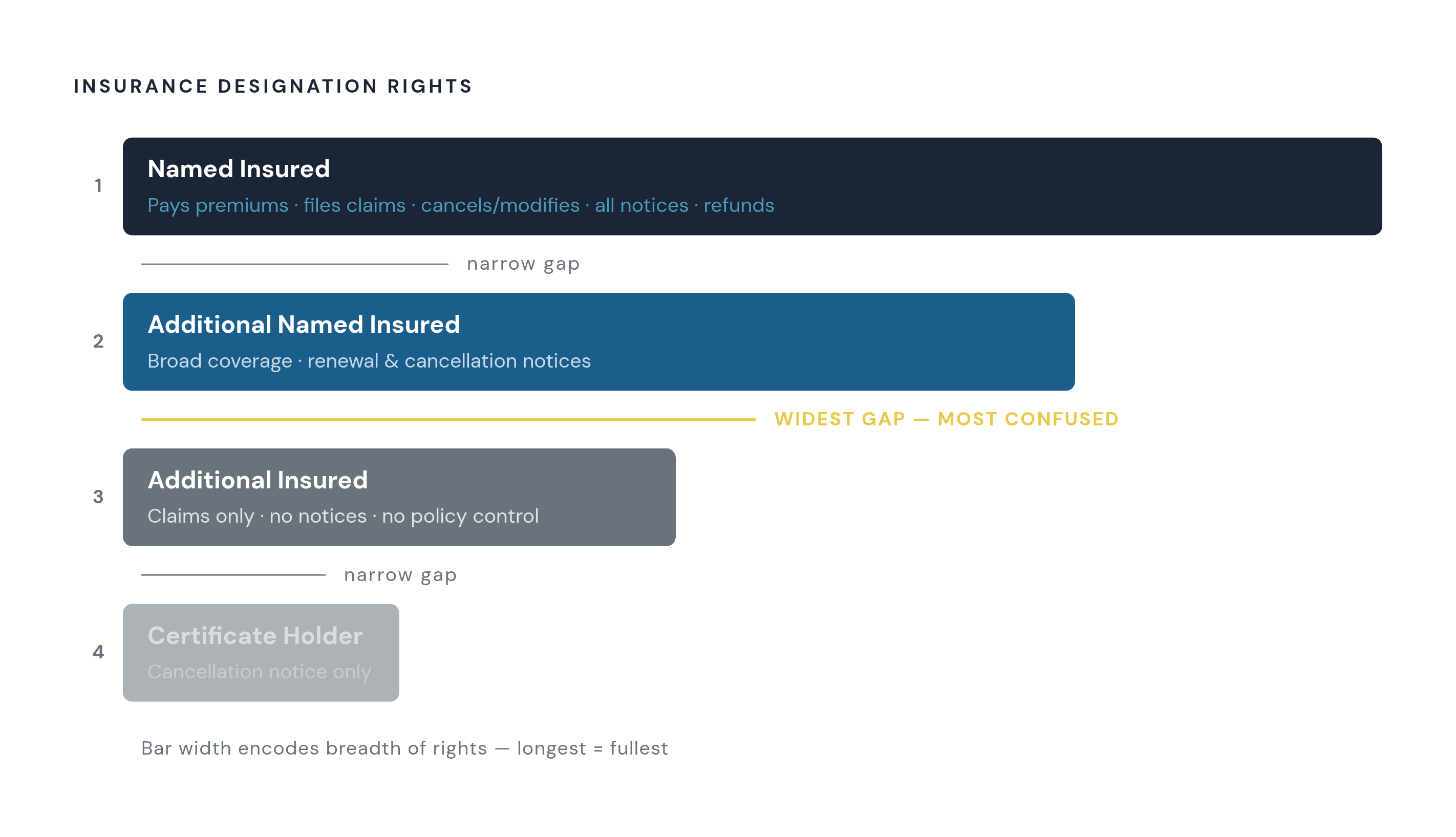
That entity gets rights nobody else on the policy touches. It pays the premium and sets the coverage limits. It files claims. It can cancel the policy or change it mid-term. It gets the renewal notices, the cancellation notices, and if the insurer owes money back, the refund. When a policy lists more than one named insured, which happens with co-founders splitting an entity or a parent company covering a subsidiary, there's a wrinkle worth flagging: only the first named insured on the list holds cancellation and notice rights. Everybody else listed gets covered, but they don't get the steering wheel.
That distinction, first versus additional named insured, matters more than it sounds like it should. An additional named insured gets added to an existing policy, usually through a rider or addendum after the policy already started, and comes away with the same breadth of coverage as the primary insured. Full stop, not a partial slice. The catch is control: an additional named insured doesn't pay premiums and can't modify or cancel anything, but does get copied on renewal and cancellation notices. That's a real operational difference from what's coming in the next section, because additional insureds (no "named") get none of that.
Adding someone as an additional named insured requires an insurable interest, meaning a real financial stake in the business. A co-owner qualifies. A holding company adding a new operating subsidiary qualifies. A landlord does not, and neither does an enterprise client just because they signed a contract requiring coverage. Insurers vary here too. Hiscox, for instance, has been cited as giving additional named insureds rights functionally equal to the primary policyholder, short of paying premiums or holding cancellation power. Other carriers restrict that further. Ask the underwriter directly rather than guessing from the sample policy language, since guessing is how gaps get discovered at the worst possible time.
What additional insured status actually provides (and what it withholds)
Additional insured is the designation everyone actually means when they say a client or landlord wants to be "added to the policy." It's added through an endorsement, not a rider to the named insured slot, and it comes with a much shorter leash: no premium payment, no policy control, and coverage that only kicks in when the claim traces back to the named insured's own work.
Picture a landlord listed as additional insured on a startup's commercial general liability (CGL) policy. A customer trips over a loose floor tile the startup never fixed, in the space the startup leases. That's covered, because the negligence sits with the named insured's operations. Now picture the same building's roof leaking because the landlord skipped maintenance for three years. Not covered, because the harm didn't come from anything the startup did or failed to do. The endorsement follows the named insured's conduct, not the additional insured's address.
Within that boundary, additional insureds can act. They can file a claim directly with the named insured's insurer the moment something covered happens; they don't have to wait around for the startup to file first. What they can't do is touch the policy's structure: no raising limits, no canceling coverage, no automatic right to notices, and absolutely no coverage for anything the additional insured does on its own outside the named insured's scope of work.
The endorsement itself sets the boundaries of duration and scope, and that's a negotiation point a surprising number of founders skip past when a contract lands on their desk. Adding an additional insured doesn't cost the named insured anything in terms of its own coverage limits either; the protection extends outward without carving anything away from the startup's share. One detail trips people up more than it should: the legal entity name on the endorsement has to match exactly. "ABC Technologies" and "ABC Technologies Inc." read as two different entities to an insurer, and a mismatch discovered at claim time can void the whole thing. Not a technicality. A dealbreaker.
Why a certificate of insurance is not the same as being an additional insured
A certificate of insurance, or COI, gets treated by a lot of procurement teams as proof of protection. It isn't. It's a summary document confirming a policy exists and listing its basic terms, nothing more. It's evidence that coverage is out there somewhere, the way a boarding pass is evidence a flight exists, not a guarantee of a seat.
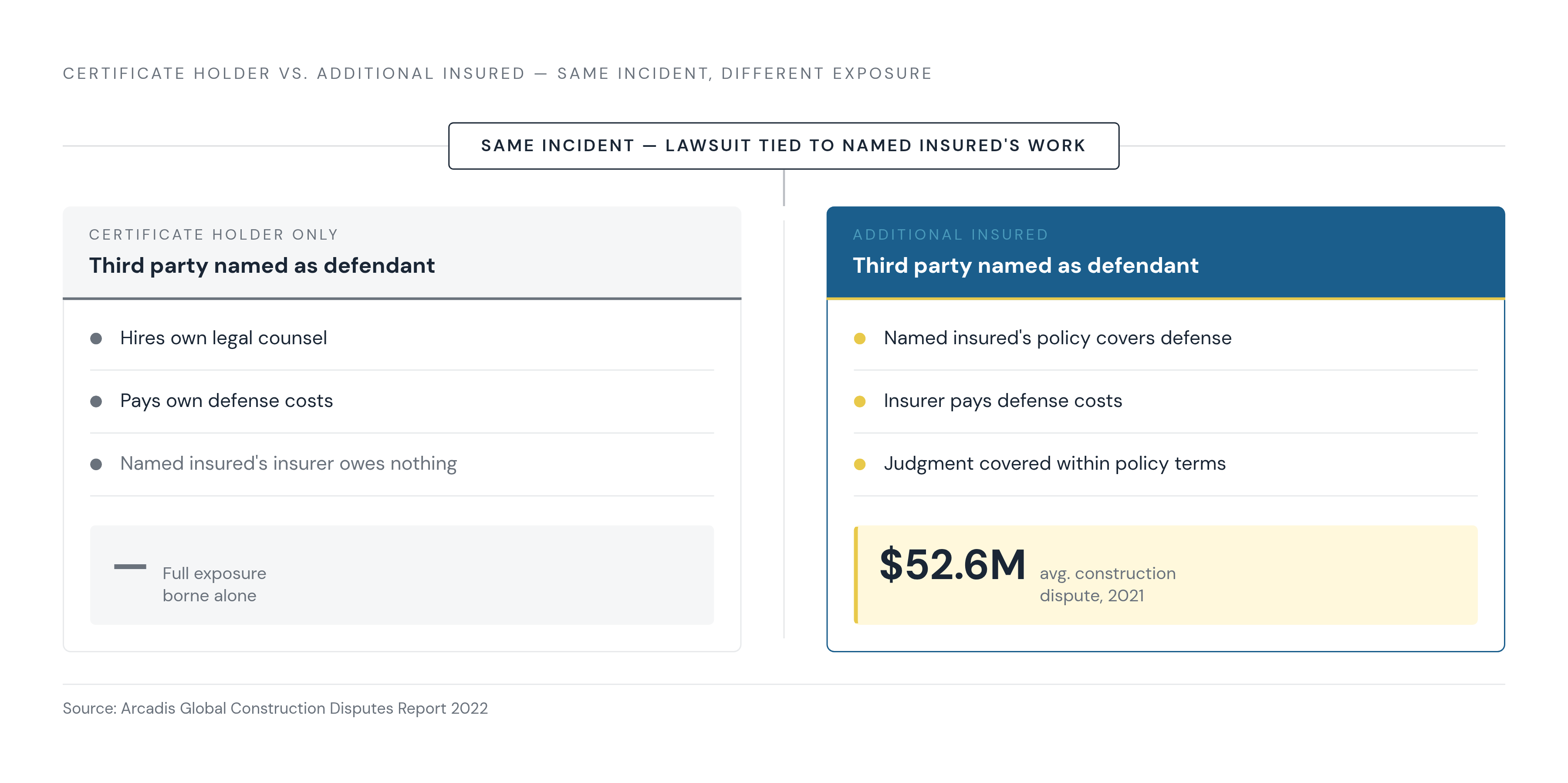
The entity named on a COI to receive notice is called the certificate holder, and that status buys exactly one thing: a heads-up if the policy gets cancelled. No claim rights attach to it at all. Run the scenario forward. A lawsuit lands, tied to the named insured's work, and the certificate holder is named as a defendant. If that party is only a certificate holder, it hires its own lawyers and pays its own defense costs out of pocket, because the named insured's insurer owes it nothing. If that same party is an additional insured instead, the named insured's policy pays for its defense and any judgment within the coverage terms. Same underlying incident, two entirely different financial outcomes.
The scale that gap can reach isn't small. The average construction dispute worldwide hit $52.6 million in 2021, according to the sources behind this piece, and that number is a useful gut check for anyone tempted to treat "additional insured" language in a contract as boilerplate. It isn't boilerplate. It's the line between a lawsuit that's someone else's insurer's problem and one that comes straight out of a company's own pocket.
Enterprise clients and landlords typically want both designations at once, certificate holder for the notification and additional insured for the actual protection, and treating those as redundant is where a lot of confusion starts. They're not the same ask wearing two names. A startup that sends over a COI listing a client as certificate holder and calls it done, while the client's procurement team assumed that satisfied the "additional insured" clause buried in the master service agreement, won't find out about the gap until a claim gets denied. Only the endorsement creates additional insured coverage. Procurement teams that know what they're doing check for the endorsement itself, not the certificate that merely describes it.
How endorsement form numbers determine the actual scope of additional insured coverage
Endorsements aren't generic. They come in standardized forms published by the Insurance Services Office, known as ISO, and most commercial general liability policies build on these forms rather than writing custom language from scratch. Knowing the form number tells a founder, in about five seconds, exactly what's covered and what isn't. That's a level of precision worth learning, because the contract clause requesting additional insured status doesn't control the outcome. The endorsement's actual wording does.
Two forms come up constantly. CG 20 10 covers bodily injury and property damage tied to the named insured's ongoing operations, meaning it protects while the startup is actively doing the work for the additional insured. Once the engagement wraps, that protection wraps with it. CG 20 37 covers claims tied to the named insured's completed work, which extends protection after the relationship ends. That distinction matters enormously for software and services companies specifically, because plenty of claims (a data pipeline bug, a faulty integration, a security gap that surfaces eighteen months post-launch) show up long after the invoice got paid.
A startup that only carries CG 20 10 leaves its enterprise client exposed for anything that surfaces after the project closes, and that gap tends to surface for the first time during a contract review, usually right when something's already gone wrong. Some enterprise contracts specify endorsement requirements in detail, which means founders signing those contracts need to check what their own carrier actually issues, not assume it lines up.
Some insurers skip the ISO forms entirely and write their own proprietary endorsements. If the form number isn't CG 20 10 or CG 20 37, the move is to request the full endorsement text and confirm the scope holds up before telling a client "yes, we've got you covered." And the entity name precision problem from the section above resurfaces here too: the additional insured's exact legal name has to appear correctly in the endorsement schedule itself, not just float correctly on the certificate.
The two companion endorsements enterprise contracts bundle with additional insured requirements
Enterprise clients, landlords, and investors rarely ask for additional insured status by itself. It typically arrives bundled with two companions: primary and non-contributory language, and a waiver of subrogation. Treat all three as one package, because that's how the contracts are written.
Primary and non-contributory, shortened to P&NC, answers a question that sounds pedantic until money's on the line: whose insurance pays first? "Primary" means the named insured's policy responds to a covered claim before anyone even looks at the additional insured's own coverage. "Non-contributory" means the named insured's insurer won't try to split the cost with the additional insured's policy unless the named insured's limits run out completely. Skip this language, and insurers sometimes argue the additional insured's own coverage should share the loss, which turns a claim into a standoff between two carriers while the actual dispute sits unresolved.
Waiver of subrogation solves a different problem. Normally, after an insurer pays out a claim, it can turn around and sue whoever else contributed to the loss to recover that money, a process called subrogation. A waiver of subrogation means the named insured's insurer agrees upfront not to do that against a specific third party, usually the additional insured or a business partner, even if that party bears some blame. It keeps the insurer from suing the additional insured after the fact, which, practically speaking, keeps two business partners from ending up in litigation against each other's insurance companies after everyone thought the incident was closed.
None of this costs much relative to what it protects against. Scheduled waivers of subrogation typically run $25 to $50 per endorsement; blanket waivers, covering multiple parties at once, generally land between $50 and $150 a year, and sometimes ride along inside the base premium at no extra charge. Cheap insurance, literally, against an expensive fight.
The practical value of these endorsements shows up when a claim actually lands. When both a waiver of subrogation and P&NC language are in place, the named insured's policy absorbs the loss in full instead of triggering a multi-party fight over who owes what to whom. Without them, carriers can spend years arguing over cost-sharing while the underlying dispute sits unresolved. These endorsements don't just determine whether coverage exists — they determine who's left holding the bag when the number gets big and the calendar gets long.
Where named insured and additional insured designations surface across the startup lifecycle
Commercial leases are usually the first place a founder runs into any of this. Nearly every commercial lease requires general liability insurance as a signing condition, and landlords, almost without exception, want additional insured status on the tenant's CGL policy, increasingly alongside P&NC and waiver of subrogation. A startup that signs the lease and fires off a bare COI, skipping the actual endorsement, is technically in breach of the lease's insurance covenant from the day it moves in. Nobody notices until something happens. Then everybody notices.
Enterprise contracts raise the stakes further. When a big client asks for additional insured status, what they actually want is for the startup's CGL policy to defend and pay out on claims tied to the startup's services. Tech E&O limits that were fine for a contract signed in 2023 frequently fall short of what the same client asks for today; large technology contracts commonly land at $5 million per claim and $5 million aggregate for Tech E&O now. Here's where a genuinely common point of confusion shows up: additional insured endorsements are standard for CGL and umbrella policies, but they work differently on professional liability (E&O) and cyber policies, where the structure of those policies limits how additional insured status can be applied. A startup should not assume it can add an enterprise client as an additional insured on its Tech E&O or cyber coverage the same way it can on general liability, regardless of how the contract's boilerplate is worded. Procurement teams that know the terrain check the endorsement, the exact entity name, and the form numbers before signing anything, not just whether a certificate exists somewhere in a shared drive.
Fundraising brings its own version of the same conversation. Insurance covenants, D&O in particular, have become increasingly common in venture term sheets, typically appearing by Series A. Venture financings fell 22% in 2023, dropping from 17,625 deals to 13,701, and fewer deals making it through diligence tends to mean each surviving term sheet gets scrutinized harder, covenants included. Securities class action filings climbed to 222 in 2024, up from 212 the year before, which gives investors a fairly concrete reason to insist on D&O rather than treating it as a rubber stamp.
Coverage benchmarks scale with stage. Seed and pre-Series A companies typically carry $1 million to $2 million in D&O coverage; Series A and B typically run $2 million to $5 million; later-stage and pre-IPO companies often carry $5 million to $10 million or more. D&O policies split into pieces worth knowing by name: Side A protects directors and officers directly when the company itself can't indemnify them, Side B reimburses the company for indemnification payments it already made, and entity coverage protects the company's own assets when a claim names the business alongside its leadership. None of this runs on the additional insured endorsement model described earlier. D&O protects the company and its officers together, under the policy's own terms, and that's a structurally different animal from a CGL endorsement extending protection to a landlord.
How named and additional insured status operates differently across the startup policy stack
Worth stepping back here, because a startup's insurance isn't one policy wearing different hats. It's a stack of distinct products, each with its own rulebook for who can be added and how.
CGL and umbrella policies are the friendliest territory: additional insured endorsements are standard, well understood, and the CG 20 10 / CG 20 37 framework from earlier applies cleanly. Tech E&O and cyber policies are the opposite. Additional insured endorsements are rare there, often unavailable outright, so an enterprise client looking for protection against the startup's professional mistakes has to lean on contractual indemnification and the startup's own policy responding when a claim lands, not on being named to the policy itself. D&O sits in its own category entirely, built around the company's officers and directors as the insured parties; additional insured mechanics don't map onto it, and investors may seek additional insured status or other protections through negotiated policy terms rather than through standard endorsements.
One more distinction worth knowing before signing anything: most of a startup's policies (E&O, cyber, D&O) are written claims-made, meaning they cover a claim filed while the policy is active, regardless of when the underlying incident happened, as long as it happened on or after the policy's retroactive date. CGL, by contrast, is typically occurrence-based. Let a claims-made policy lapse, or switch carriers without buying a tail endorsement to bridge the gap, and a startup can end up with zero coverage for something that happened during the old policy period but only surfaces as a claim later. That's not a footnote. That's how a company that thought it was covered finds out it wasn't.
Cost gives some sense of scale. A full SaaS insurance stack, covering Tech E&O, cyber, D&O, and general liability together, can vary significantly in cost depending on stage, revenue, and risk profile, with each component scaling against annual recurring revenue, headcount, and how sensitive the data being handled actually is. Strong security posture and compliance certifications can influence underwriting outcomes, since carriers weigh risk controls when setting cyber and E&O premiums, which makes that audit less a compliance checkbox and more a line item that pays for itself against the insurance bill.
Named insured, additional named insured, additional insured, certificate holder: four terms, four different sets of rights, and only one of them, the first, holds the full picture. Everything else on this list is a narrower cut of that same protection, shaped by an endorsement that either exists in the right form or doesn't. Reading the declarations page is the easy part. Reading the endorsement schedule is where the actual coverage lives.
Sources
- Named insured vs. additional insured: What’s the difference?
- Additional vs. Additional Named Insureds | biBerk
- Additional Insured vs. Named Insured Explained (2026)
- altonrisk.io
- Named vs. Additional Insured | Hiscox
- What Insurance Covenants Are and How Founders Negotiate Them
- insurancexdate.com
- contractorsliability.com