Insurance Licensing Requirements for Insurtech Startups Selling Coverage
Startups must choose between three licensing structures before selling their first policy.

- Written by
- Everett Fairweather
- Published
- October 14, 2026
- Reading time
- 10 min read
What this covers
A founding team with a working product, a pricing model, and a slick onboarding flow still cannot sell a single policy until it answers one question: what kind of regulated entity will it be, and under whose license will the coverage it sells actually be issued? A startup can have the best underwriting model in its category, but it cannot bind a single risk until its legal structure is settled and approved. Three paths exist: become a fully admitted carrier, operate as a Managing General Agent under a carrier's paper, or operate as a licensed insurance agent or broker. These are not three flavors of the same business. Each one assigns balance-sheet risk differently, it needs licensing in a different set of places, and it leaves the company facing a different compliance load from the day it opens its doors.
Becoming a Licensed Insurance Carrier
Becoming a full insurance carrier gives a startup the most control, because it owns the product, sets the price, holds the risk, and keeps the margin that would otherwise go to a carrier partner. Carrier formation starts with picking a domiciliary state, the home base where the company is legally formed and first licensed. Every additional state requires its own separate application, its own review, and its own approval, pursued one at a time.
The reason this path is so capital-intensive comes down to solvency. State insurance departments require carriers to hold capital against a risk-based capital ratio, a formula that measures how much a company must keep in reserve relative to the risk on its books, and rating agencies often ask for more on top of that. Industry benchmarks put reserve requirements for full carriers above $10 million, but the real threshold can run into the tens of millions, depending on the lines written and the states targeted. None of that capital goes toward growth. On top of the reserve sits fixed overhead that does not show up in a product roadmap: a licensed carrier needs actuaries, risk managers, and compliance officers as full-time, ongoing roles, not contractors brought in for a single filing.
Twenty-seven new reciprocal exchanges formed between 2017 and 2024, and direct premiums written through this structure have grown substantially in that period, which suggests the model is attracting real capital, not just curiosity.
The sharpest trap in the carrier path is what happens after the first state. That's a timeline problem no amount of product quality or funding can shortcut. It has to be planned for from the very first domicile decision.
How the MGA Model Redistributes the Licensing Burden
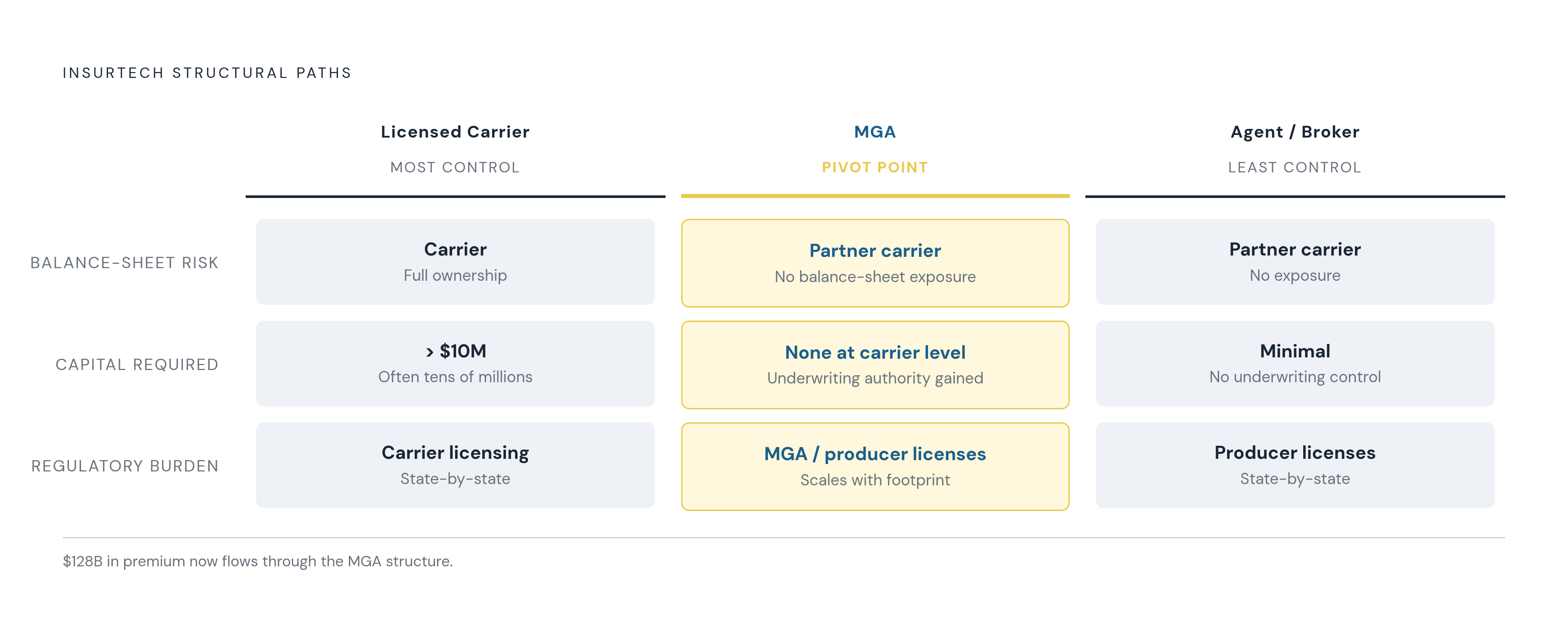
Companies want underwriting authority and product control without raising carrier-level reserve capital, and the Managing General Agent structure exists for exactly that. An MGA is a specialized insurance intermediary that a carrier authorizes to perform functions normally handled inside the insurance company itself: designing products, underwriting risk, binding coverage, setting prices, and in some arrangements, handling claims. The carrier stays on the hook for the balance sheet, the reinsurance, and the capital management that makes claims payment possible. The MGA, in turn, puts its money into technology, underwriting talent, and distribution.
This isn't a fringe workaround. Premium flowing through MGAs in the U.S. reached about $128 billion in 2025, a volume that marks this as an established, durable channel in the insurance market rather than a temporary arrangement companies use on their way to becoming carriers.
What the MGA model does not do is eliminate licensing. The MGA entity still has to hold producer or managing general agent licenses in every state where it binds or underwrites business, a requirement that tracks closely with the state-by-state agent licensing burden described in the next section. Choosing to be an MGA trades one kind of regulatory weight (capital and solvency) for another (state-by-state licensure that scales with the company's footprint).
The real risk in this model is dependency. Carriers can, and by regulation must be able to, terminate an MGA agreement on written notice. Losing that one relationship can mean losing the ability to write business at all, overnight, regardless of how strong the underwriting results have been. That vulnerability is what pushes some companies toward a different kind of control: owning distribution directly, as an agent or broker, rather than leaning entirely on delegated underwriting authority.
The agent and broker path: the fastest route to market and its real limitations
Operating as a licensed insurance agent or broker is the quickest and least capital-intensive way to start selling coverage. A producer license, the general category covering agents and brokers in most states, authorizes someone to solicit, negotiate, and sell insurance on behalf of a carrier. The company selling the policy doesn't set the price, doesn't shape the coverage terms, and doesn't carry any of the risk.
Licenses split by product line. Many insurtechs pursue both, because serving a broad customer base often means selling across both categories.
Getting licensed in a single state is only the start. Specialty lines add further layers on top of that: surplus lines licensing for hard-to-place risks, crop insurance credentials regulated by a federal agriculture agency with their own separate training requirements, and title insurance licensing, which most states handle as a distinct credential from standard P&C or L&H authority.
This path suits insurtechs whose core business is distribution: comparison platforms, embedded distribution intermediaries, digital brokerages built to match customers with coverage. It does not suit a company that needs to control underwriting, set its own pricing logic, or shape the terms of the product itself. That's the fork every founding team eventually has to name: choose the agent or broker path if the business is fundamentally about distribution, choose the MGA path if the business needs underwriting authority without carrier-level capital, and choose the carrier path if the business needs full ownership of the product and the balance sheet behind it. Whichever fork a company takes, the next problem is the same: fifty states, each with its own rules.
State-by-State Fragmentation and the Compliance Burden
Resolving the structural choice doesn't resolve where the company must be licensed. U.S. U.S. insurance regulation runs entirely at the state level. A startup that has picked its path still faces fifty separate regulatory relationships, each with its own licensing requirements, filing timelines, and renewal obligations. No federal insurance license exists for property, casualty, life, or health coverage. A coordinating body writes model laws and best practices, but every state department of insurance decides for itself whether to adopt them as written, modify them, or ignore them.
A handful of regulatory bodies matter across every path: the NAIC, which coordinates model law development rather than licensing directly; the Federal Insurance Office, which monitors systemic risk but holds no direct licensing authority; and the individual state departments of insurance, which hold the actual licensing power.
None of this moves at a uniform pace. A 2025 study of global insurers found that 67% report rising compliance costs tied directly to this kind of regulatory fragmentation. For carriers, the seasoning requirement makes that expansion even slower, since some of the largest state markets can stay closed off for years after a successful home-state launch. And this fragmented baseline is only the floor. New regulatory obligations are stacking on top of it, regardless of which structural path a company has chosen.
Emerging regulatory obligations that apply regardless of which structural path a startup chooses
Licensing answers one question: is the company allowed to operate? It no longer answers the harder question of what standards that operation has to meet. Every insurtech operating as a carrier, MGA, or licensed agent now carries data security, AI governance, and cybersecurity obligations that simply did not exist in this form five years ago, and these obligations apply on top of whatever licensing path a company has chosen.
Data security is the clearest baseline. The NAIC Insurance Data Security Model Law applies to insurers, insurance agents, and every other entity licensed by a state department of insurance, and it has been enacted across a substantial number of jurisdictions already, making it close to a default expectation for any company operating across multiple states.
AI governance is moving faster and cutting deeper. Colorado amended its AI regulation to expand oversight beyond life insurance into auto and health plans, and it set a firm compliance deadline with no grace period attached. A 2025 analysis found that Colorado's expansion touches 83% of the U.S. insurance market by premium volume. That means a pricing model that cannot explain why one customer pays more than another with an identical risk profile creates exposure across most of the country's insurance business, not just within Colorado's borders.
The NAIC's Big Data and Artificial Intelligence Working Group met repeatedly across 2025 to weigh whether the nation needs a comprehensive AI model law. Pilot programs testing an AI Systems Evaluation Tool launched in March 2026 and run through September 2026 across a number of states, and what those pilots find will decide whether a formal model law gets drafted. The AI compliance picture for insurance is still being written, so companies building AI-driven underwriting or pricing today are building toward a regulatory target that hasn't fully settled yet.
Vendor relationships carry exposure too. An insurtech using an outside AI vendor, an external data provider, or a third-party scoring model sits inside that oversight framework just as much as it would if the model were built in-house.
Embedded insurance adds one more wrinkle. When coverage gets built into a checkout flow, a travel booking, or a gig platform, the licensing analysis for that distribution has to be done state by state, because many embedded products fall outside the NAIC's Limited Lines Producer framework that governs traditional limited lines like travel and credit insurance. None of these obligations are one-time filings. They accumulate, layer on top of each other, and require standing compliance infrastructure.
The Licensing Process in Sequence, From Entity Formation to First Policy Sold
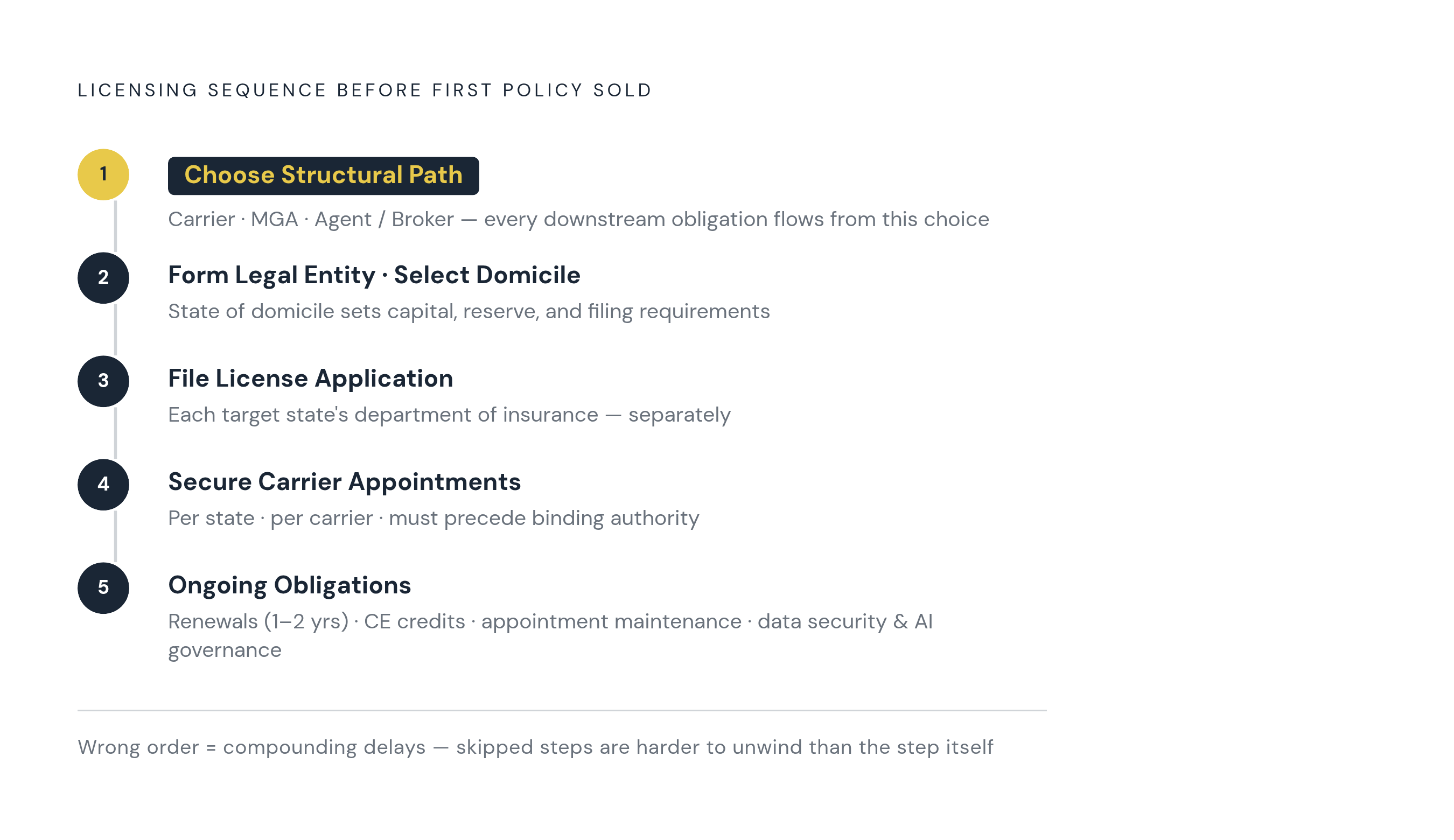
Stripped of structural debate and regulatory nuance, the actual path to a first policy sold follows a fixed order, and getting that order wrong costs real time.
That choice determines every licensing requirement, every capital obligation, and every carrier relationship that follows, so it has to come before anything else, not alongside it.
Next comes entity formation and domicile selection. The legal entity has to exist in a chosen domicile state before any insurance department will even accept an application. For a carrier, domicile sets the primary regulator for the life of the company. For an MGA or an agent, domicile shapes where the first license is filed but doesn't limit where the business can eventually operate.
Then you file the license application itself, separately with each target state's department of insurance. Fees and processing times differ by state and by entity type.
Holding a producer license doesn't authorize anyone to sell anything on its own. Agents and MGAs need carrier appointments, filed with and accepted by each state's department of insurance, for every carrier they intend to represent in every state where they operate.
The NAIC's model MGA Act, known as Model #225, sets out the framework and required contract provisions for states that have adopted it.
None of this ends at the first sale. Licenses renew on state-specific schedules, usually every one or two years, continuing education requirements apply in most states, appointments have to be actively maintained, and the data security, AI governance, and cybersecurity obligations described above have to be folded into a standing compliance program. Skipping ahead at any point in this sequence, forming an entity before picking a structural path, or filing for licenses before understanding appointment requirements, doesn't save time. It creates delays downstream that are harder to unwind than the step that was skipped.
Investor Expectations in Licensing and Structural Decisions
The insurtech funding market has grown more selective, and investors increasingly treat regulatory authorization itself, whether that's carrier status, an MGA structure, or a genuine multi-state agent license footprint, as proof that a team can execute, not as a compliance detail to confirm later.
The funding data backs this up. Follow-on rounds now account for roughly 91% of capital raised in the insurtech sector, with Series B standing out as a particularly important stage for scaling companies. AI-native underwriting and distribution companies have attracted larger rounds specifically once they could show real production usage, and production usage presupposes a company that is already licensed and operating, not one still working inside a regulatory sandbox.
Sandboxes do offer a narrower alternative route. Kentucky's program, extended through 2030, requires a detailed description of the innovation, a proposed business plan, a filing fee, proof of available funds, and extensive disclosure of financial backing and executive leadership. Programs like this reduce friction at the margins, giving a company room to test an idea under lighter regulatory supervision, but they don't substitute for the licensing sequence a company needs once it's ready to scale.
What this means in practice is that structural choice and licensing progress belong in the pitch itself, not in the appendix. Investors in the current environment want to see that a founding team understands which path it has chosen, why it chose that path over the other two, and what compliance milestones sit ahead of it. They're visible to the market, weighed by the people deciding where capital goes, and they shape what kind of company an insurtech is able to become. The startups that make it to market are the ones that made this foundational decision on purpose, early, and built a compliance function around it from day one rather than retrofitting one once the regulators came calling.